The first amps I ever played loud weren’t mine. They were the battered combos in the rehearsal rooms at uni, and I had no idea what any of the knobs did. I just turned everything up until it sounded big.
Later I had an old Marshall. No idea what model, long gone now. I wanted it as loud and rock and roll as I could get it, so I’d crank it and then shove an overdrive into the front to push it harder. It sounded like a bag of wasps. The clarity, the note definition, all of it gone. I blamed the pedal. Then the guitar. Then my hands.
What I didn’t understand was headroom.
So, what is headroom in an amp, and why does it quietly decide how every pedal you own is going to sound? Let’s get into it.
Key Takeaways
- Headroom is how much clean volume an amp can produce before it starts to distort.
- Wattage buys headroom, not volume. Doubling the watts only adds about 3dB.
- High-headroom amps stay clean when loud. They’re the classic pedal platform.
- Low-headroom amps break up early, which is the sound in a lot of blues and rock.
- For pedals, get a high-headroom amp and use the effects loop for delay and reverb.
What is Amp Headroom?
Headroom is the amount of clean volume an amplifier can produce before it starts to distort. That’s the whole thing. It’s the gap between “clean” and “the amp is now doing its own thing,” measured in how far you can turn up before you cross the line.
Lots of headroom (a high-headroom amp) means it stays clean even when it’s loud. Little headroom (a low-headroom amp) means it breaks up early, with that warm, overdriven crunch arriving while the volume is still polite.
Here’s the part nobody told me, and it reframes the whole topic: wattage buys headroom, not volume. Doubling an amp’s power only gets you about 3dB louder, and it takes roughly 10dB to sound twice as loud. So a 100-watt amp isn’t twice as loud as a 50. On paper it’s barely louder. What those extra watts actually buy you is clean room, more volume before the breakup kicks in.
That’s why a 12-watt Princeton dirties up before halfway, while an 85-watt Twin stays glassy and clean almost all the way round. Same volume knob, completely different point of no return.
One isn’t better than the other. But knowing which one you’ve got, or which one you want, changes everything about how you set up.
High Headroom vs Low Headroom Amplifiers
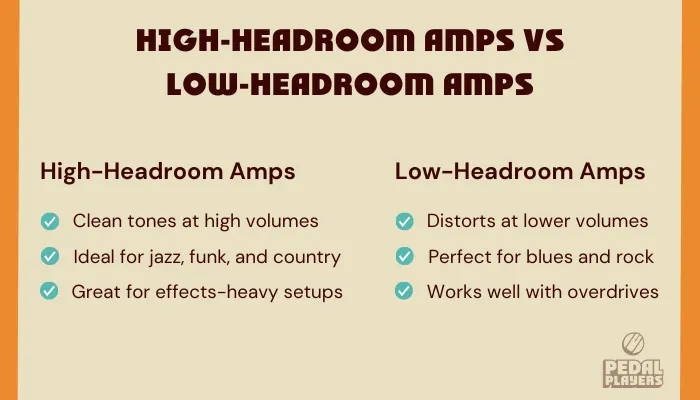
The choice between high and low headroom is about more than tone. It tells you how the amp will behave in the real world, at band rehearsals and on stage, before you ever buy it. Here’s how the two compare.
High-headroom amps stay clean even when you crank them. The Fender Twin Reverb is the benchmark. 85 watts, and you have to be borderline antisocial before it breaks up. Pristine, uncoloured cleans and miles of room for pedals. It’s the natural home for jazz, funk and country, anything where the note needs to ring out clean. The catch: it weighs about as much as a small fridge, and it’s loud enough to clear a room.
Low-headroom amps break up early. A Vox AC15 or an old tweed Deluxe, 15 watts, starts to sweat and grind while the dial is still low. That chewy, chimey, tube-driven crunch. You ride it with your pick attack and the volume knob, and the amp itself is doing half the distortion. This is the sound in a lot of blues and classic rock.
Quick myth, because everyone reaches for it. People will tell you AC/DC for that early-breakup sound. They’re wrong. Angus and Malcolm Young ran big 100-watt Marshalls cranked loud, and Malcolm’s was actually picked for more clean headroom. That’s a high-headroom amp pushed to the edge by sheer volume, not a small amp breaking up early. If you want the genuine low-headroom sound on a record, listen to Neil Young’s 1959 tweed Deluxe instead. A 15-watt amp that doesn’t get louder past about 11 o’clock, it just saturates more.
Factors Affecting Headroom in an Amp
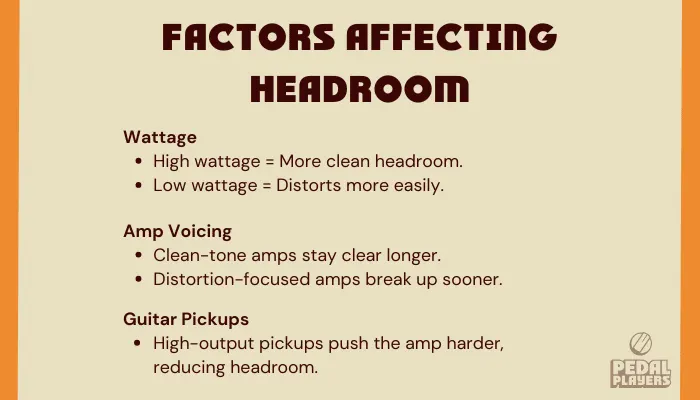
When you’re looking at a new amp, a few things decide how much headroom it has.
- Wattage. The big one. More watts means more clean room before breakup, as we covered above. Less watts means it dirties up sooner.
- Amp voicing. Some amps are built for clean, others for dirt. An amp with cascading gain stages will break up far earlier than one designed for clarity, regardless of the watts on the badge.
- Your guitar. Your pickups matter as much as the amp. High-output humbuckers shove the front end harder and eat into your headroom. Lower-output single coils leave more of it on the table.
Testing Your Amp’s Headroom
To find your amp’s headroom, plug in your own guitar and turn the volume up slowly, listening for the point where clean tips into grit. Every guitar-and-amp pairing crosses over at a slightly different spot. Your pickups move it as much as the amp does.
My Fender Deluxe Reverb starts to break up around 5 to 6 on the volume. Below that it’s clean. Above it you’re into Fender crunch. I’ve never struggled with it for clean work, there’s plenty of room for most rooms, but it is not a Twin.
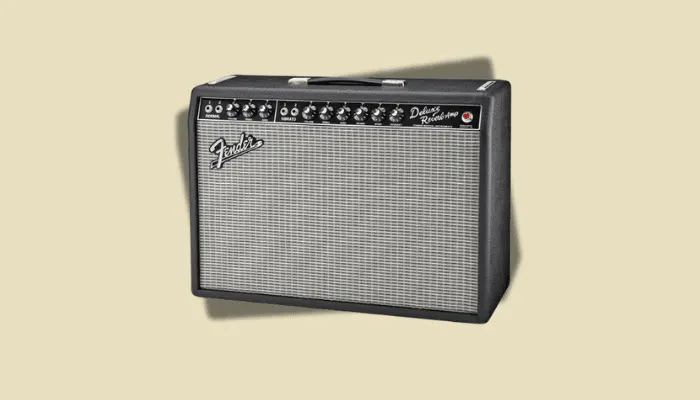
The Fender Deluxe Reverb. Loads of clean room for most rooms, but it breaks up around 5 to 6. The Twin Reverb is the real high-headroom king.
My Marshall SV20 is a different game, because the Studio Vintage has no master volume, just two Loudness controls. I jump the two inputs with a short patch lead, set Loudness 2 (normal) around 11 o’clock, and keep Loudness 1 (high treble) a notch or two behind it. That balance gives me a gorgeous, loud Marshall clean without tipping into breakup. It took me a while to find. There’s no single right number here, you dial it by ear.
For a rough map across the wattage range: a 12-watt Princeton Reverb breaks up around 3.5 to 4.5 on the dial. A 15-watt Vox AC15 starts to grind around 11 o’clock, a touch later with single coils. An old 15-watt tweed Deluxe just keeps saturating past 11 rather than getting any louder. And the 85-watt Twin? You’re pushing past 8 before it gives up the clean. The breakup points track the watts almost exactly, told in dial positions instead of numbers on a badge.
If your amp dirties up early and low on the dial, you’ve got a low-headroom amp. If you can push past halfway and it’s still ringing clean, you’ve got headroom to spare.
One more thing the spec sheet won’t tell you: the room matters. Shove an amp hard against a wall and the low end blooms and turns to mush. Pull it a foot or so out and half of your “this amp sounds boomy” problems just vanish.
The Effects Loop: The Bit That Took Me Years to Work Out
This is the part I wish someone had told me fifteen years ago.
When you drive an amp into its own breakup and then run delay or reverb into the front of it, the repeats turn to mud. That cranked old Marshall I mentioned at the start? That’s exactly what was happening. It ate every pedal I put in front of it, and for years I just assumed that’s how it was, because I’d never tried it any other way.
Here’s the reason. When the amp is distorting, it distorts everything hitting the front of it, including your echoes and reverb tails. Each repeat gets shoved back through the dirty preamp and grows its own grit, then the next repeat piles on top, and the whole thing collapses into a fuzzy wash. There’s no space left between the note and its echo.
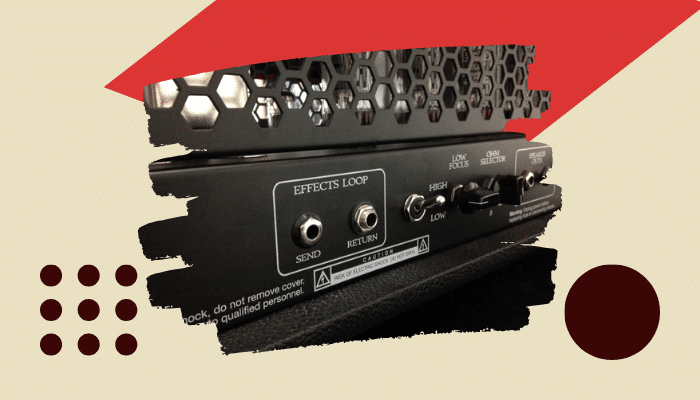
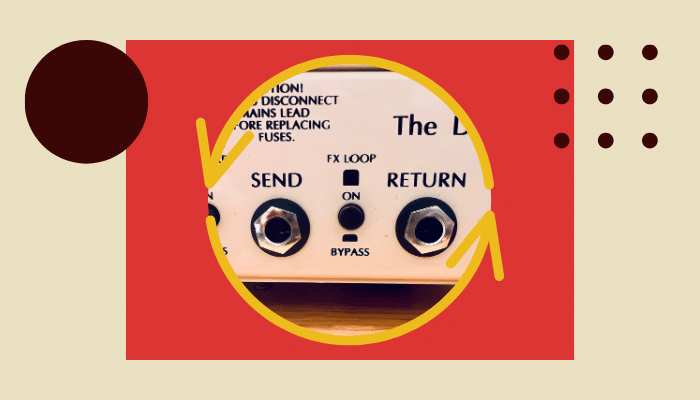
The fix is the effects loop. The loop sits after the preamp, where the amp makes its distortion, and before the power amp. Put your delay and reverb in there and they land on top of the dirty tone instead of getting fed into it. The repeats ring out clean.
I found this out by accident one day on my old Marshall, just messing about, plugging things into sockets I’d ignored for years. Same story on the EVH 5150. The second I moved the time-based stuff into the loop, the clarity came back like someone had cleaned a window. That, by the way, is the whole reason to mess about with your gear. You stumble onto things.
So here’s the running order to keep in your head:
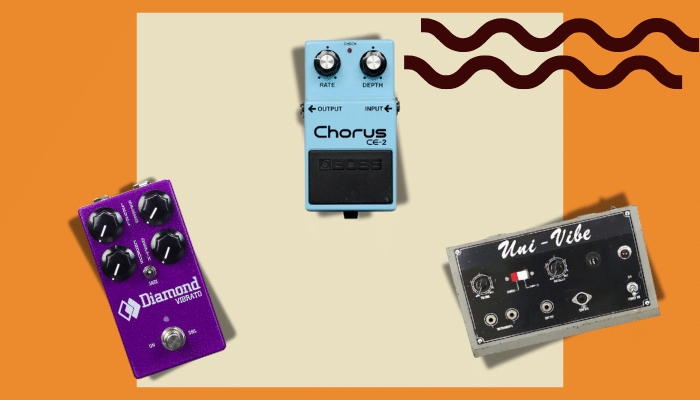
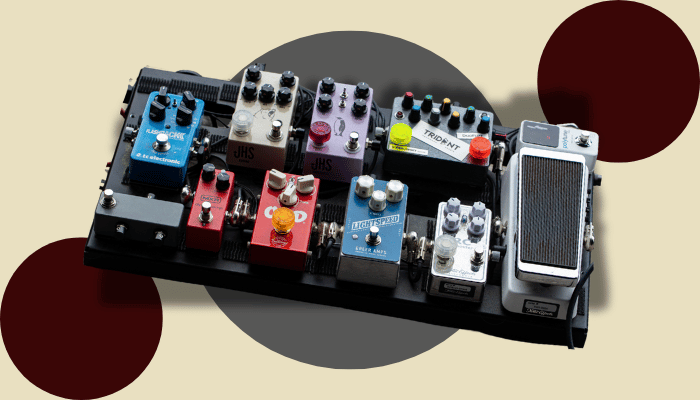
- Clean, high-headroom amp: put everything out front. Overdrive, distortion and fuzz first, then modulation, then delay and reverb last, then into the amp. Nothing after the time-based effects re-distorts them, so they stay clean.
- Amp doing its own breakup: drive your dirt pedals into the front, but run modulation, delay and reverb in the loop.
One honest caveat, because there are no laws here. Running delay into a dirty amp on purpose is a real, deliberate sound. Eddie Van Halen built a career on an Echoplex slammed into the front of a cranked amp. Mud is only a problem if you didn’t want it. But on a low-headroom amp that breaks up early, the loop is usually your friend.
Best Amp Headroom for Pedals
This is where headroom stops being theory and starts costing you money.

If you build your sound around pedals, headroom is the single most important spec on the amp. A high-headroom amp gives your pedals a clean, uncoloured canvas. Overdrives stay defined, delays and modulation stay clear, and you’ve got room to kick in a volume boost for solos without the amp folding. This is the “pedal platform” everyone bangs on about, and it’s real.
A low-headroom amp does something different, and sometimes better. It adds its own warmth and compression, blending the pedal into the amp’s natural grit for a lovely organic, amp-in-the-room sound. The trade-off is the mud problem above, so you’ll want that effects loop for your time-based pedals.
Now the picks, because a guide that won’t tell you what to buy is just a manual.
The one I reach for: my Marshall SV20H. Glorious cleans, takes pedals beautifully, and these days I run it clean far more than dirty. Funny how that happens the older you get.
Over a grand, no regrets: the Victory Duchess. Around £1,300 and one of the best pedal-platform amps I’ve played. If the budget stretches, it’s special.
The honest budget answer: the Harley Benton Tube 15 Celestion. It’s stupidly cheap, it sounds genuinely great with pedals, and the one-watt switch means you get real tube tone at whisper volume. I’ve spent proper time with one, and the short version is I couldn’t put it down. It gives my Blues Junior a proper run, which it has no business doing at the price.
Then the don’t-bother, because this matters more than any pick.
Do not buy a big clean amp for your bedroom. I love my SV20, but I’d never recommend it as a home amp, and the same goes for a Fender Twin, the standard Fender combos and the Marshall Studio heads. They’re built to stay clean while loud, which means the good stuff only arrives at volumes that’ll get you evicted. At home you’ll live on 2 and never once hear what you paid for.
For practising at home I’ve turned to the dark side: a Quad Cortex, though any decent modeller does the job. Headphones on, a sound I can actually work with, nobody banging on the wall. Then I let the real amps roar when I get to the rehearsal room. No shame in it.
Why Headroom Matters for You
So where does this leave you?
If you play mostly clean, or you build your tone with pedals, point yourself at a high-headroom amp. Clean room is the one thing you’ll never regret buying. Jazz, funk, country, pedal-heavy rigs, all of it lives here.
If you want the amp itself to be your overdrive, the warm early breakup of a low-headroom amp is the sound. That’s your blues and your classic rock, that AC/DC-adjacent grit (just remember they got there with a loud big amp, not a small one). Just be ready to use the effects loop the moment you add delay.
And if you’re playing at home with people in the house, be honest about it. The dream amp and the practical amp are rarely the same amp, and there’s no trophy for suffering through a 50-watt tube head at conversation volume.
Plug in, turn it up to where it breaks up, and find your line. Once you know where your amp crosses from clean to crunch, you stop fighting it and start using it. That’s the whole game.