

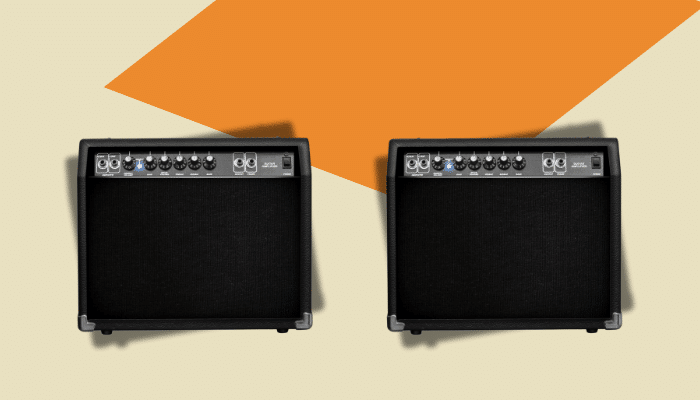
I ran into this exact problem last year.
My wet/dry setup sounded massive at home, but at band rehearsals I kept fighting levels and walking away frustrated. The balance that felt perfect in my practice space turned muddy with a drummer, and moving three feet to the left changed everything I was hearing.
Going mono before my next gig was the boring choice… and it immediately improved my live sound.
If you gig in clubs with quick changeovers and limited soundcheck time, mono should be your default.
Wet/dry is a luxury setup that needs stable conditions to shine. This article will help you figure out which approach actually fits your gigging reality.
What Wet/Dry Actually Gives You (And What It Costs)
A wet/dry rig typically splits your signal two ways:
Dry amp: Your core guitar tone. Gain, EQ, punch, and immediate response
Wet amp: Ambience and space. Delay, reverb, modulation, sometimes with a bit of dry mixed in
When properly dialled, wet/dry can feel:
- Wider and more immersive
- More “3D” with clear separation
- Punchy in the mids while spacious on top
That spatial quality is what makes people fall in love with the approach. It can be genuinely stunning.
It can also fall apart the moment you leave your bedroom.
Here’s what wet/dry actually requires to work consistently:
- Two amps that need matching (or complementary) volume
- Separate signal paths that need balancing
- Room acoustics that affect each amp differently
- More cables, more power draws, more things to go wrong
None of this is insurmountable, but it’s also not plug-and-play. Every wet/dry setup faces these variables, and theychange venue to venue.

Why Wet/Dry Often Falls Apart Live
The challenges with running wet/dry live aren’t about gear quality. They’re about physics and practical realities.
Where You Stand Changes Everything
Two separate sound sources don’t blend evenly across a room. Move a couple of meters on stage, and the balance can completely flip.
What sounded perfect at soundcheck might feel too wet (or bone-dry) by the second song. This is just how sound propagates from two point sources in a room. It’s not something you can EQ away.
Higher Volume Reveals Balance Issues Faster
At gig volume, reverb and delay can mask your pick attack faster than you’d expect. A tasteful mix at bedroom levels can turn into ambient wash when competing with cymbals and bass.
The problem: you often can’t hear this clearly until you’re already on stage with the band.
Your “Wet” Side Often Isn’t Truly Wet
Many popular approaches (including the well-known TPS method) keep some dry signal in the wet path. This can sound beautiful, but it also means you’re effectively balancing two partially dry signals in the air.
That’s one major reason mono often wins for consistency: you’re not just adding ambience, you’re splitting your fundamental tone across two amplifiers that the room treats differently.
FOH Can Accidentally Break Your Concept
With a venue engineer and limited time, one of these scenarios happens constantly:
- Only one amp gets mic’d (your wet/dry becomes all-dry or all-wet out front)
- Both amps get mic’d, but not blended how you intended
- Monitors are essentially mono, so you don’t hear your intended mix anyway
None of that is anyone’s fault. It’s just reality when you’re one of four bands with 15 minutes to soundcheck.
Also worth mentioning:
Any two-amp setup has more chances for ground loop hum and phase issues, which compounds the “why does this feel fiddly today?” factor.
Reality Check: Two Things Players Don’t Plan For

These come up constantly in real gig conversations, and they’re worth stating plainly.
The Soundperson May Only Mic One Amp
If only one cabinet gets mic’d, your carefully balanced setup can accidentally become all dry or all wet in the house mix depending on which amp they chose.
The simplest fix: make it easy on everyone.
“Please mic this amp only, the other is just for my on-stage monitoring.”
Even if you want both mic’d, it helps to decide which amp is your “safe default” if the venue only has time for one mic.
If Your Wet Side Contains Dry Signal, You’ve Doubled the Variables
TPS-style wet/dry (where the wet path includes some dry) can sound gorgeous, but it means your core tone is coming from two physical locations. In a real room with reflections and phase interaction, that can turn into endless micro-adjustments.
This is often the hidden complication people are actually experiencing when they struggle with wet/dry live.
Quick Diagnosis: Is Your Rig Fighting You?
If you’re unsure whether wet/dry is helping or hurting, these are reliable tells:
It sounds different every time you move on stage → You’re hearing room acoustics change the balance in real time.
It sounds hollow or phasey (that “parked wah” feeling) → Likely comb filtering between the dry component in your wet path and your dry amp.
You keep turning the wet side up and down all rehearsal → Classic sign you’re trying to solve a room/position problem with level adjustments.
If two or more of these are true, mono is probably the better choice for your next few gigs.
The Decision Guide: Wet/Dry or Mono?
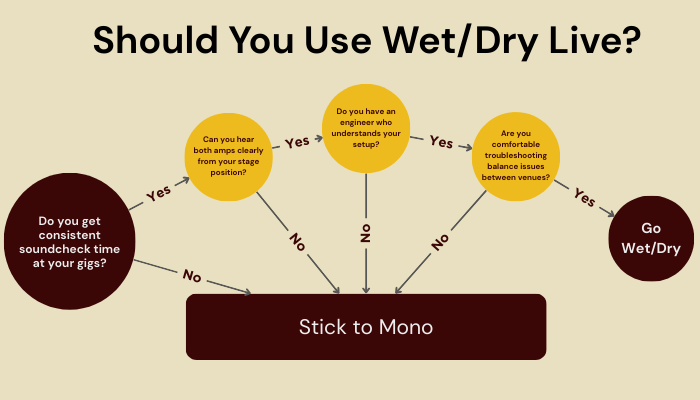
Choose Mono If Most of These Are True
- You play venues with quick changeovers and limited soundcheck
- You don’t have your own dedicated engineer
- You often can’t hear both amps evenly on stage
- You find yourself constantly tweaking levels between songs
- You want a rig that sounds good fast and stays consistent night to night
Why it works: A great mono rig gives you most of the “big” feeling with far less risk. Your core tone stays punchy, your effects sit naturally in one signal path, and what you hear on stage is much closer to what the audience hears.
Choose Wet/Dry If Most of These Are True
- You can place and monitor both amps consistently venue to venue
- You play stages where you can actually hear the stereo blend clearly
- You have adequate time to soundcheck and dial the balance
- Spacious delay and reverb are fundamental to your musical identity
- You genuinely enjoy the extra setup work and aren’t constantly second-guessing
Why it works: When conditions are stable and you can maintain the balance, wet/dry can deliver a genuinely immersive tone that mono struggles to replicate.
Middle Ground: Dual-Mono (Often the Best Live Compromise)
If you like the feel and stage presence of two amps but hate balancing wet/dry, run the same full signal to both amps.
Benefits of dual-mono:
- Still feels big and present on stage
- FOH can mic just one amp without breaking your sound
- Eliminates the fragile balance game
- Your effects still hit both amps naturally
This is honestly what I recommend to most players who want “more” than mono but don’t want wet/dry’s complications.
A Practical Compromise: Simplify Before Abandoning Wet/Dry
If you love the idea of wet/dry but hate the hassle, try these adjustments before giving up entirely:
Set your dry amp to sound great on its own. This matters more than most players realize. If your dry amp isn’t working solo, splitting the signal won’t fix it.
Turn the wet side down further than you think you need. Most players run their wet amp too loud. Start with it barely audible and bring it up slowly.
Stop tweaking per song. Create one “safe” wet level that works for most of your set. Constant adjustments = you’re chasing a moving target.
Have a mono fallback ready. A simple A/B switch that lets you go full-signal-to-dry-amp instantly is cheap insurance.
If wet/dry still feels like a fight after implementing these, mono is probably the right call for your next few gigs. You can always revisit wet/dry later when you have more control over your stage setup.
My Takeaway After Switching Back to Mono
When I went mono for a full gig week, the improvement wasn’t theoretical. It was immediate:
- Soundcheck got noticeably faster
- Levels stopped feeling like a moving target
- My gain tones felt more direct and responsive
- I stopped second-guessing my rig mid-set
Wet/dry can absolutely be brilliant. But for typical club gigs, simplicity wins more often than guitarists want to admit.
The reality is that most audiences won’t notice the difference between a great mono rig and a wet/dry setup. But you’ll feel the difference in stress levels.
Quick Self-Check Question
After your last rehearsal or gig, did you feel:
“My tone was solid and consistent,” or “I was fighting levels all night”?
If it’s the second one, go mono for your next gig. You can always rebuild the bigger setup later when you have more consistent venues. But a reliable live sound is worth more than a perfect home demo rig.
FAQ: Wet/Dry vs Mono Guitar Rigs
Should I use wet/dry or mono for live gigs?
Most gigging guitarists should default to mono for typical club venues. Wet/dry requires consistent monitoring, adequate soundcheck time, and stable room acoustics. Conditions that rarely exist at most gigs. Mono delivers reliable, punchy tone that translates consistently.
What’s the difference between wet/dry and mono guitar rigs?
Mono runs your full signal (dry tone + effects) through one amplifier. Wet/dry splits your signal: dry amp handles coretone while a separate wet amp handles ambience effects. Wet/dry can sound wider but requires careful balancing to work well live.
Why does my wet/dry rig sound different every gig?
Room acoustics, your position on stage, and audience placement all affect how two separate amps blend. Moving even a few feet can drastically change the balance you hear. This is physics, not a gear problem, and why mono is more consistent across venues.
What is a dual-mono guitar rig?
Dual-mono sends the same full signal (dry + effects) to two amplifiers simultaneously. You get the stage presence of two amps without wet/dry’s balancing challenges. It’s often the best compromise for players who want “more” than mono but find wet/dry too temperamental.
How loud should the wet amp be in a wet/dry rig?
Start with your wet amp barely audible, then gradually bring it up until you hear the spatial effect without losing punch from your dry amp. Most players run it too loud. Good rule: if someone mutes your wet amp and your tone feels incomplete, it’s probably too loud.
