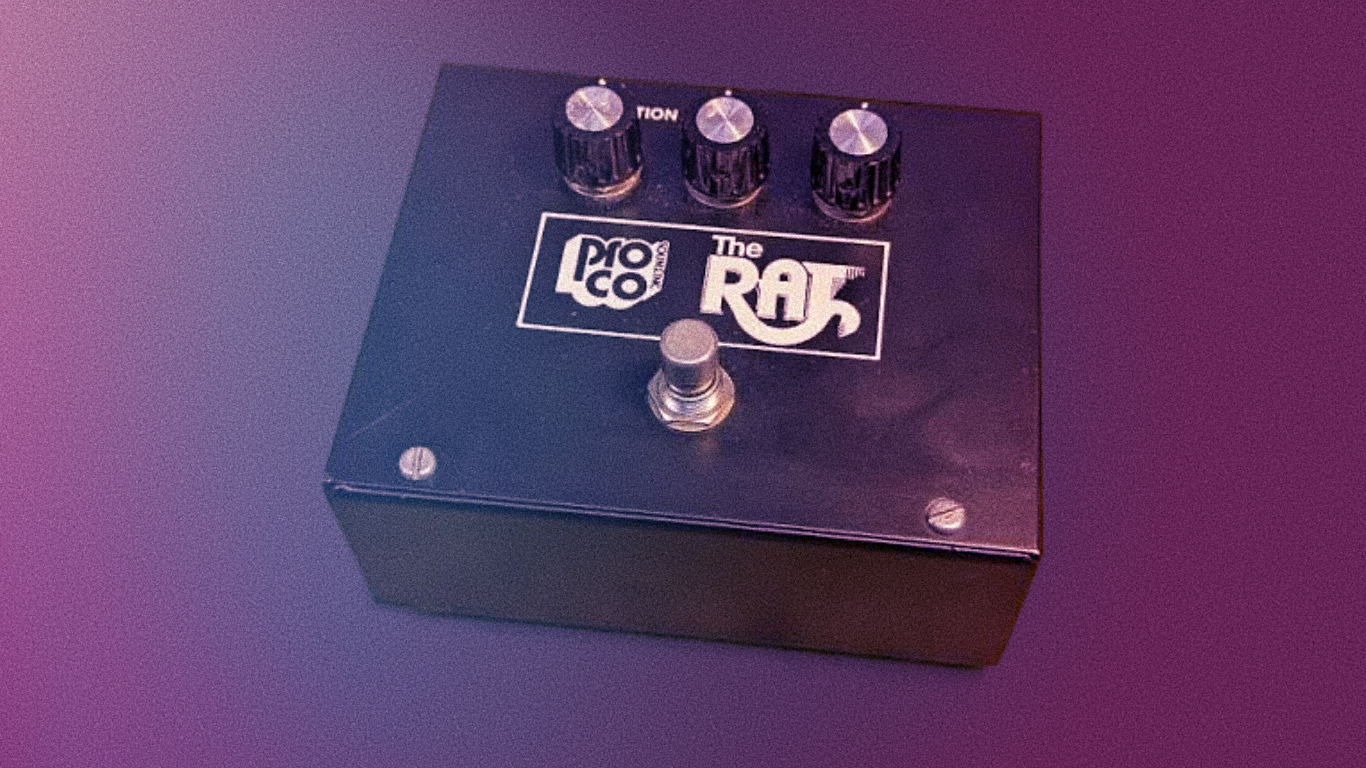
Picture a damp basement in Kalamazoo, Michigan, sometime around 1978. Rats in the walls, allegedly. A ProCo engineer named Scott Burnham, whose actual job title was Hippie in Charge of Technology, is hot-rodding a distortion circuit and fits the wrong-value resistor into the op-amp gain stage. The chip overloads. It clips its own rails. And out comes a sound he later said he had literally never heard before.
That mistake is still in production today. Forty-five years on, the ProCo Rat is one of the most recorded distortion pedals in rock history, and almost everything you think you know about it is slightly wrong.
The famous records that “made” it? Half of them barely used one. The version debates that eat 300-comment forum threads? Mostly noise.
The pedal earned its legend by being borrowed, mythologised, and misremembered, and that accidental, on-loan quality is the whole point.
Here’s what the Rat actually is, who really used it, and which one you should buy.
Spoiler: probably the cheap one.
Full confession before we start: I own a Rat 2, but the pedal that actually makes my board is a clone. More on that later.
What a ProCo Rat actually does
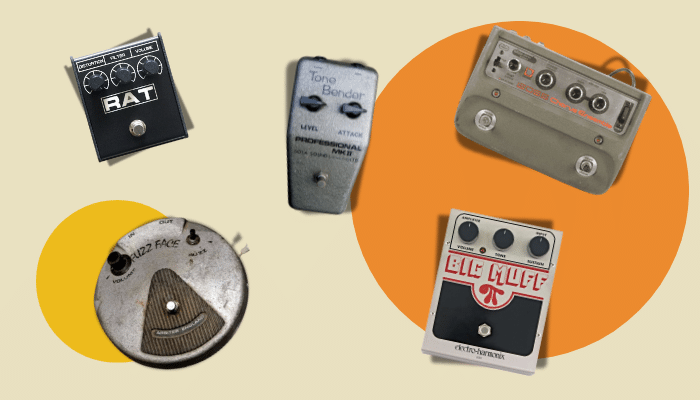
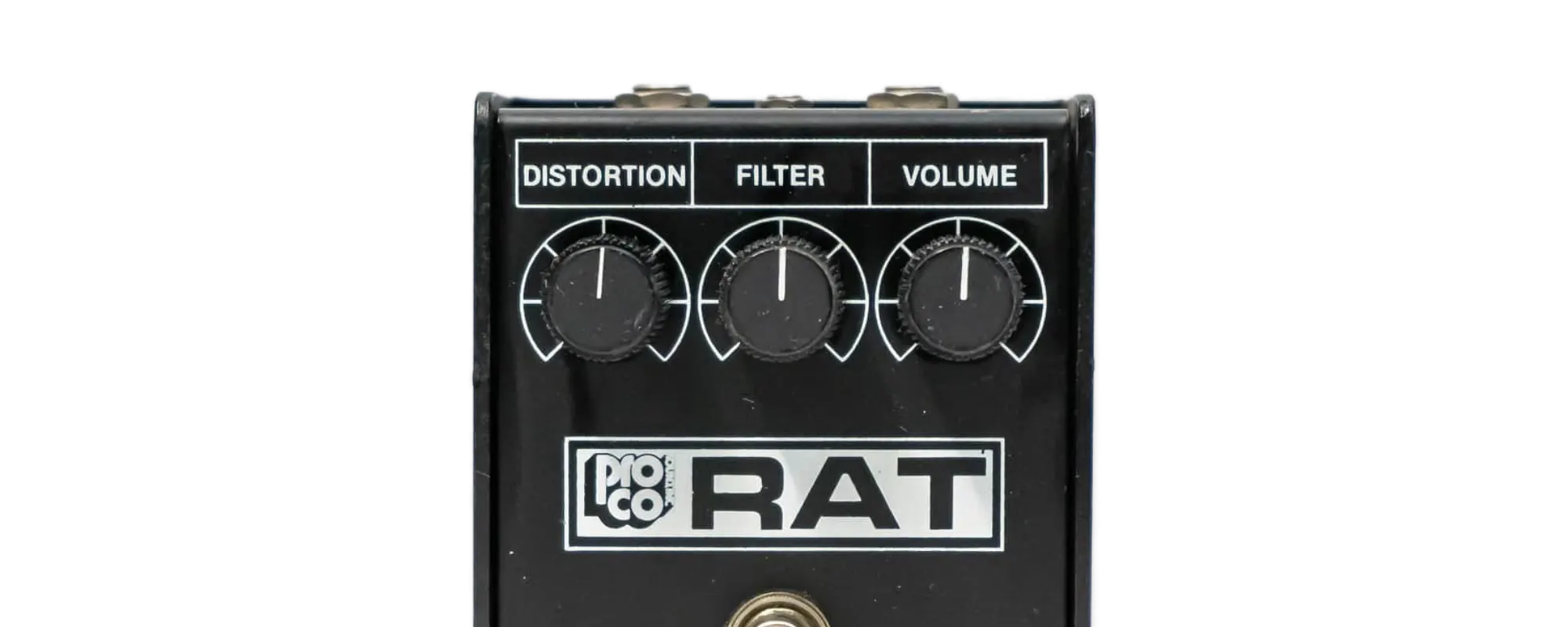
Strip the legend off and a Rat is a hard-clipping distortion box with three knobs: Distortion, Filter, Volume.
Turn the gain down and it does a gritty, mid-forward overdrive. Turn it up and it spills into something close to fuzz. That range is why it never sits neatly in one box, and why it shows up everywhere from blues to grunge to whatever Sonic Youth were doing. If you want the map of where it sits between gain types, that’s the whole point of our article on overdrive vs distortion vs fuzz.
But the knob that matters is the Filter, and you’re almost certainly using it wrong.
The Filter runs backwards. It’s a low-pass filter, so turning it clockwise cuts more high end, the exact opposite of every tone knob you’ve ever touched. Most players set it at noon and never look at it again. That’s the cliché. Back it off counter-clockwise, and the Rat turns into a fizzy, biting razor. Crank it the other way, and it goes thick, dark, almost woolly. Same pedal, two completely different bands’ worth of tone.
I’ll be honest, I used it wrong for years. I just turned it until it sounded good and never once clocked which direction was doing what. But the thing is, it never really mattered.
Your ears get there faster than the theory does. But knowing the Filter is a low-pass and not a treble boost is the difference between searching blind and searching with purpose.
The Rat isn’t a one-trick distortion. The trick is the knob nobody turns.
The records you think are Rat records (mostly aren’t)
Here’s where it gets slightly uncomfortable.
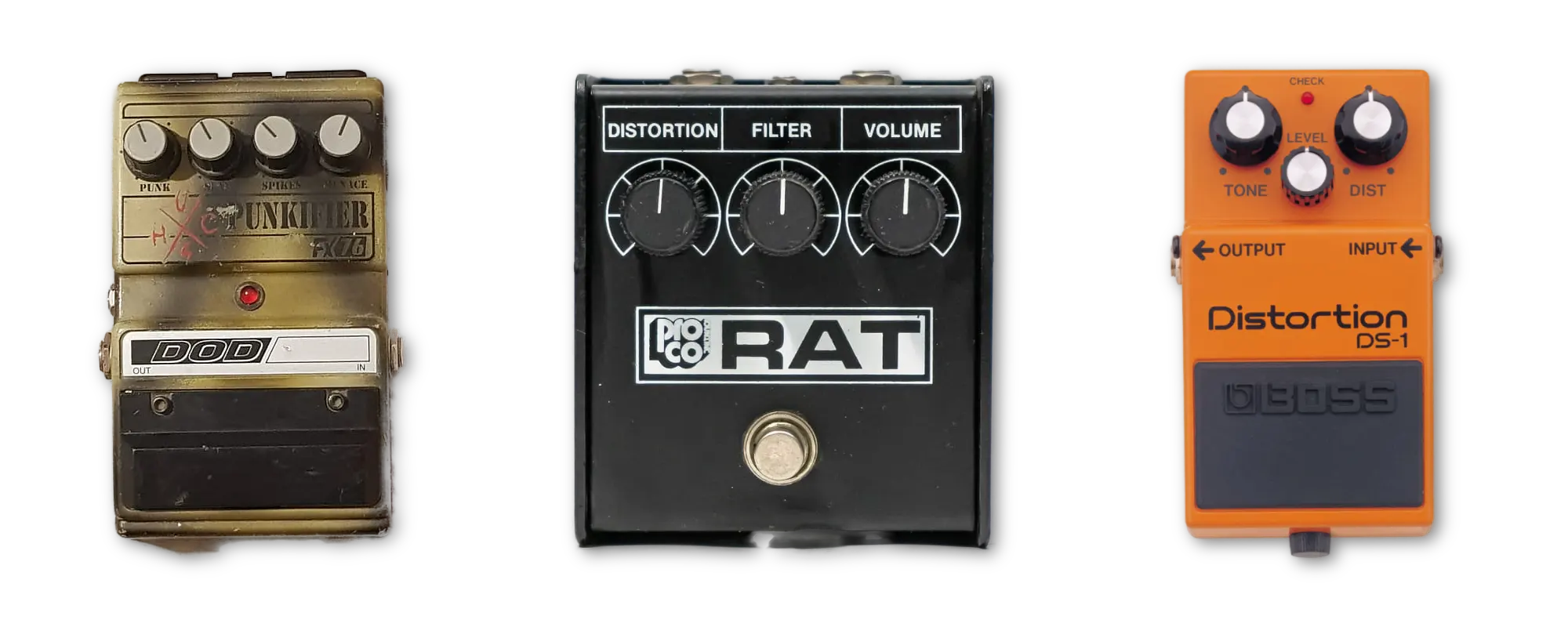
You “know” the Rat is the sound of grunge, of Cobain, of every snotty alt-rock riff from 1991. Kurt Cobain’s Rat lived on one song. He borrowed a Pro Co Rat from Krist Novoselic for “Territorial Pissings” during the Nevermind sessions because the track needed a rawer, uglier distortion than his DS-1 could give.
Live, he used one exactly once, a pedal swap with Krist at the Astoria in London in December 1989. It never lived on his board. The full story is in our Kurt Cobain pedalboard breakdown, and “borrowed it for one song” is about the size of it.
Then there’s Blur. “Song 2,” the woo-hoo song, the one everybody credits to a Rat. It wasn’t a Rat. The studio tone on that track was a DOD FX76 Punkifier. Graham Coxon is a genuine, lifelong Rat man, often running two of them, but the most Rat-sounding Blur song in the catalogue isn’t actually a Rat at all.
David Gilmour gets the same treatment. Some articles on the internet will tell you “Money” and “Comfortably Numb” are Rat tones. They predate his documented Rat use by years. The Rat shows up on his board later, which we’ll get to, but not on the songs everyone attributes to it.
The pedal you think you know is mostly hearsay.
Where the Rat really lives
So drop the myths, and the real fingerprints are still everywhere. They’re just not where the magazines point.
Jeff Beck ran a Rat live from the mid-’80s through to 1999 and all over the Guitar Shop album. David Gilmour’s Rat is documented on his actual 1994 Division Bell touring board, decades after the songs people misattribute.
Thurston Moore built a chunk of Sonic Youth’s Dirty out of a Turbo Rat. Thom Yorke leaned on a Turbo Rat for his distortion in Radiohead. Joe Perry, James Hetfield, Nuno Bettencourt, Buzz Osborne from the Melvins. The list of players who actually committed to a Rat is longer and stranger than the one the listicles keep recycling.
That’s the strange magic of this pedal. It earned its myth by being the box everyone quietly reached for, and nobody bothered to credit accurately.
Which ProCo Rat should you buy?
Now the part you actually came for, because there’s a sale on and you’re staring at four different Rats wondering which is The One.
A while back, someone asked r/guitarpedals exactly this. The thread ran to over 350 comments. The top reply, hundreds of upvotes deep, was four words of wisdom dressed up as a paragraph: just buy the ProCo.
The differences between this Rat and that Rat are subtle unless you’re chasing something genre-specific. Three hundred and fifty comments to arrive at “get the normal one.”
They’re right. But there’s one difference that does matter, and it’s the engine of every ProCo Rat versions argument on the internet: the chip.
Old Rats used the LM308 op-amp. It’s crunchy, mid-forward, and has more distortion than fuzz. ProCo switched to the OP07 chip in the ’90s when the LM308 went obsolete, and the newer circuit is more scooped, a little fuzzier. That’s the whole vintage-versus-modern war in one sentence. Whiteface this, 1985 reissue that, NOS chip the other. It all collapses down to LM308 crunch versus OP07 scoop.
I’ll put my cards on the table here. I’m a sceptic on the rare-chip religion.
The idea that a specific obsolete op-amp is the secret sauce, and that a £200 vintage unit will fix your tone where a £80 new one won’t, has always smelled like the same hope we all buy in those late night pedal purchases.
There’s a real difference between an LM308 and an OP07. There isn’t a £120 difference. If you love owning old things, buy the old thing and enjoy it. Just don’t tell yourself you’re buying tone. You’re buying a story, and sometimes the story is worth it.
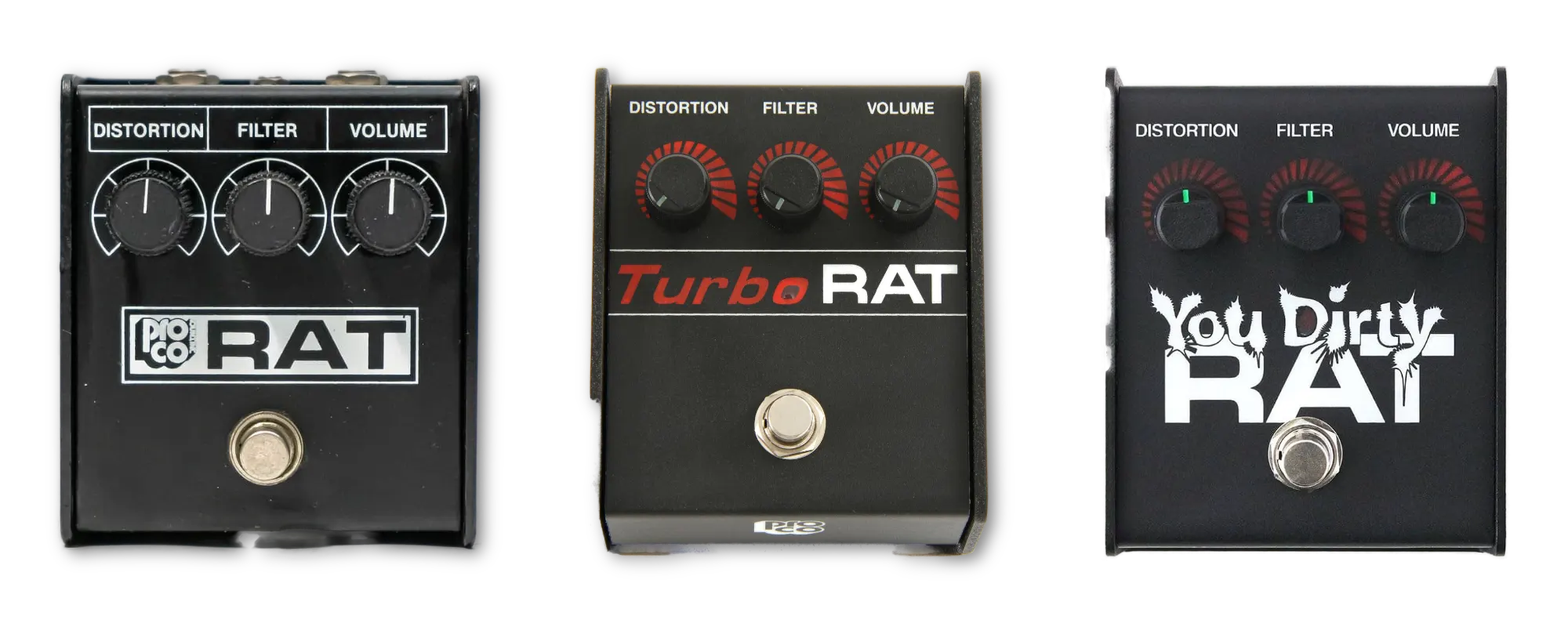
So, my honest steer. Most players want the standard Pro Co Rat 2. It’s the best rat pedal for the money, it’s built like a brick, and it does light grit through full violin-lead sustain on the one Distortion knob.
Want more teeth and more volume on tap? The Turbo Rat swaps the silicon clipping for LEDs, which means louder, less compressed, nastier. It’s the one Thurston and Yorke reached for, and it has a genuine cult for good reason.
Want something softer and more amp-like? The You Dirty Rat uses germanium clipping for a rawer, more open feel. Everything past that is a forum argument, not a tone problem.
Do you even need the real one?
This is the question ProCo would rather you didn’t ask.
There are a dozen Rat clones now, and a lot of them are very good. Even £80 for an original feels a bit cheeky in 2026 when you watch a blind Rat shootout on YouTube and genuinely can’t pick the real one. People have tried. They mostly can’t.
The JHS PackRat gives you nine versions of the circuit in one enclosure, which is the corksniffer’s dream box. The Black Mass 1312 is the cult favourite, a Rat with a meaner streak. The TC Electronic Magus Pro is the budget hero everyone keeps recommending, and the Mooer Black Secret or a £20 Mosky will get you 90% of the way there for pocket change.
The Rat is one of the classic circuits every player should know, and that means it’s also one of the most cloned.
This is the point I have to come clean.
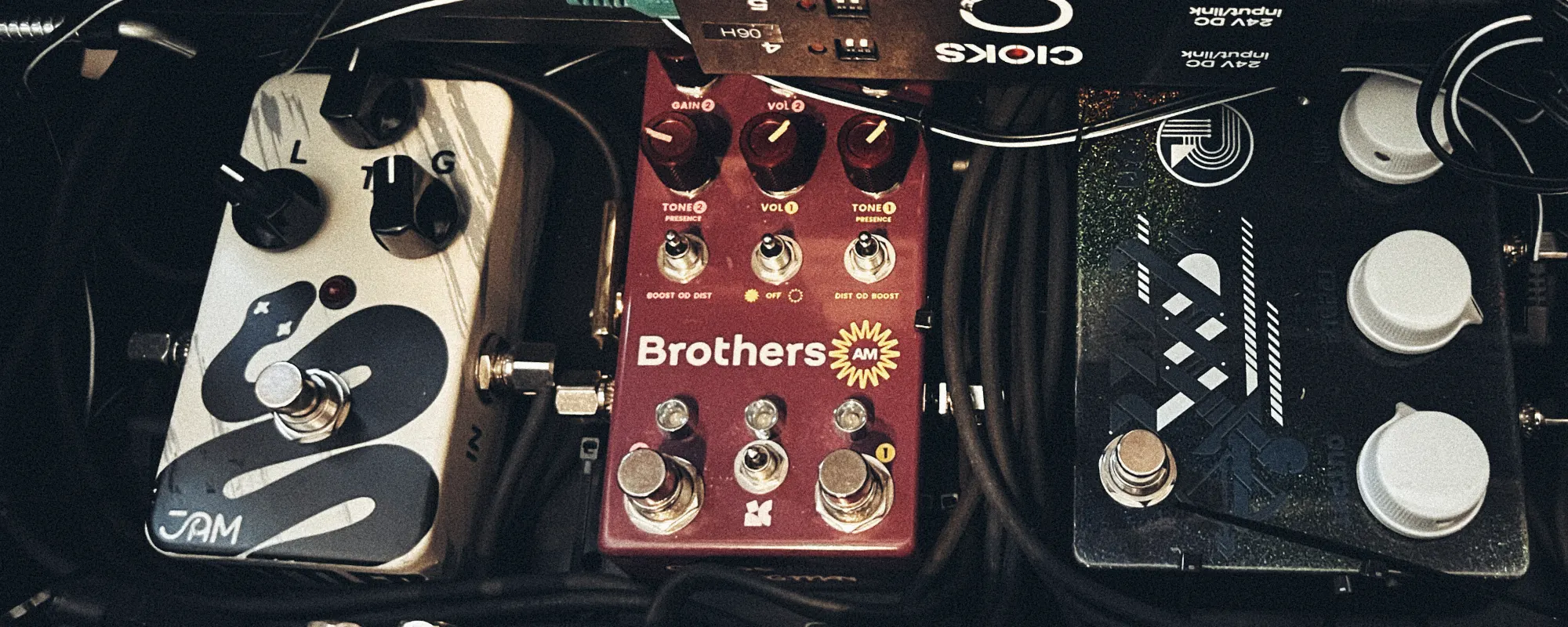
The Rat that actually makes my board isn’t a Rat. It’s a Jam Pedals Rattler. I own the Rat 2, I love the Rat 2, and the Rattler still wins the spot, mostly because it’s a smaller body and real estate on a board is real estate.
Tonally, there are differences, but they’re in the same ballpark, and honestly, I find the Rattler easier to control. I play mostly low-ish gain rock, so the Rattler is my high-gain pedal, the thing I kick on when I need just a bit more dirt than usual. I dial it to keep some clarity. It can sound brutal when I let it, and I love it for that.
So why buy the original?
Because it’s a tank, it’ll outlive your amp, and there’s something honest about owning the actual thing instead of someone’s tribute to it. The clones win the spec sheet. The original wins the floor. And sometimes, if you’re me, a good clone wins the board anyway.
An accident you can’t reverse-engineer
Think back to that basement. One wrong resistor, one overloaded chip, one sound nobody had heard before. Every Rat clone on the market, every PackRat mode and boutique BAT, and £20 Mosky, is somebody trying to engineer their way back to a mistake one hippie made by accident in 1978.
That’s the thing about the Pro Co Rat. You can’t design your way to it. You can only buy one and turn it up.
So get the Rat 2 if you want the sound that’s on more records than anyone remembers. Get the Turbo Rat if you want it with teeth. Get a good clone if a smaller box earns its place. I won’t tell anyone.
Skip the version rabbit hole, skip the collector premium, and spend the saved money on strings or lessons.
Oh, and turn the Filter knob both ways and listen. Took me years. Don’t be me.