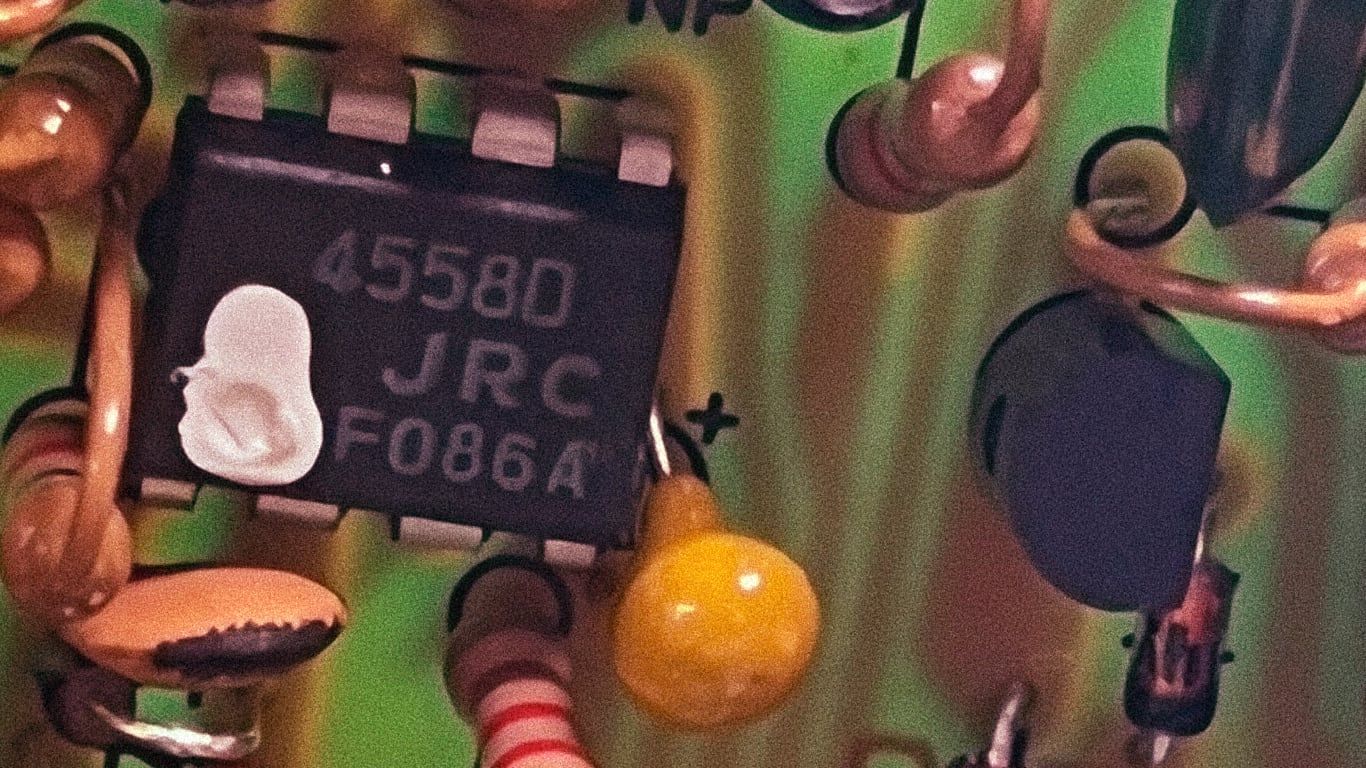
Somewhere right now, a guitarist is unscrewing the bottom plate of a little green pedal, phone flashlight in one hand, screwdriver in the other (a two-handed job that somehow needs three). They’re looking for three letters printed on a chip the size of a fingernail: J, R, C.
If the letters are there, the pedal is worth more. If they’re not, it’s “just” a Tube Screamer.
The chip they’re looking for is the JRC4558, and for about forty years it’s been sold as the secret behind the Tube Screamer sound. It’s a cheap dual op-amp. In a Tube Screamer, it matters far less than the legend says. Most of the sound comes from the circuit wrapped around it. The man who designed the pedal didn’t even use the JRC4558 at first, and the most famous Tube Screamer in history may not have had one inside.
Here’s how a part you can buy for pocket change became the magic.
What Is the JRC4558?
The JRC4558 is a dual operational amplifier made by Japan Radio Company. It’s one of a family of 4558-type chips, and it turns up all over the effects world: the Tube Screamer, the Boss OD-1, the Orange Squeezer and plenty of others.
In a Tube Screamer, the op-amp is the engine of the overdrive stage. It boosts your signal and pushes it into a pair of small clipping diodes, and together they rough the sound up. Without the chip there’s no overdrive. That much is true.
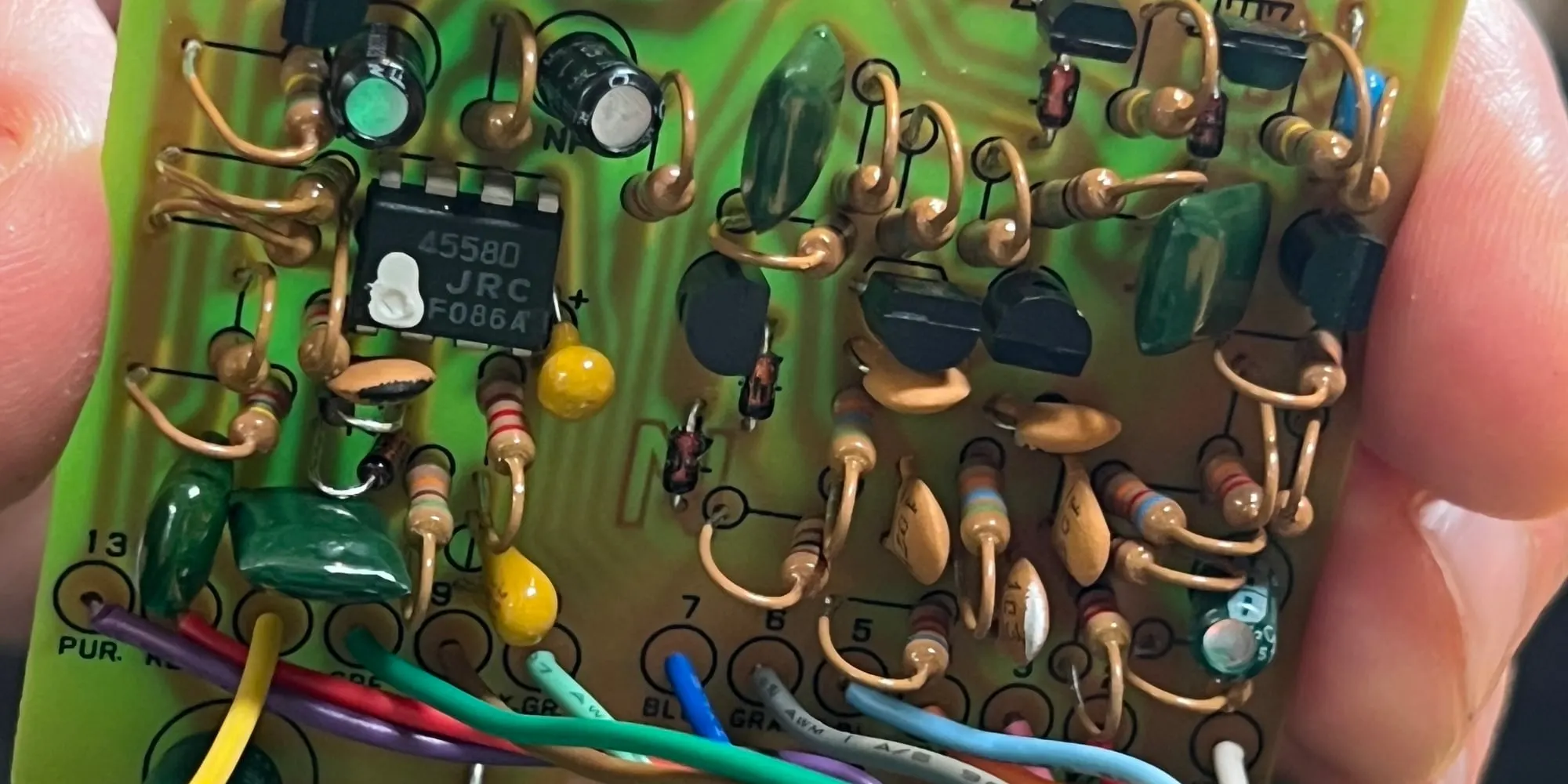
The question is whether this particular chip is where the sound comes from. That’s the myth.
How the JRC4558 Became the Legend
The Tube Screamer didn’t start out as a holy relic. It started as a sensible product.
Susumu Tamura designed it at Maxon around 1979 to compete with the Boss OD-1 and the MXR Distortion+. It sold as the Maxon OD808 in Japan and the Ibanez TS808 Tube Screamer everywhere else. John Lomas, a former Ibanez product manager, later called the TS9 launch “not a magical moment by any stretch of the imagination.” By 1985 the TS9 was out of production.
Then Stevie Ray Vaughan made it famous, players went hunting for the pedal that made that sound, and used prices took off. Premier Guitar reported shops selling used TS9s for well over $250 while Ibanez was selling old units to dealers for five dollars. Same green box.
When a sound is hard to pin down, people look for a part they can name, buy and fit. The JRC4558 was perfect. It had a name. You could check for it. And Lomas himself credited the chip for the pedal’s pushed-forward midrange.
So the legend settled: original 808s had the JRC4558, the JRC4558 is the sound, and everything else is a lesser pedal.
The trouble is what was actually inside them.
Which Chips Were Really Inside Tube Screamers
Tamura has said which chips he used, and it doesn’t match the legend.
He tried the UA741 and MC1458 first and found them expensive imports. The earliest narrow-case TS808s used a UA1458. Later the circuit moved to the Raytheon RC4558. After that, the chip depended on the production lot: sometimes a JRC, sometimes a Texas Instruments RC4558.
The TS9 is murkier still.
| Chip | Where it turned up | Source | How sure |
|---|---|---|---|
| UA1458 | The earliest narrow-case TS808s | Susumu Tamura | Designer’s account |
| Raytheon RC4558 | Later TS808s | Susumu Tamura | Designer’s account |
| JRC4558 or TI RC4558 | TS808s, varying by production lot | Tamura; Analogman | Both agree |
| Toshiba TA75558 | Most original TS9s | John Lomas | His account. Analogman says early TS9s usually had the JRC4558D |
| JRC4558D | Only about 5 to 10% of TS9s | Craig Hopkins, citing a figure from Ibanez’s pre-reissue buy-up | Reported |
Read that table again and the legend starts to wobble. There is no single “original” Tube Screamer chip. There were several, chosen on price and availability by a company that didn’t think the pedal was special. If you want the full TS808 versus TS9 story, we’ve covered it in TS9 vs TS808.
Does the Chip Change the Sound?
This is where the JRC4558 myth either lives or dies, so let’s take the witnesses one at a time.
What the Chip Testers Say
Mike Piera runs Analogman, the shop that turned modding Tube Screamers back to original spec into a business. He sells chip swaps. If anyone has a reason to tell you the chip matters, it’s him.
He’s tested the chips side by side and says there is “VERY little difference” between them. He still prefers the JRC.
Fair enough. Everyone’s allowed a favorite. But when the guy who sells the swaps says the difference is small, believe the small part.
Where the Tube Screamer Sound Really Comes From
Electrosmash took the circuit apart and found the famous mid hump in the filters, not the chip. A filter in the clipping stage cuts the bass below roughly 720Hz, and the tone stage rolls off the top above about 723Hz. Squeeze the signal between those two and you get the honk everyone recognizes. The clipping diodes sit in the op-amp’s own feedback loop, which is where the roughing up happens.
So the shape of the sound is set by parts that cost even less than the chip.
Electrosmash doesn’t call the chip myth busted, though. It calls it unproven. That’s the honest version, and it’s worth keeping.
So Is Anyone Hearing Anything?
Maybe. Players hear what they hear, and different chips can behave a little differently at the edges. But “a little differently at the edges” is a long way from “the secret.”
I’ll be honest about where I sit. I’m not the kind of person to lust over a chip. Put a Tube Screamer in a full band mix and ask yourself whether anyone in the room is going to hear which op-amp is inside it. I wouldn’t be too precious about it.
The Chip in Stevie Ray Vaughan’s Tube Screamer
Now the best bit.
If the chips are that close, there’s only one Tube Screamer whose chip really matters: Stevie’s. He’s the reason the legend exists.
Collector Craig Hopkins owns one of Stevie’s early TS9s, with a late-September 1981 date code. He reports it has a JRC2043DD inside. Not the JRC4558. And it’s a chip Analogman says can “sound BAD” in some pedals. According to Hopkins, that pedal was part of Stevie’s rig until July 1985, and it went with him on the 1985 tour of Japan.
That’s one collector’s report, and we’ll probably never know which chip Stevie played through on which night. But if it’s right, the pedal on the most famous board in this whole story didn’t have the chip the legend is about.
And there’s a second twist on top.
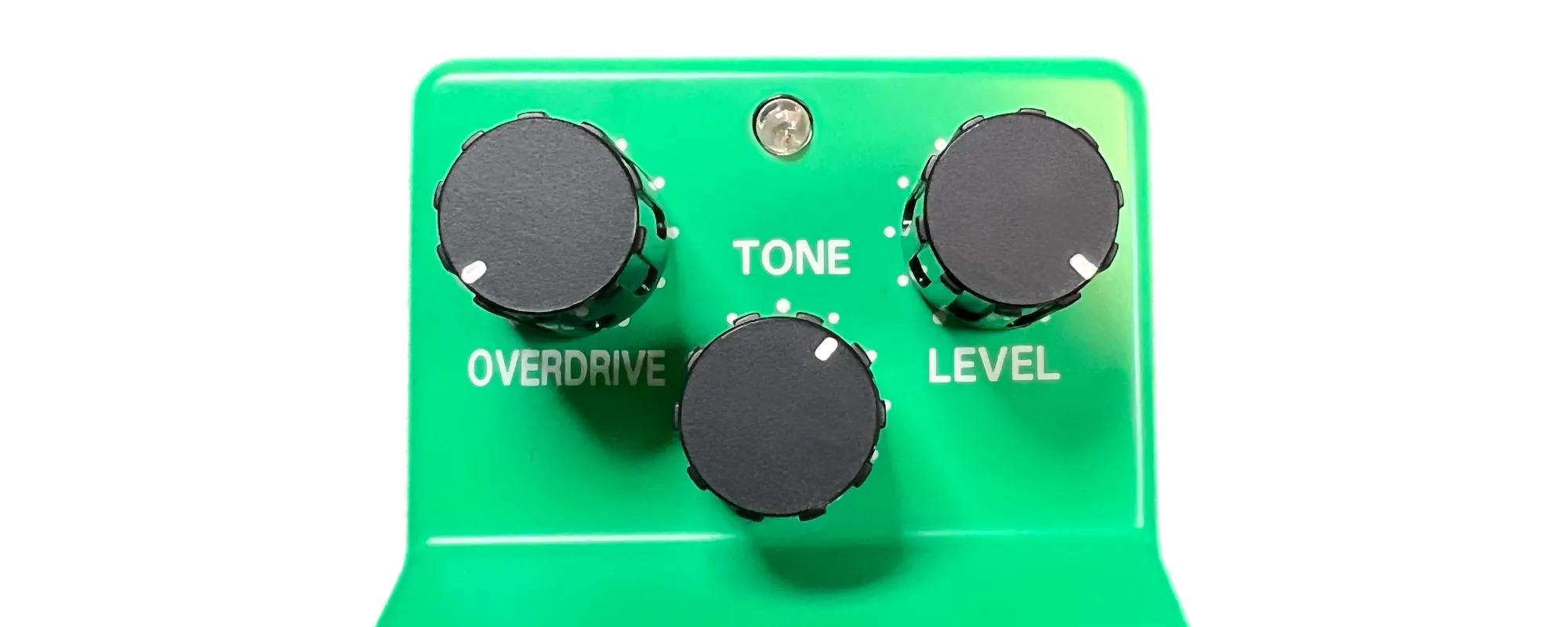
According to a friend of Stevie’s, quoted by Hopkins, he ran his Tube Screamer with the Drive “off or extremely low” and the Level full or nearly full. He was using it as a push into a loud amp. The chip was barely being asked to do anything. You can hear what that sounds like in the episode, where I play the same part with the Tube Screamer off and then on, set close to how Stevie had it.
If you want to try it on your own rig: get your amp to the edge of breaking up first, with the pedal off. Then set the Drive at zero, turn the Level up until the pedal is clearly louder than bypass, and set the Tone somewhere between 12 and 3 o’clock to suit your amp. That’s Stevie’s setup, and it works on any Tube Screamer, whatever chip is inside.
Should You Pay More for a JRC4558 Tube Screamer?
For the sound alone, no.
An original 1981 TS808 in good condition goes for around $674 on Reverb’s price guide. A new JRC4558 costs pocket change from a parts supplier. If you’re paying the difference for the chip, you’re paying for the legend.
Buy the Tube Screamer, or the TS-style clone, that sounds right through your amp. The current TS808 and TS9 reissues do the job.
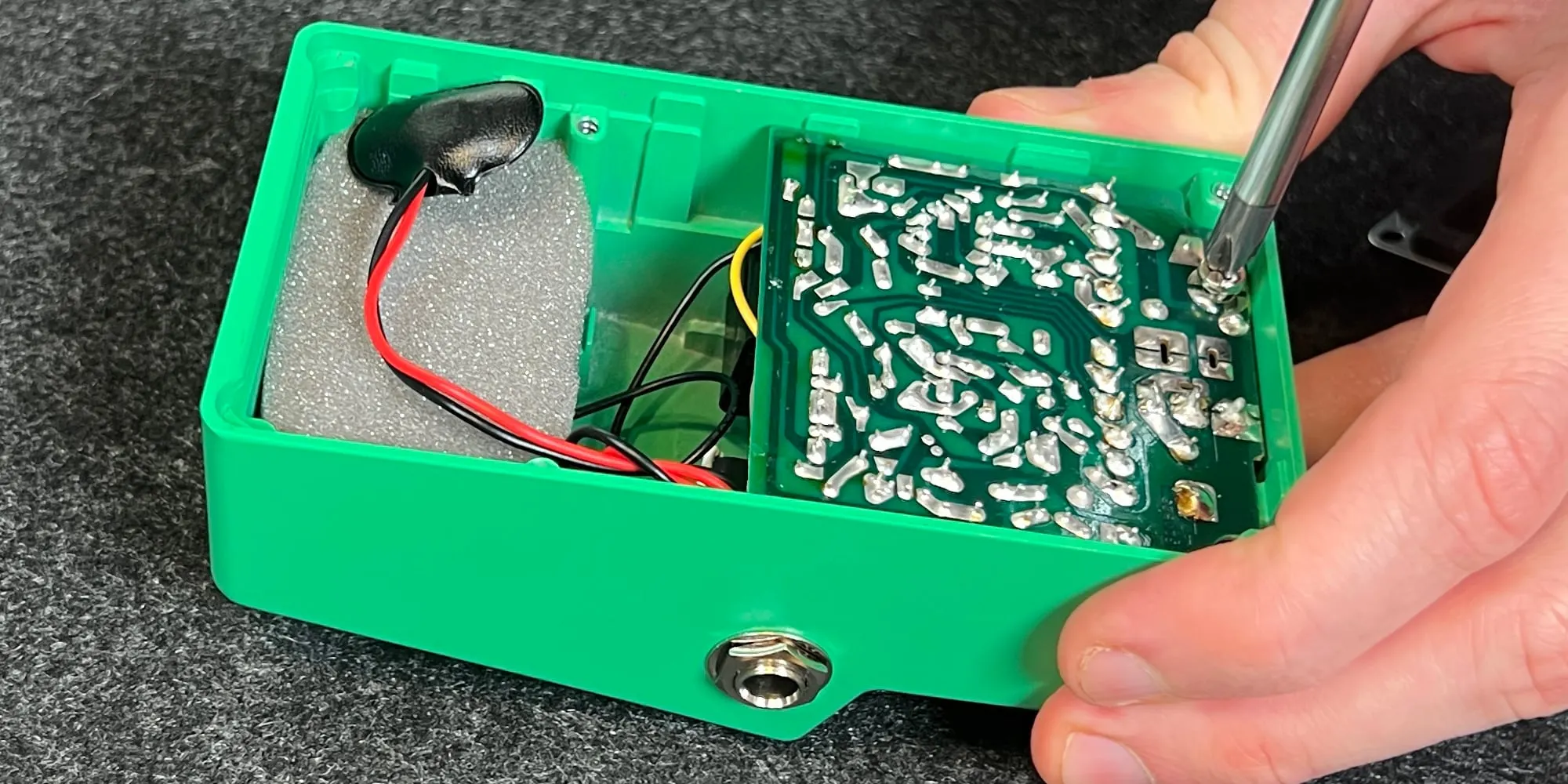
If you’re curious, and your pedal has a socketed chip, swapping one in costs almost nothing. Just don’t expect a different pedal.
Now the truth.
If I saw an old JRC Tube Screamer at a decent price, I’d probably still buy it. Not because I think it would sound better than any other Tube Screamer. Just because it would be a nice story to tell.
And that’s the real answer to the JRC4558 myth. The chip isn’t the magic. The story is.
Tamura put it best: “When designing it, I did not dream that the 808 would become so famous.” Nobody built the magic into that pedal at the factory. We added it afterward, one legend at a time.
If you want the full story of how a pedal nobody thought was special ended up with its own magic chip, it’s in the episode. And every episode gets an issue of Pedal Talk, my free newsletter, with the practical side for your own rig. Sign up just below and you’ll get the next one.