


The delay pedal placement question hits my inbox more than any other signal chain topic. And honestly, I get why it’s confusing. Every forum has a different “rule” about where delay should go, and half the advice contradicts the other half.
Here’s what I’ve learned after years of moving my delay around like a chess piece:
The placement of a delay pedal isn’t about following someone else’s diagram. It’s about understanding what actually happens to your sound when you put it in different positions on your pedalboard.
The traditional delay pedal setup puts it near the end of your chain, right before reverb. That works great… until it doesn’t.
Sometimes that “textbook” delay effect pedal placement murders the character you’re after, turning your carefully crafted tone into digital mush.
In this guide, I’ll show you exactly how the placement of pedal delay affects your sound in each position, plus the practical framework I use to decide where mine goes for different situations.
No rigid rules, no “this is the only way” nonsense. Just real-world insights that’ll help you find what works for your rig.
What Is a Delay Pedal and How Does It Work?
A delay pedal is basically a time machine for your guitar signal. It grabs what you play, holds onto it for a bit, then spits it back out while you’re playing something else.
The market’s flooded with delay pedals now. From dead-simple analog boxes to digital monsters with endless modes.
The delay pedal does way more than just add echo to your solos. I use mine for everything from thickening rhythm parts to building entire soundscapes.
Those three delay controls – time, feedback, and mix – are the difference between Edge-style rhythmic patterns and Gilmour’s ambient washes.
Want the full picture on how delay shapes your tone? Check out our complete Guitar Delay Pedals Guide.
Standard Delay Pedal Placement in the Effects Chain
The textbook delay pedal placement puts it near the end of your chain, and there’s solid logic behind this.
The standard approach goes like this:
Compressor → Gain → Modulation → Delay → Reverb.
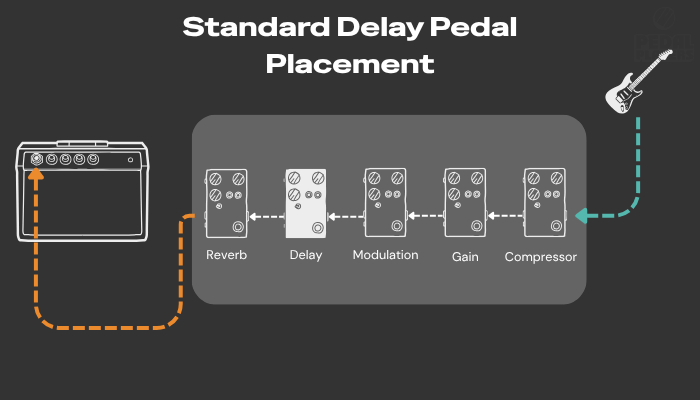
Putting delay after modulation means you’re echoing the fully-processed sound. Your chorus swirls stay intact in each repeat instead of turning into audio soup.
Most players stick the delay just before reverb. This setup works because your delays get a touch of ambient wash without drowning in it.
Think of it like this: delay creates the echoes, reverb puts them in a space.
This positioning lets each effect do its job without stepping on the other’s toes. Your delays stay articulate while still feeling natural.
But this “standard” approach assumes you want clean, pristine repeats. Sometimes you want chaos.
Learn this traditional placement first. It works for a reason, and you need to know the rules before breaking them.
Delay Pedal Placement: Before or After Modulation and Distortion?
The placement of the delay pedal relative to your dirt and modulation is where things get interesting.
Before or After Distortion
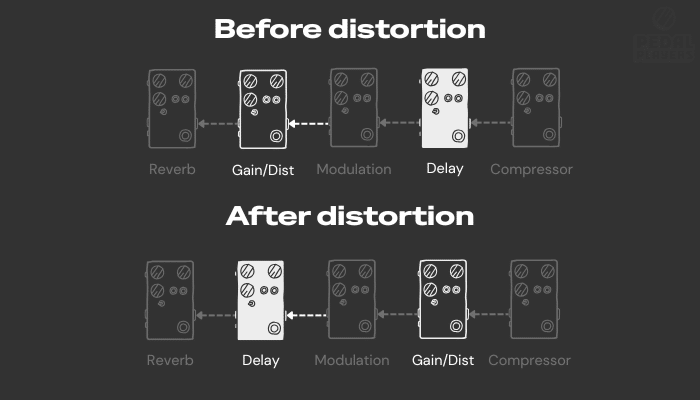
Most guitarists put delay after distortion for good reason: you’re distorting your dry signal, then adding clean repeats. Everything stays clear and articulate.
But delay before distortion? That’s where things get weird.
When delay comes before distortion, every repeat gets pushed through your gain stages. It can sound like garbage. Muddy, undefined, like playing through a broken speaker.
Or it can sound incredible for that lo-fi, shoegaze wall-of-sound.
Before or After Modulation
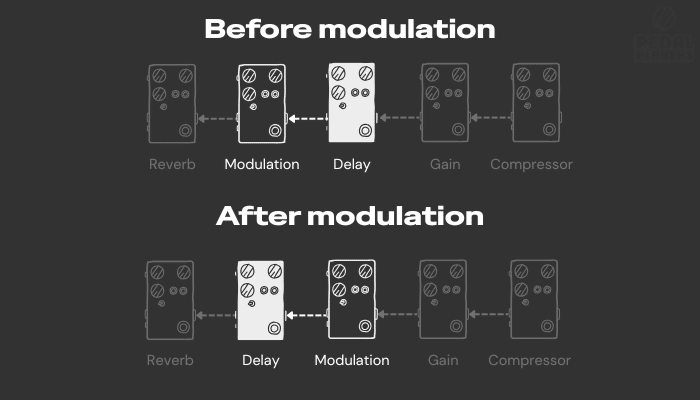
Placing the delay after modulation effects keeps things predictable:
- Your modulation adds character to your dry signal
- Delay captures that modulated tone perfectly
- Each repeat maintains those swirly textures
Put your delay pedal before modulation, and it creates rhythmic patterns that evolve with each repeat.
Here’s what actually happens to your tone:
- After modulation:
Delays capture the movement perfectly - Before distortion:
Instant vintage vibes, like tape into a cooking amp - In effects loop:
Delays float above your core tone
Sometimes, “worse” tone is better tone. Those muddy delays from “wrong” placement might be exactly what cuts through a dense mix.
Using the Effects Loop for Delay Pedals
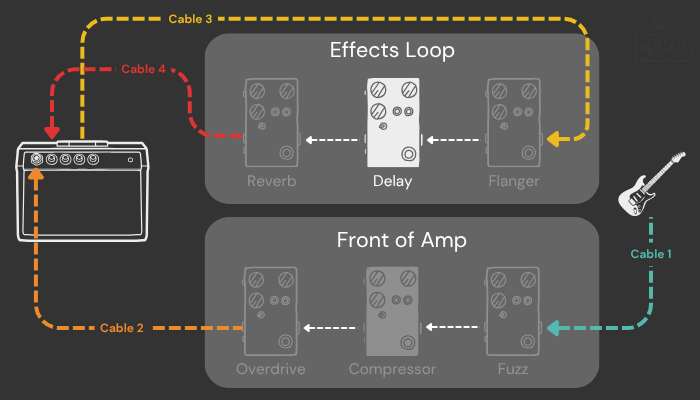
The effects loop is probably the most underused feature on most amps, and it can transform how your delay pedal sounds.
Running a delay pedal through your effects loop places it after your amp’s preamp but before the power section. Your delay works with your actual amp tone, not your raw guitar signal.
The benefits:
- Your amp’s character comes through in every repeat
- Way less noise with high-gain sounds
- The delay doesn’t mess with your distortion
It’s dead simple. Cables from Send to delay input, delay output to Return.
The biggest difference: when you crank your amp’s gain, delays in front get compressed and muddy. Delays in the loop stay crystal clear.
If you’re pushing your preamp hard, try the loop. It’s like your delays got an upgrade.
Creative Delay Pedal Setups and Alternative Placements
Forget everything about “proper” delay placement. Sometimes the best sounds come from doing everything wrong.
One approach that sounds way better than it should, is putting your delay pedal before modulation effects. Your repeats get progressively more warped with each echo.
Running multiple delay pedals in different positions builds textures you can’t get any other way:
- Delay before overdrive gives you lo-fi, tape-saturated vibes
- Delay after reverb creates massive washes
- Two delays in series with different times = instant U2
I keep a short slap delay early in my chain and a longer ambient delay at the end. Engage both for serious walls of sound.
The best part about creative delay pedal placement? There’s no wrong answer. That “mistake” might become your go-to sound.
How Delay Pedal Placement Affects Your Tone
The placement of a delay pedal doesn’t just change when you hear echoes. It totally alters the character of those echoes and how they interact with everything else in your signal.
Put your delay pedal at the end of your chain, and you’ll capture your fully formed tone. Every repeat sounds exactly like what you played, with all your effects intact.
Clean? Sure. Exciting? Not always.
Move that same delay pedal earlier in the chain, and everything changes. Now your repeats are getting mangled by whatever comes after – distorted, modulated, transformed with each pass.
The type of delay matters too. Analog delays add murky warmth that gets even murkier through distortion. Digital delays stay pristine no matter where you put them. Sometimes that’s exactly what you don’t want.
Here’s what actually happens to your tone:
- After modulation
Your delays capture the movement perfectly. Each repeat swirls exactly like the original - Before distortion
Instant vintage vibes, like running tape into a cooking tube amp - In effects loop
The delays float above your core tone instead of mixing with it
The dirty secret: sometimes “worse” tone is better tone.
Those muddy, undefined delays from “wrong” placement might be exactly what cuts through a dense mix.
Understanding these tonal shifts means you can choose your placement deliberately, not just follow someone else’s diagram.
Tips for Experimenting with Delay Pedal Placement
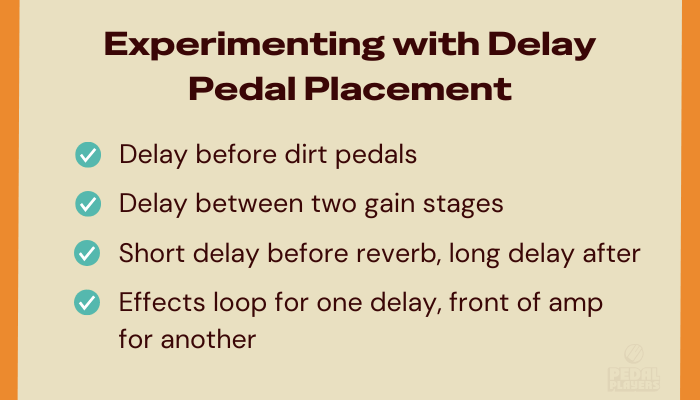
Pick a riff you know inside out, then move your delay to a different spot every time you play it. Or even better, loop it. Then, all you have to do is listen.
Try these experiments:
- Delay before dirt pedals with cranked repeats – instant shoegaze
- Delay between two gain stages
- Short delay before reverb, long delay after
- Effects loop for one delay, front of amp for another
Take notes like “delay after fuzz = apocalypse” or “before chorus = seasick in the best way.”
Trust your ears over any guide. If it sounds good to you, it is good.
Want to move beyond basic delay settings? Explore How to Use a Delay Pedal: Advanced Techniques to master layering, modulation, and rhythmic depth like a pro.
Common Delay Pedal Placement Mistakes to Avoid
Let’s talk about delay pedal placement mistakes. Not because they’ll ruin your tone forever, but because I’ve made all of them and can save you some frustration.
The biggest “mistake” everyone warns about is placing delay before overdrive or distortion.
This only ruins your sound if you’re trying to get clean, articulate repeats. Sometimes muddy is exactly what you want. The mistake is doing it accidentally when you’re after clarity.
Real mistakes that actually matter:
- Running three delays and two reverbs all at once (spoiler: it’s audio soup)
- Ignoring your amp’s effects loop when running high gain – you’re fighting unnecessary noise
- Setting every time-based effect to the same tempo – congratulations, you’ve created mush
The worst delay pedal placement mistake? Not experimenting because someone on a forum said there’s only one “right” way.
If your delay sounds like garbage and you don’t want it to, check: Is it before a high-gain pedal? Are you stacking too many time effects? Could the effects loop help?
Know the “rules” so you can break them on purpose, not by accident.
Every placement has its place. Even the “wrong” ones.
Finding Your Perfect Delay Pedal Setup
After all this talk about delay pedal placement, here’s the truth: your perfect setup is the one that makes you want to plug in tomorrow.
I’ve shown you the textbook approach, the rebellious approach, and everything in between. Understanding how placement affects tone is only half the battle. The other half is figuring out what sounds good to YOUR ears.
My delay pedal setup today looks nothing like it did five years ago. That’s not indecision. That’s growth.
Start with standard placement. Learn why it works. Then systematically break every rule until something magical happens.
The best delay pedal placement discoveries came from happy accidents. Your “mistake” might be the secret that defines your sound.
Keep exploring different configurations, but don’t get paralyzed by options. Sometimes, good enough IS good enough.
Your perfect delay pedal setup is out there. Or more likely, it’s several different setups depending on what you’re playing that day.
And that’s exactly how it should be.
Frequently Asked Questions About Delay Pedal Placement
Guitarists often have questions about optimizing delay pedal placement. Understanding the basics can enhance your setup and sound.
Here are some common questions:
Where should a delay pedal be placed in the effects chain?
The standard delay pedal placement is near the end of your chain. Typically after distortion and modulation but before reverb. This keeps your echoes clean and articulate. However, there’s no “wrong” placement. Delay before distortion creates vintage, saturated repeats perfect for shoegaze, while the effects loop works great for high-gain amps. Start with the traditional placement, then experiment based on what sounds good to your ears.
Should delay go before or after distortion?
Delay typically goes after distortion for clean, articulate repeats of your distorted tone. This is the “correct” way for most styles. But delay before distortion has its place too – it creates that saturated, vintage vibe where repeats get increasingly mangled. Try both. Your “wrong” placement might be someone else’s signature sound.
What happens if my delay pedal is before distortion?
When delay comes before distortion, every repeat gets pushed through your gain stages, creating progressively degraded echoes. This can sound terrible if you want clarity – muddy and undefined. But it can also sound incredible for lo-fi textures, vintage tape-style saturation, or that wall-of-sound shoegaze tone. The “mistake” is doing it accidentally when you actually want clean repeats.
Can delay pedals be used in the effects loop?
Absolutely. Using a delay pedal in your amp’s effects loop places it after the preamp, which means cleaner repeats even with high gain. It’s especially useful for metal and hard rock players who want distorted tone with pristine delays. Just connect Send to your delay input, delay output to Return. Not every style needs this, but if you’re pushing your preamp hard, the loop can be a game-changer.
Does delay go before or after chorus?
Delay usually goes after chorus and other modulation effects. This way, your delay captures the full modulated sound – each repeat maintains those swirly chorus textures perfectly. Putting delay before chorus creates evolving patterns where each repeat gets progressively more warped. After is standard and predictable; before is experimental and can create unique rhythmic textures.
