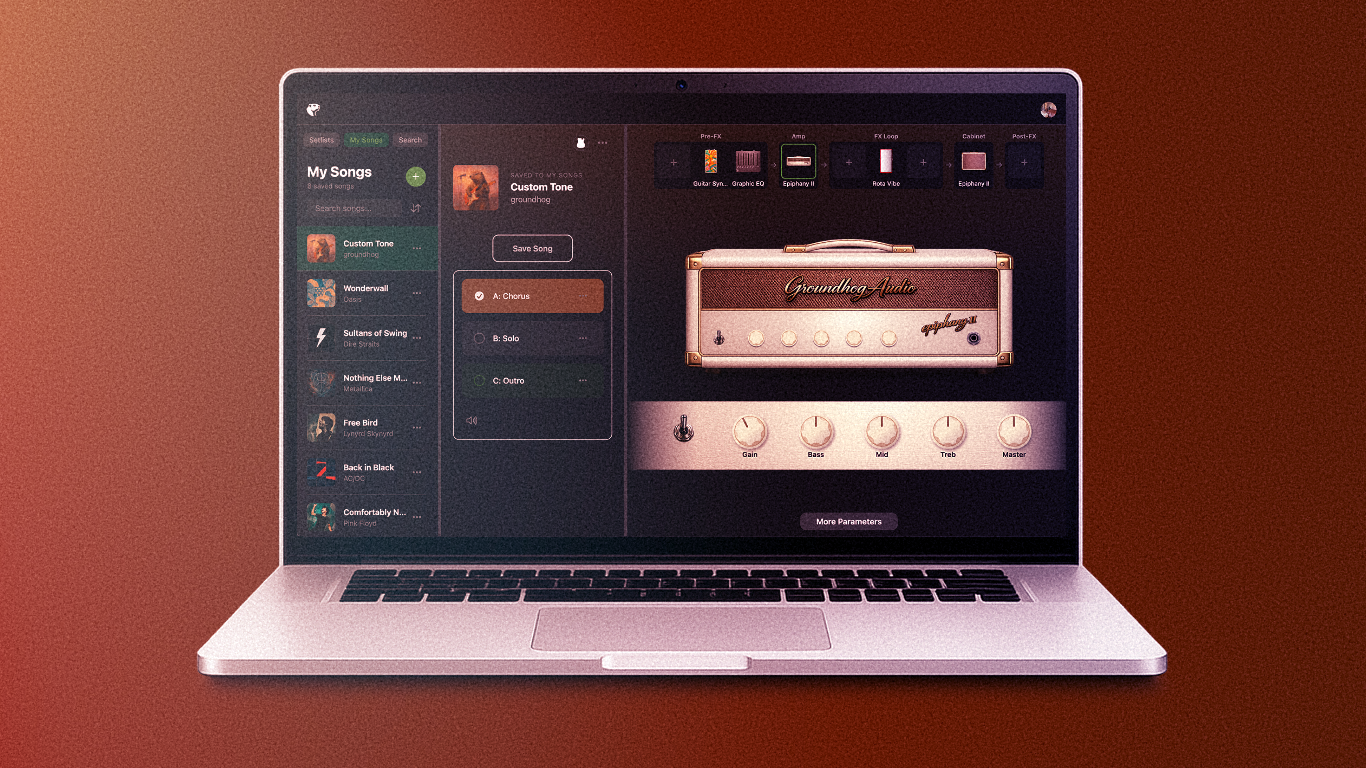
Open the app, and it looks exactly like Spotify. Search bar up top, album art in a grid, your recently played running down the side.
You type in “Texas Flood.” You tap it.
Three seconds later the pedal at your feet has rebuilt Stevie Ray Vaughan’s tone, the bark, the bloom, the way the amp sags when you dig in, and it’s sitting there waiting for your hands. No knobs. No forum threads at 1 am. No fourth overdrive you bought to chase a sound you heard once on a record.
That’s the pitch behind the Groundhog OnePedal, the AI guitar pedal that started funding on Kickstarter for around $500.
“Sound like your favourite song with a single click.”
And here’s the uncomfortable part: it mostly works.
So let’s ask the question the marketing skips. When an AI guitar pedal builds your tone out of someone else’s record, whose sound is that?
It isn’t yours. You own a search result, not a tone.
What an AI guitar pedal actually does
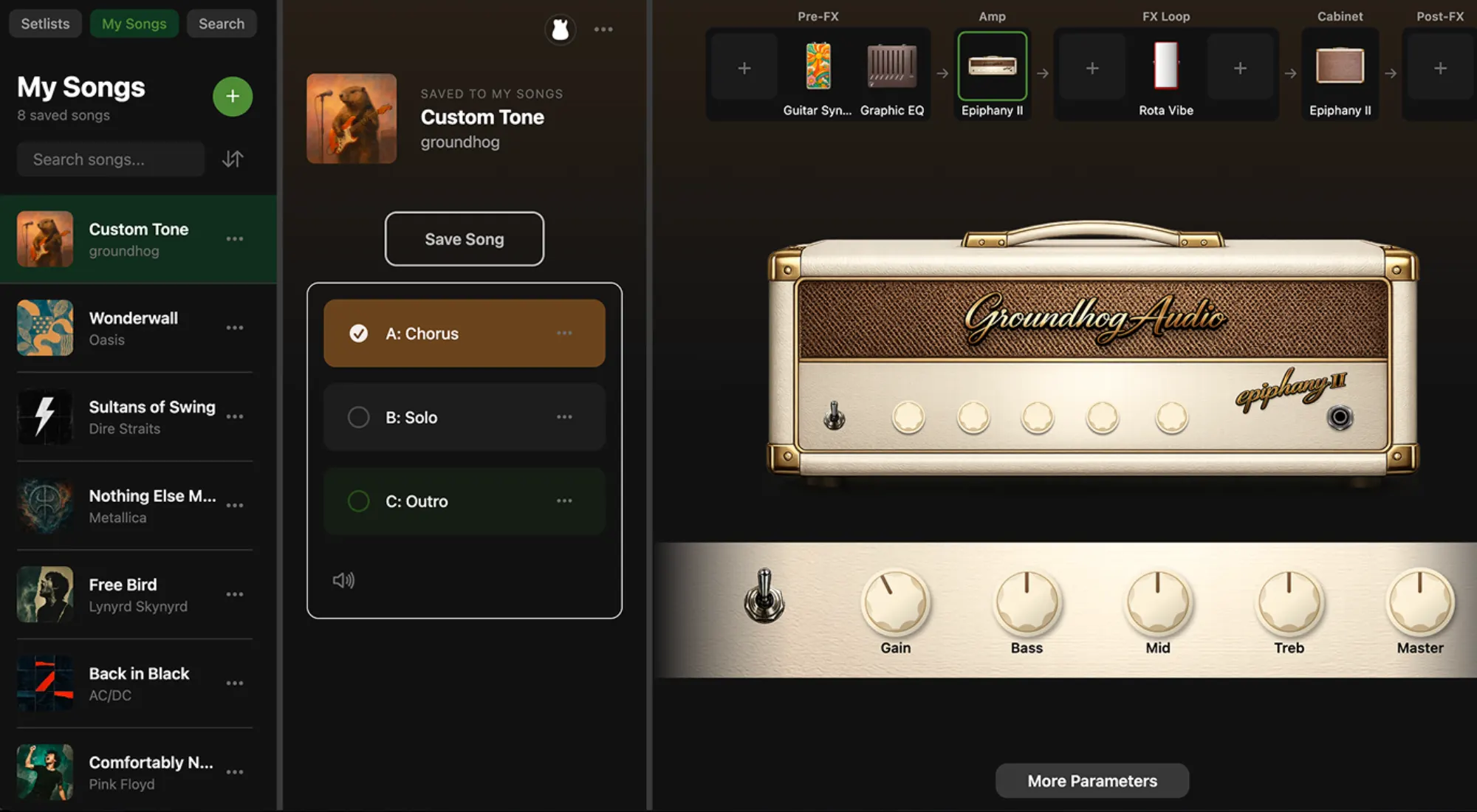
Strip the magic away, and the mechanism is blunter than the ad copy. The OnePedal doesn’t match “a tone” in the abstract. You hand it a finished, mastered, commercially released recording, and its tone-matching engine tears the guitar back out of the mix, analyses it, and reconstructs the whole chain: amp, cab, reverb, and the pedals it thinks were in front. Untangling what came from a pedal and what came from the amp is half the trick.
It does this against a library of more than 100,000 songs. Tap a track, get the rig.
That’s a clever piece of engineering. It’s also not tone-chasing. It’s tone-downloading.
And it’s worth seeing the other shape this takes, because it cuts the opposite way. Chaos Audio’s AI FX Builder and the Polyend Endless don’t copy anything. You type “gritty fuzz that cleans up when I roll my volume back” and the thing writes a brand-new effect algorithm from scratch, one that didn’t exist until you described it.
Chaos literally markets the result as yours, an effect you made and get to keep.
One pedal copies a record. The other invents something from a sentence. Hold that gap. We’re coming back to it. But for now, the OnePedal.
You didn’t build that SRV sound. You searched for it.
Can you even copyright a guitar tone?
Here’s where it gets strange, and where “whose sound is it” stops being rhetorical.
You can’t copyright a tone. Timbre, the actual colour of a sound, the thing that makes a Strat a Strat, isn’t protectable. When Katy Perry got sued over “Dark Horse,” the courts were clear that the raw building blocks of music, timbre, rhythm, and pitch, aren’t anyone’s property on their own.
Nobody owns the glassy quack of a Strat. Nobody owns Gilmour’s woolly Big Muff sustain. Not even Lord Gilmour.
But the recording is owned. Absolutely, ferociously owned. That master the pedal feeds on belongs to a label, and lifting from it without permission is the kind of thing that runs $150,000 per track when it reaches a courtroom. The whole AI music world is on fire over exactly this right now. The major labels sued Suno and Udio for training on copyrighted recordings, and a fair-use ruling that could set the rules for everyone is due this summer.
So follow the logic. The AI guitar pedal copies from the one thing that is owned, the record, to hand you the one thing nobody can own, the tone.
Now back to that gap.
The prompt pedals don’t escape either. They just fail from the other end.
In January 2025, the US Copyright Office ruled that typing a prompt doesn’t make you the author of whatever the machine spits out. So the promise that it’s yours to keep is a lovely idea with no legal floor under it. You didn’t write that algorithm any more than you wrote the SRV tone.
Whose sound is it? Legally, nobody’s. You own neither end of it.
But you never owned your tone anyway
Now I have to be honest, because this is the part where my own argument should make me shudder.
You were never building tone from nothing. None of us were.
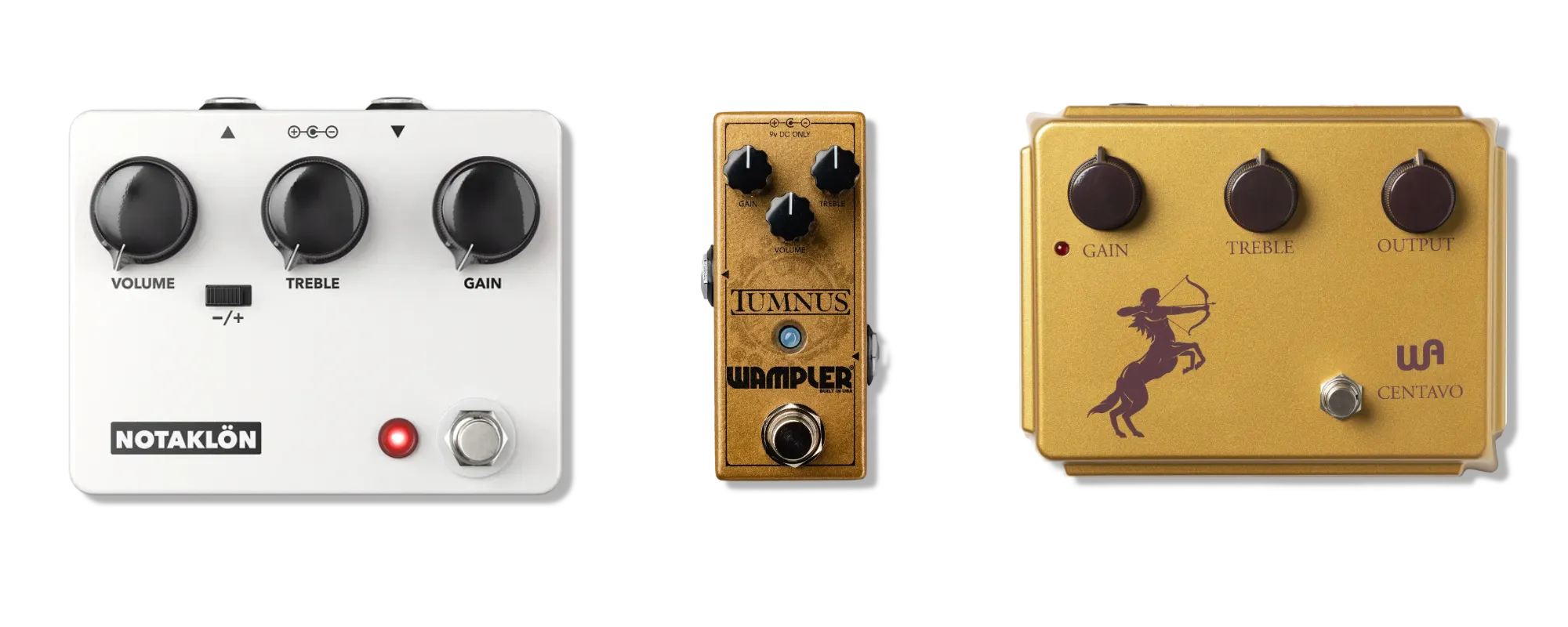
The entire pedal industry is a tone-copying machine, and has been for thirty years. You want the Klon sound? The real ones go for four to ten grand, so you buy a clone, and there are dozens. The Wampler Tumnus, the Warm Audio Centavo, a cheap Behringer that nails it.
JHS sells one and calls it the Notaklön, which is about as honest as the joke gets. You want a vintage Vox AC30? Buy the Kemper profile of one for about 30 bucks. Tone has been a product on a shelf for years. We just had to point at it ourselves.
And every time the tech made it easier, the same people screamed that it was cheating. Modelling amps were fake. Profilers were soulless. Jim Root said going digital felt “sacrilegious.” Chris Shiflett called it “blasphemy.” Then in 2025, the five best-selling amps on Reverb were all digital, and not one tube amp cracked the top ten.
The purists lost. They always lose.
So go on, tell me the AI guitar pedal is any different. It’s just the next honest step. It’s the clone economy finally admitting what it always was.
Except one thing…
A clone hands you a circuit. You still plug it in, set the gain, point it at a song, and play. A Kemper profile is an amp you still aim. Every one of those tools left the last decision to you: what to do with the thing. The AI guitar pedal takes that decision too.
It picks the target. It picks the settings. It hands you the finished destination and asks nothing of you on the way there.
The problem was never the copying. It’s who points the thing.
The searching was the sound
Because here’s what the match button quietly deletes. The search itself. This was the part that was actually yours.
Your tone, the real one, was never a setting. It was a thousand small accidents. The amp you couldn’t afford, so you ran a cheaper one too hot. The delay you set wrong and kept because wrong sounded better. The pedal order you stumbled into at 1 am and never touched again. None of that is retrievable from a 100,000-song library, because it never lived in any song. It lived in the looking.
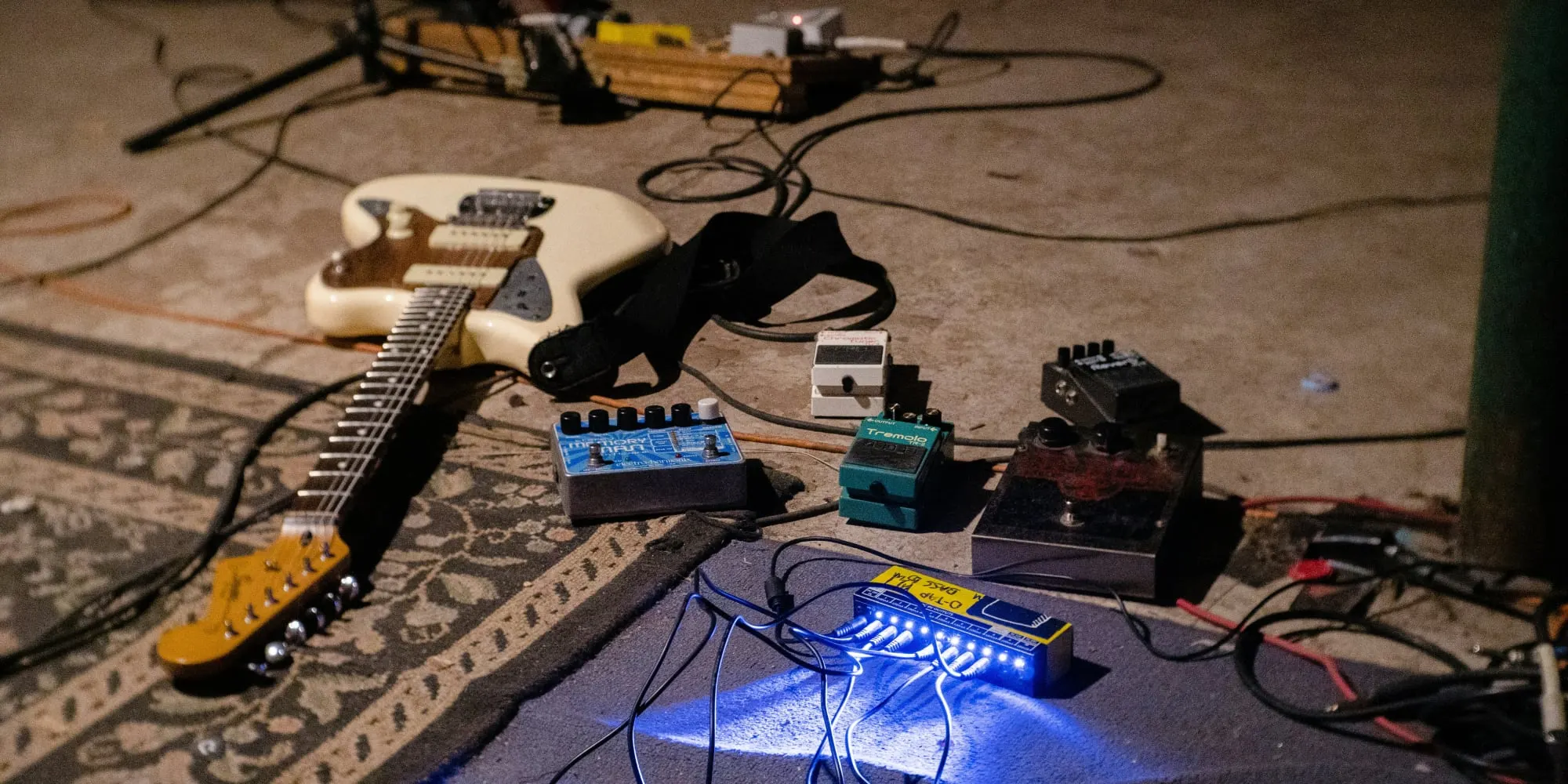
Photo by Bernie Almanzar on Unsplash
People will tell you the real danger is that everyone ends up sounding the same. Match the same canon and the catalogue collapses inward, every bedroom a copy of the same five records.
Maybe…
But that fear is ancient, and it keeps being wrong. Gojira, Periphery, and Loathe run more or less the same digital tools and sound nothing like each other, because the tone was never the thing that made them them.
The hands were. The songs were.
That goes both ways, and that’s the whole point. It’s why the homogenisation panic is overblown. It’s also exactly why an AI guitar pedal can’t hand you a sound. It can hand you the settings. It cannot hand you the reason you’d ever choose them.
So use it as a map. A fast road to the ballpark, a teaching tool, a Tuesday-night shortcut when you just want to play “Comfortably Numb” before bed. It’s brilliant for that. Just don’t mistake the map for the territory. The second you stop at the match, you’ve outsourced the only part of tone that was ever going to be yours.
A search result isn’t a signature
So yes, in 2026, you can have nearly any guitar tone ever recorded sitting at your feet in three seconds. That’s real, and it’s kind of wonderful, and I’ll probably buy one one day, because I’m exactly as susceptible to this as you are.
But you still won’t have a sound. You’ll have a search result.
And a search result belongs to whoever indexed it, not to whoever typed the query. That’s the trade the AI guitar pedal never prints on the box. It doesn’t make you an author. It makes you a listener with a guitar in your hands, scrolling a catalogue that plays beautifully and means nothing, waiting for you to do the one thing it can’t do for you.
Go point it somewhere it’s never been.