Your amp sounded huge in the bedroom. Tight low end, singing mids, treble that shimmered off the ceiling. Then you loaded into the gig, plugged the same rig into the same guitar, and the whole thing turned to mush. The bass ballooned, the mids vanished, and your solo drowned under the drummer’s cymbals. You stood there twisting the amp’s bass and mid knobs and got nowhere, because those three knobs were never built for that job.
That gap is where an EQ pedal earns its place on the board. The EQ pedal fixes the room, not the amp.
An EQ pedal is not about buying a new amp or a new guitar. It is about taking the rig you already own and giving it the frequency control your amp’s tone stack cannot reach. Cut the mud. Tame the ice-pick. Push a solo through the band without turning into a wall of volume. That is the whole pitch, and once you use one properly it is hard to give back.
Key Takeaways
- An EQ pedal gives you precise frequency control that lives well beyond your amp’s basic tone knobs. Surgical, not broad.
- Use it to fix muddy or harsh tones, boost solos so they cut through the mix, and adapt your sound to rooms that fight you.
- You probably want one if your amp sounds great at home but terrible live, you run multiple guitars through one amp, or you keep fighting a specific frequency.
- The starter move that works every time: a subtle mid boost around 1 to 2.5kHz to make a solo stand out. Not louder, just present.
What Is an EQ Pedal?
An EQ pedal (short for equalisation pedal) is a guitar effect that lets you boost or cut specific frequency ranges in your signal. Think of it as a far more precise version of the treble, middle, and bass knobs on your amp.
Your amp’s tone controls give you broad strokes. An EQ pedal gives you a scalpel. You can hunt down the exact frequency causing a problem and pull it out, or lift the exact range that makes your guitar sing, without touching anything either side of it.
Here is the difference that matters. Your amp’s EQ usually shapes three broad ranges at fixed points. Most EQ pedals give you 3 to 10 specific bands. That means you can add punch to your solos without muddying up your rhythm playing, which the amp knobs simply cannot do.
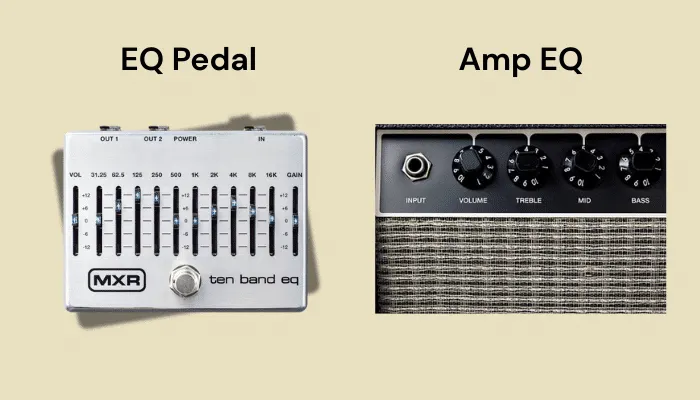
An EQ pedal gives guitarists precise control over frequency ranges, unlike an amp’s EQ, which adjusts broader tonal settings.
How Do EQ Pedals Work?
It comes down to frequency. Your guitar puts out a complex stack of them every time you play, from the deep fundamental of your low E to the bright harmonics that give your tone its character. An EQ pedal sits in that signal and lets you push some of those frequencies up, pull others down, or leave them dead centre and untouched.
On most units the range is wide. You can boost a band by up to +15dB, cut one by up to -15dB, or leave it flat at the centre detent. That is a lot of control for a small box.
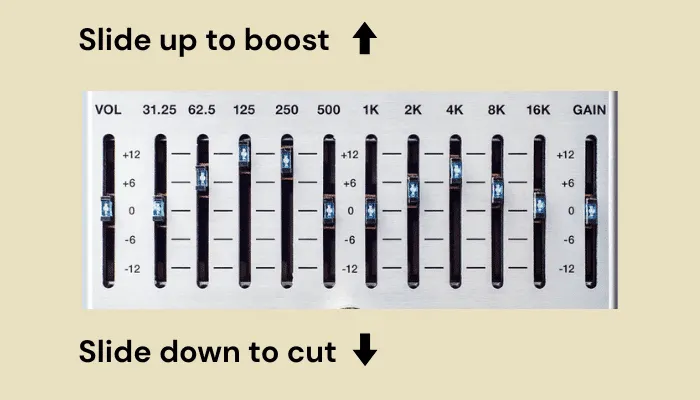
By sliding the EQ pedal controls up or down, guitarists can boost or cut specific frequencies to shape their tone with precision.
The Two Main Types of EQ Pedals
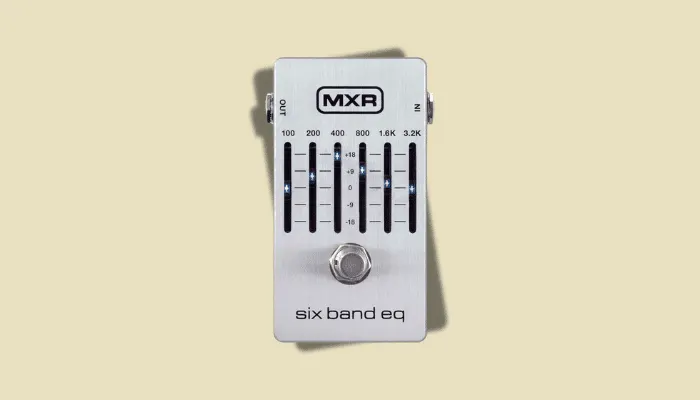
A graphic EQ pedal gives you a row of sliders, each fixed to one frequency band. A six-band unit might sit at 100Hz, 200Hz, 400Hz, 800Hz, 1.6kHz, and 3.2kHz. The MXR M109S Six Band EQ is the classic, running roughly 100Hz to 3.2kHz with true bypass and no volume slider to get in your way. The layout is the whole point: one glance shows you your entire tone curve. Push the 800Hz slider and you can literally see the midrange punch you just added.
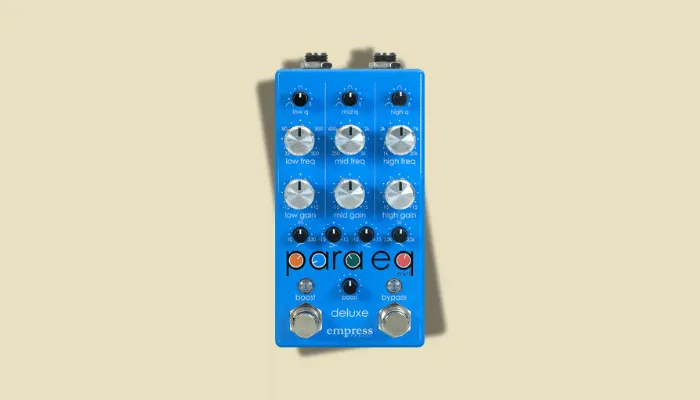
A parametric EQ pedal goes deeper. Instead of fixed bands, you pick the exact centre frequency, then set how wide or narrow that band reaches (the Q), then boost or cut. If your amp feeds back at a resonant 2.3kHz, a parametric can reach in and kill that one frequency without touching its neighbours.
That precision is real, and for most working players it is also more than you will ever use. I run a graphic EQ pedal and never once wished it were parametric. Start with sliders. If you genuinely hit a wall a graphic cannot solve, the parametric world will still be there.
What Does an EQ Pedal Do? The Practical Applications
Here is where the EQ pedal stops being theory and starts saving gigs. Whether you are chasing a genre sound, fixing a tonal problem, or lifting a solo, this is how you put one to work.
Tone Shaping for Different Musical Styles
For vintage rock, boost around 800Hz to 1kHz for midrange growl and shave a little off 2 to 3kHz to keep it from turning shrill. That is roughly how the classic-rock guys got sustain without an ice-pick on top.
Metal players usually want the scooped sound: cut the mids around 400 to 800Hz, lift the bass at 100 to 200Hz and the treble at 3 to 5kHz. Do not scoop too hard, though, or your guitar vanishes in the mix the second the band kicks in live.
For clean jazz and blues, keep it subtle. A gentle lift around 1 to 2kHz adds presence, and trimming anything muddy below 100Hz keeps the tone clear and defined.
Problem-Solving Applications
Muddy, cloudy amp? Reach for the EQ pedal and cut between 80 and 200Hz to tighten the low end. Most players are surprised how much clarity that one move buys.
Harsh, ice-pick treble? The EQ pedal handles it. Cut around 3 to 5kHz. Start small. Even 2 to 3dB can turn a brittle tone into something you actually want to hear.
And the big one, the solo boost. An EQ pedal used as a boost works nothing like an overdrive pedal or a compressor run as a boost. It adds no distortion and no raw volume. Here is the move I actually use: a subtle mid boost somewhere around 1000 to 2500Hz. You do not always need more volume. You need to cut through, and a small mid bump makes your solo stand out over the band without changing your core tone. That is the single most useful thing an EQ pedal does on my board.
Acoustic Guitar Applications
Acoustic is a different animal. Under-saddle piezo pickups strip out the natural body and resonance of the guitar and leave you with a thin, quacky honk. An EQ pedal helps, but for acoustic the easiest fix is a purpose-built box. The TC Electronic BodyRez (around $59 to $84) is an acoustic pickup enhancer that uses tuned filters and light compression to put the body back, with feedback suppression and true bypass built in. Cheap, single-purpose, done.
If you gig acoustic and need a DI as well, the LR Baggs Session DI steps up to a full preamp with EQ, saturation, and a notch filter for feedback. Either way, the moves are the same on a plain EQ pedal: cut 2 to 3kHz to kill piezo harshness, lift 100 to 200Hz to restore body, and add a little around 5 to 8kHz for sparkle.
Do I Need an EQ Pedal? When EQ Pedals Make the Biggest Difference
The honest answer is that not every guitarist needs an EQ pedal. But if any of the problems below sound familiar, an EQ pedal is probably the thing you have been missing.
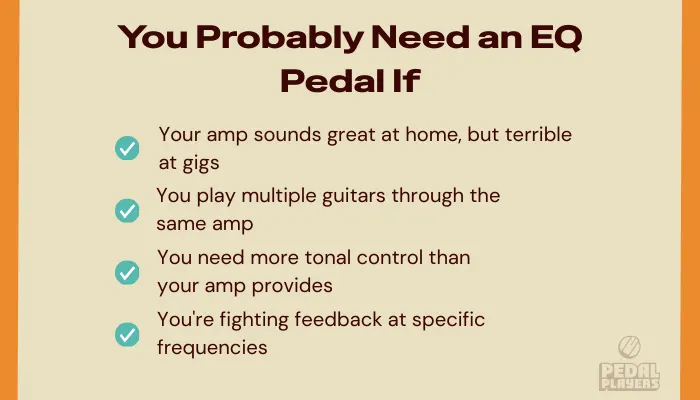
An EQ pedal is especially useful if your amp sounds inconsistent at gigs, you play multiple guitars, or you need precise tonal control.
Your amp sounds great at home but terrible at gigs. Different rooms push different frequencies, and an EQ pedal lets you adapt to any stage in seconds. I have watched guitarists rescue a dead live sound just by cutting the one frequency the room was fighting.
You play multiple guitars through the same amp. A Telecaster and a Les Paul are two different instruments through one amplifier. An EQ pedal lets you compensate for both without touching your amp settings between songs.
You need more control than the amp gives you. Plenty of great amps have thin tone stacks. A vintage Fender might only offer treble and bass. An EQ pedal hands you the midrange those amps never had.
You keep fighting feedback at specific frequencies. When a rig squeals at one particular pitch, an EQ pedal can surgically pull that frequency out and leave the rest of your tone intact.
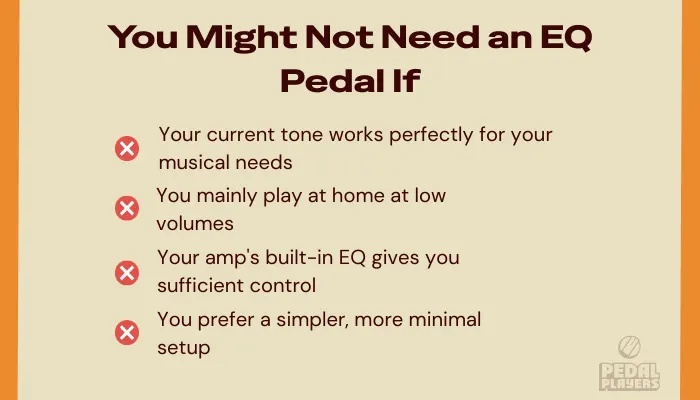
If your amp’s EQ already meets your needs or you prefer a simple setup, an EQ pedal may not be necessary.
You can skip an EQ pedal if your current tone already works for the music you play, you mostly play quietly at home, your amp’s built-in EQ gives you enough control, or you just want the smallest, simplest board you can get away with. No shame in that.
Where to Put an EQ Pedal in the Chain
Where the EQ pedal sits changes what it does, because placement decides how it interacts with your other pedals and your amp. If you want the full picture on order and layout, that lives in the guitar pedalboard setup guide. For the EQ pedal specifically, there are three spots that matter.
Before Distortion/Overdrive Pedals
Put the EQ pedal early and you shape what frequencies actually hit your dirt. Cutting bass before it reaches the overdrive tightens the whole thing up, changes how the distortion responds and compresses, and keeps feedback-prone frequencies from getting amplified into a problem.
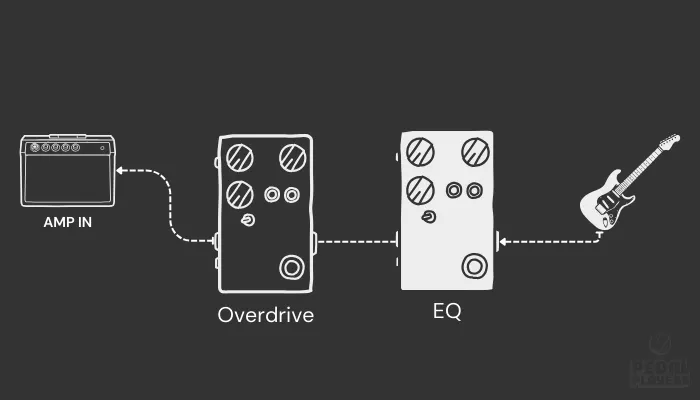
Placing your EQ pedal before distortion helps control frequencies, tighten your tone, and reduce muddiness or feedback.
After Distortion/Overdrive Pedals
Put the EQ pedal after your dirt and you are sculpting the finished, distorted tone instead of what feeds it. This is the more traditional tone-shaping spot, it is easier to hear exactly what you are changing, and it is the natural home for general adjustments.
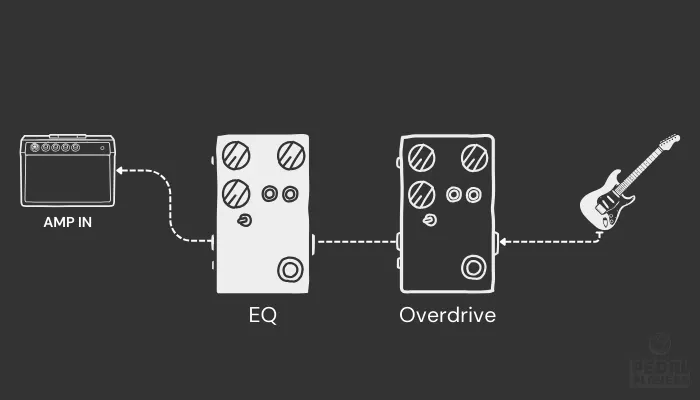
Placing an EQ pedal after distortion shapes your final tone, making adjustments clearer and more precise.
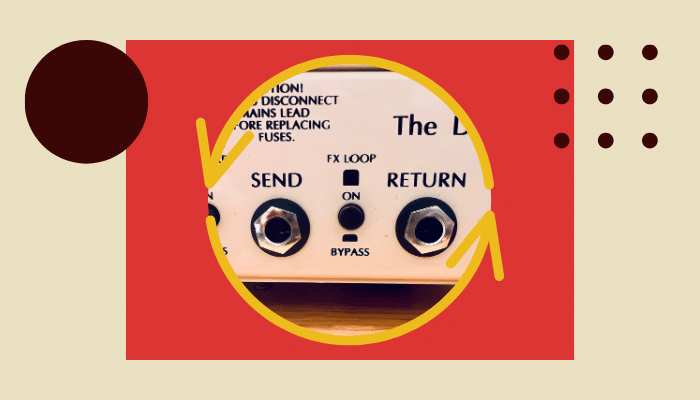
In Your Amp’s Effects Loop
If your amp has an effects loop, dropping the EQ pedal in there gives you control over the power amp and speaker response rather than the front end. It is the place to correct room acoustics, run the EQ pedal as a clean level and headroom tool, and fine-tune your overall sound without disturbing the rest of your pedal chain.
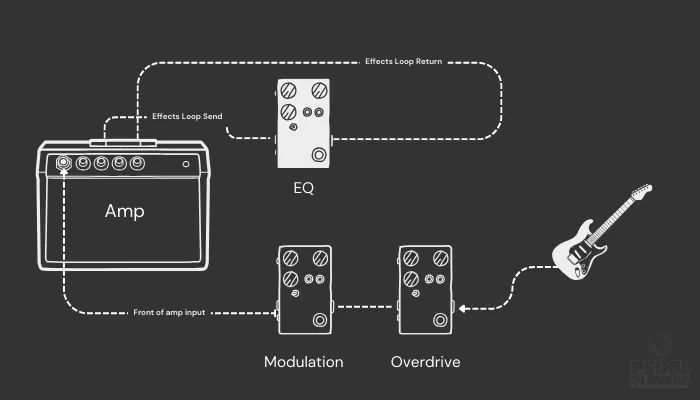
Using an EQ pedal in your amp’s effects loop allows precise tone shaping, room correction, and fine-tuning of your overall sound.
EQ Pedal vs Amp EQ: Understanding the Difference
Guitarists always ask why they need an EQ pedal when the amp already has tone controls. It is a fair question, and it is the same one behind the wider pedals versus amp effects debate. Here is the practical answer.
Your amp’s EQ gives you 3 or 4 broad ranges, fixed centre frequencies, and a limited cut and boost. An EQ pedal gives you 3 to 10 or more specific bands, tighter frequency selection, and a much wider range, often plus or minus 15dB.
Your amp’s EQ is a paint roller. An EQ pedal is a fine brush. One covers the wall. The other does the detail work the roller was never going to reach.
Which EQ Pedal Should You Buy?
The taxonomy stuff (three-band, six-band, specialised) matters less than which box actually goes on your board. Here is the shortlist that covers almost everyone, with rough 2026 street prices. Match the pedal to the job, not the spec sheet.
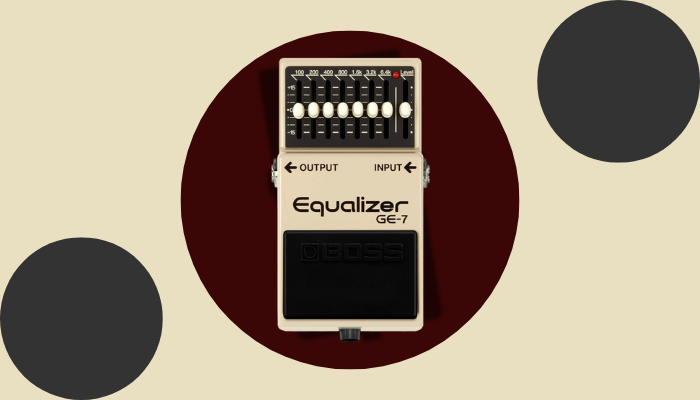
Boss GE-7 (around $105 to $132). Seven-band graphic, the default guitar EQ pedal for good reason. It is the one I run, unmodded, mostly as a subtle solo boost and a tone sweetener. People love to call it a noisy EQ pedal, and older units earned that. A newer one used sensibly stays quiet. You only get fizz when you shove the sliders way up, which is not how you should be using it anyway.
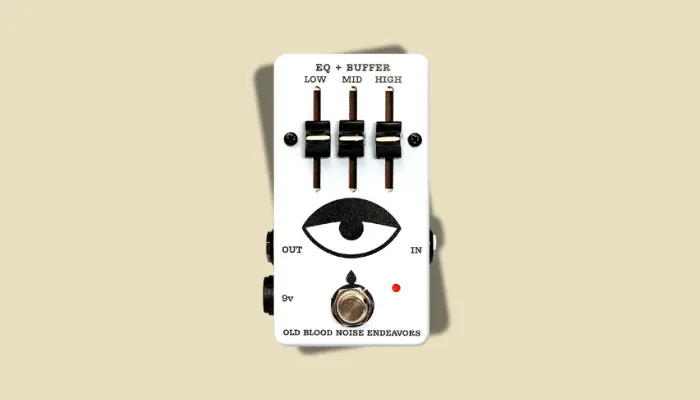
A simple three-band EQ pedal offers bass, mid, and treble control, ideal for basic tone shaping without extra complexity.
MXR M109S Six Band EQ (around $89). Simpler than the GE-7, true bypass, plus or minus 18dB across 100Hz to 3.2kHz. A clean, grab-and-go graphic EQ pedal.
MXR M108S Ten Band EQ (around $129 to $160). The step up. Ten bands, dedicated noise-reduction circuitry, a second output, and runs on 18V for extra headroom. This is the graphic EQ pedal for players who want more resolution.
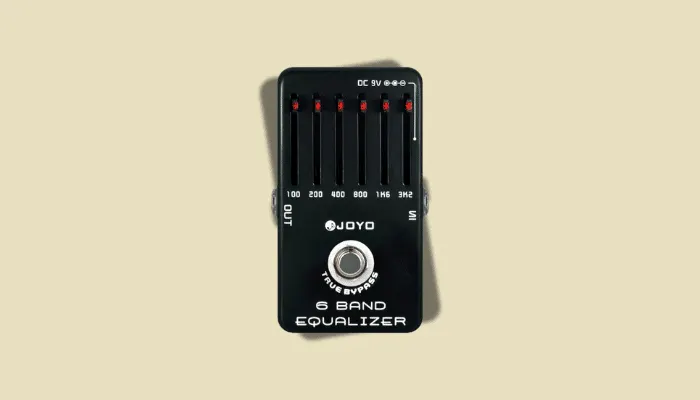
Higher-band EQ pedals give you more slider resolution for problem-solving, live use, and studio work.
Behringer EQ700 (around $20 to $32). A plastic GE-7 clone with the same seven bands. If you just want to try an EQ pedal for the price of a couple of pints, start here.
Empress ParaEq MkII Deluxe (around $349). The boutique parametric pick, sweepable bands plus a boost. Superb, and honestly more than most players need. Buy it if you already know you want parametric control.
Source Audio EQ2 (from around $287). The programmable, preset-based, MIDI-capable digital option. This is the EQ pedal that does everything, if everything is what you are after.
Boss EQ-200 is worth a look too, a modern dual-channel ten-band with presets, for the player who wants the GE-7 idea with a lot more under the hood.
Practical EQ Pedal Settings to Try
General Starting Points
For single-coils (Strat, Tele), try a slight boost around 100 to 200Hz for body, a small lift around 1 to 2kHz for presence, and a cut around 3 to 4kHz only if it gets harsh.
For humbuckers (Les Paul, SG), a treble lift around 3 to 5kHz can open things up, and a small cut around 500Hz helps if the tone is too thick. Adjust to your actual pickups.
For live performance, set the EQ pedal to cut below 80Hz to lose stage rumble, nudge the mids up around 1 to 2.5kHz to cut through, and go easy on treble boost because a PA will turn it harsh fast.
How to Find the Problem Frequency
When something sounds wrong but you cannot name it, use the boost, sweep and cut method. Set a narrow band and boost it hard, around 6 to 8dB. Sweep that boosted band slowly across the spectrum while you play. The problem frequency jumps out and sounds noticeably uglier than everything around it. When you find it, flip that same band from boost to a cut, start around -6dB, and dial to taste.
On a fixed graphic EQ pedal like the GE-7 you approximate the same thing. Shove one slider up, listen for the ugliest band, then pull that slider down into a cut. Same idea, fewer moving parts.
Quick Problem-Solving Settings
- Too muddy: cut 100 to 300Hz.
- Too harsh: cut 3 to 5kHz.
- Not enough punch: boost 800Hz to 1.6kHz.
- Getting lost in the mix: boost the 1 to 3kHz range.
- Too boomy: cut 80 to 150Hz.
Start with small moves, 2 to 3dB, and use your ears, not your eyes.
Is an EQ Pedal Worth It? The Bottom Line
If your rig already nails every room and every guitar, you do not need an EQ pedal. Be honest about that. But if you keep fighting mud, harshness, feedback, or a solo that will not cut, an EQ pedal is the most precise, cheapest fix you can bolt onto the gear you already own.
So here is the one thing to actually do with it. Forget the twenty-band spectrum-analyser fantasy. Use it like I do: a subtle mid boost around 1 to 2.5kHz, kicked in for solos, to make your sound cut through the band. Nothing crazy, no volume jump, just presence. It makes a bigger difference than it has any right to.
Set that one EQ pedal move up first. Everything else an EQ pedal can do, you will discover on your own once you trust your ears over the sliders.