

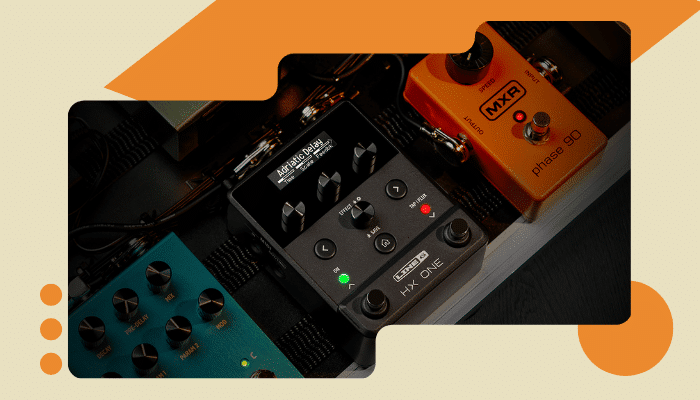
You need a rotary sound for one song, a specific fuzz for another, and maybe an octaver for that weird bridge section your bandmate wrote last week. Buying three boutique pedals for sounds you’ll use occasionally doesn’t make sense. But if you’ve been burned by cheap multi-effects pedals before, you already know that “all-in-one” hasn’t always meant “all-done-well.”
That’s changing. Fast.
The multi-effects landscape in 2026 looks nothing like it did even five years ago. Digital modeling technology has reached a point where the gap between analog and digital is smaller than most guitarists think. And one pedal in particular is proving that multi-effects deserve a place on even the most committed analog pedalboard.
I’ll be honest: I was as sceptical as anyone. I’ve spent years building pedalboards around individual stompboxes, convinced that the character and feel of dedicated analog pedals couldn’t be matched by a digital unit. But after spending time with the Line 6 HX One and watching how guitarists around me are rethinking their setups, I’ve had to reconsider some assumptions I held pretty firmly.
This isn’t just another product review. In this article, I’m going to trace the rise of multi-effects from clunky rack units to compact board-friendly pedals, take an honest look at what the HX One actually delivers (and where it falls short), and explore why the smartest pedalboards in 2026 are blending analog and digital in ways that would have been unthinkable a decade ago.
Whether you’re a committed analog player who’s curious about digital, a gigging musician tired of hauling 15 pedals to every show, or someone trying to figure out whether the HX One is worth the $299, you’re in the right place.
TL;DR
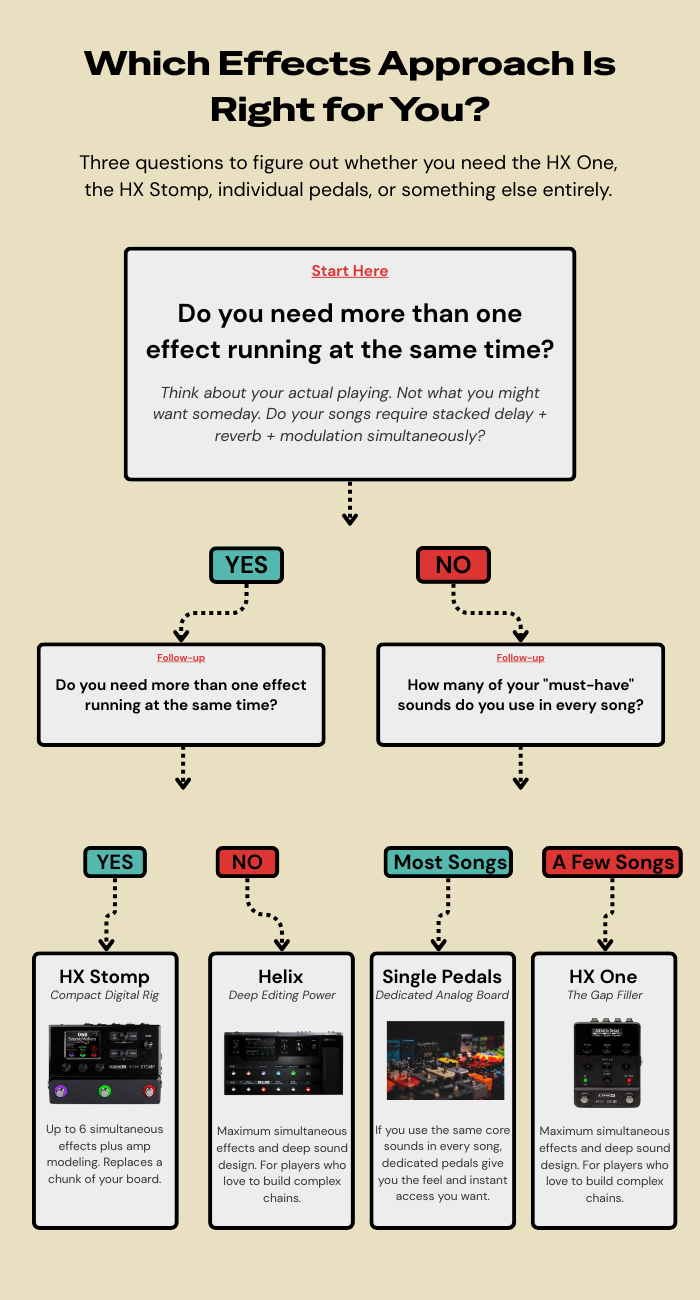
- If you need simultaneous effects or amp modeling, look at the HX Stomp instead.
- The Line 6 HX One runs 250+ Helix-quality effects, one at a time, for $299.
- It’s designed to fill gaps on analog boards, not replace them.
- The exclusive Flux feature and four-cable method support set it apart from simpler multi-effects.
- For occasional sounds you don’t need a dedicated pedal for, the economics are hard to argue with.
The Pedal That Proved One Effect Was Enough
To understand why the HX One matters, you need to understand the problem it was built to solve. And that means going back to a pedal that quietly became one of the most important multi-effects units ever made.
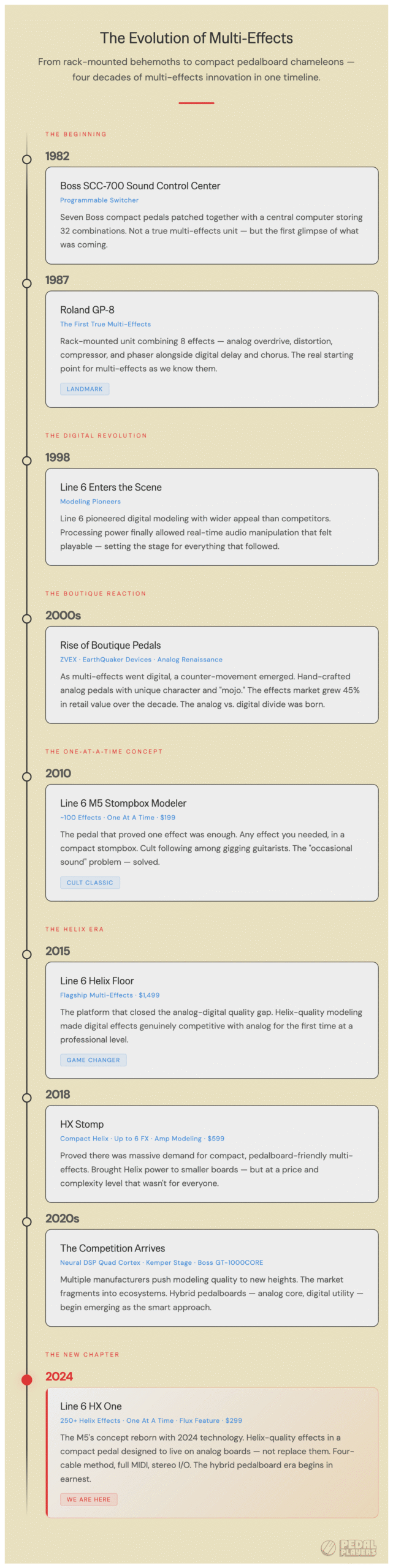
Why Gigging Guitarists Loved the M5
The Line 6 M5 Stompbox Modeler launched in the early 2010s with a concept so simple it was almost radical: one pedal that could be any effect. One at a time.
Need a rotary speaker for your Pink Floyd cover? The M5 had it. A fuzz for one song in your set? Covered. An octave pedal for that bridge section you play twice a month? Done. You scrolled to the effect, stomped it on, and it behaved like a regular pedal on your board.
That simplicity solved what every working musician knows as the “occasional sound” problem. You have two or three songs that need a specific effect you don’t own. A Leslie simulation, a ring modulator, a particular tape delay. Each of those might cost $150–$250+ in a dedicated pedal, plus the board space and power to run it.
For sounds you use on one or two songs a night, that maths never made sense.
The M5 gave you around 100 effects in a compact footprint. It didn’t try to replace your whole board. It didn’t do amp modeling. It didn’t run multiple effects simultaneously. It just gave you access to whatever single sound you needed for that moment, and then got out of the way.
Musicians built cult-like loyalty around it. Many still have their M5s on their boards today, over a decade later.
What Happened When It Disappeared
Then Line 6 quietly discontinued it. No announcement, no replacement. Stock dried up, and Sweetwater listed it as “no longer available.”
Line 6’s ecosystem had evolved dramatically, the Helix Floor, the HX Stomp, the HX Effects. But all were more expensive and more complex than what M5 users actually needed. If all you wanted was one great effect at a time without menu diving or preset architecture, your only option was to hold onto your aging M5 and hope it kept working.
That gap sat open for years.
The M5 wasn’t perfect, though. Some of its effects had that slightly thin, processed quality that gave early multi-effects their reputation. The interface worked, but it wasn’t elegant. It was a product of its time.
What the M5 got right wasn’t the execution. It was the concept.
One effect at a time. No complexity. No amp modeling you didn’t ask for. Just a library of sounds available when you need them, invisible when you don’t. That idea was ahead of its time. And when the M5 disappeared, it left behind a proof of concept that nobody followed up on.
Until now.
What the HX One Actually Brings to Your Board
The Line 6 HX One is the same idea as the M5. One effect at a time, in a compact pedal, designed to live on your existing board. But the technology underneath is a completely different story.
The HX One runs on the same Helix engine that powers Line 6’s flagship processors. That means 250+ effects drawn from the same DSP platform used by touring professionals and studio engineers. Same algorithms. Same sound quality. Just one effect at a time, in a box that costs $299.
Here’s what that actually means in practice.
250+ Effects, One at a Time (and That’s the Point)
If you’re coming from the M5, the jump is significant. Around 100 effects to over 250, with noticeably better sound quality across the board. Delay that sit in the mix properly. Modulation effects with depth and movement that the M5 couldn’t quite achieve. Reverb that doesn’t sound like they’re happening inside a cardboard box.
But the philosophy hasn’t changed. You pick one effect, you use it, you move on. No building signal chains, no scrolling through preset banks, no nested menus.
For some guitarists, the one-at-a-time limitation sounds restrictive. In practice, it’s the opposite. It’s what makes the HX One so fast to use on a gig. There’s no complexity standing between you and the sound you need. Scroll, select, play. It behaves like a regular stompbox on your board, which is exactly what most analog-leaning players want from a digital pedal.
The Features That Actually Matter
Specs lists are easy to find. What’s harder to find is someone telling you which features actually change how you use the thing. So here’s what stands out after real use.
The Flux Feature is the headline that deserves the attention. It’s exclusive to the HX One, and you won’t find it on the Helix Floor, the HX Stomp, or any other Line 6 product. Flux generates dynamic effects that react to your playing in real time, adding an extra layer of expression that makes certain sounds feel more alive than their standard Helix counterparts. If you value feel as much as sound, this is worth exploring.
Four-cable method support is the feature that experienced players will appreciate most. It means you can route drive and compression effects to the front of your amp while sending delays and reverbs through the effects loop. All from one pedal. You can even program whether each preset runs in the “Pre” or “Post” position. For players integrating the HX One into a traditional amp setup, this is a genuine game-changer that most compact digital pedals simply can’t do.
Full-size MIDI jacks. 5-pin DIN in, out, and thru. These are rare in a pedal this size. If you’re running a MIDI-controlled board, the HX One slots in without adapters or workarounds. It’s a small detail that signals Line 6 designed this for working musicians, not bedroom players.
Stereo I/O opens the door beyond guitar. Keyboard players, synth players, and anyone running a stereo rig will find this useful.
Top-mounted jacks save more pedalboard space than you’d expect. Side-mounted jacks on a compact pedal can eat into the footprint of neighbouring pedals. Top-mounting is a design choice that says “this pedal was built to live alongside other pedals,” not to sit alone on a desk. Top-mounted jacks also make pedalboard cable management easier, especially on cramped boards where every centimetre counts.
HX One vs M5 vs HX Stomp: The Comparison That Matters
If you’re trying to figure out where the HX One sits in the Line 6 ecosystem, this is the breakdown that matters:
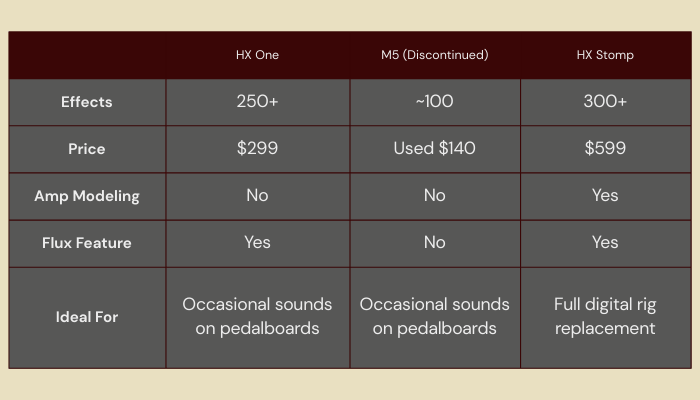
| Feature | HX One ($299) | M5 (Discontinued) | HX Stomp ($599) |
|---|---|---|---|
| Effects | 250+ | ~100 | 300+ |
| Simultaneous Effects | 1 | 1 | Up to 6 |
| Amp Modeling | No | No | Yes |
| Flux Feature | Yes | No | No |
| Four-Cable Method | Yes | No | Yes |
| MIDI | Full 5-pin DIN | Basic | Full 5-pin DIN |
| USB | USB-C | USB Mini | USB-C |
| Best For | Occasional sounds on analog boards | Was the only option | Full digital rig replacement |
The HX Stomp is more powerful on paper. More effects, simultaneous stacking, amp modeling. But it’s also twice the price and significantly more complex. If you want a digital Swiss army knife that replaces a chunk of your board, the HX Stomp is the better choice. If you want one great effect at a time to fill the gaps on an analog board you already love, the HX One is the more focused tool for that job.
The HX One won’t replace your entire pedalboard. It’s not trying to.
That’s exactly why it works.
Why Guitarists Are Reconsidering Multi-Effects in 2026
The HX One is a compelling product. But it’s also a symptom of something bigger. A shift in how players think about digital effects, pedalboard economics, and the old analog-versus-digital divide.
The Modeling Quality Revolution
Let’s address the elephant in the room. Multi-effects used to sound digital. Not “digital” as a neutral descriptor, but digital as an insult. Thin. Sterile. Like someone had photocopied your tone and handed you the copy.
That was a fair criticism. Ten years ago, it was largely true.
It isn’t anymore.
The Helix platform changed things significantly. So did the Kemper Profiler, the Neural DSP Quad Cortex, and Boss’s AIRD technology. The processing power available in modern multi-effects units has reached a point where the gap between analog and digital is genuinely difficult to hear, especially in a live context.
Here’s the anti-guru take on this: if you can reliably tell the difference between a Helix delay and an analog delay in a full band mix with a drummer hitting a snare four feet from your head, you have better ears than most professional sound engineers I’ve spoken to. In a studio with monitors and time to A/B test? Maybe. On stage at a gig? The difference is academic for the vast majority of players.
That doesn’t mean analog pedals are irrelevant. Far from it. It means the quality argument against digital effects no longer holds the way it once did. And that changes the calculus for every guitarist building a board in 2026.
The Economics of Pedalboard Real Estate
Price out the boutique version of every effect category the HX One covers.
A quality boutique overdrive (small-batch, hand-built pedals rather than mass-produced models) often runs $200–$400. And sometimes far more. A good delay, roughly the same. A solid reverb, $250 and up. A dedicated phaser, a tremolo, a rotary simulator, a ring modulator. Each one is another $150–$300, another patch cable, another spot on your power supply, another few inches of board space you don’t have.
The guitar effects market grew 45% in retail value in the decade leading up to 2016, driven largely by boutique makers. That growth brought incredible innovation, but it also brought incredible prices. A $400 boutique overdrive is normal now. And if you want to see what’s actually driving those prices (parts, labour, scale, marketing, and margins), here’s my breakdown of why guitar pedals are so expensive.
The HX One gives you 250+ effects for $299.
You don’t need a calculator to see why that appeals to working musicians. It’s not about whether analog pedals sound better. It’s about whether the marginal improvement justifies the cost and space, especially for sounds you use occasionally rather than constantly.
For your core tone, your always-on overdrive, your favourite fuzz, dedicated analog pedals still make a strong case. For the rotary you need on two songs, the synth sound for one bridge, and the specific delay for your set closer? The economics point firmly toward a multi-effects solution.
The Rise of the Hybrid Pedalboard
This is the trend that matters most, and it’s the one that makes the old analog-versus-digital debate feel increasingly outdated.
The question isn’t analog or digital anymore. It’s analog and digital, and which sounds go where.
The hybrid pedalboard approach is straightforward: analog pedals for your core tone, digital multi-effects for utility, versatility, and occasional sounds that don’t justify a dedicated pedal.
Build a hybrid board the simple way
If you’re blending analog pedals with a digital utility pedal, start here: pedalboard setup guide.
Overdrive, fuzz, compressor. Keep those analog if you love how they feel under your fingers. Delays, modulation, pitch effects, the weird stuff you pull out twice a set, that’s where a unit like the HX One earns its place.
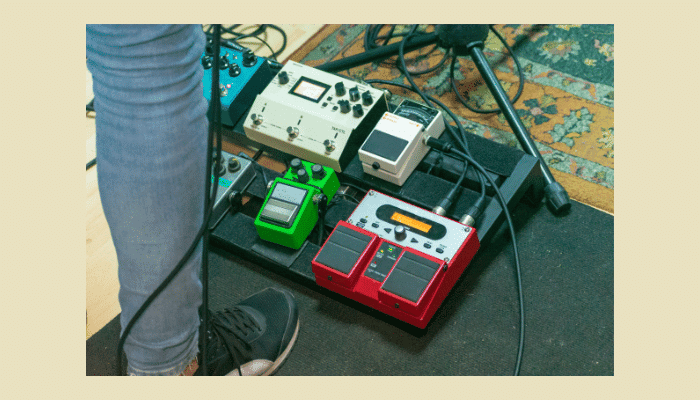
The HX One was designed for exactly this. It fits on analog boards. It doesn’t try to replace them. Top-mounted jacks, compact footprint, one-at-a-time simplicity. Every design choice points toward integration, not domination.
The false binary between analog and digital is collapsing. The smartest boards I’m seeing in 2026 aren’t purely one or the other. They’re both, and the players using them aren’t compromising. They’re getting the best of each approach and spending less money doing it.
Is the HX One Right for Your Rig?
Trends are interesting. But you’re not building a trend. You’re building a pedalboard. So let’s get specific about whether the HX One actually belongs on yours.
What We Liked
- 250+ Helix-quality effects at half the price of the HX Stomp
- One-at-a-time simplicity keeps it fast to use on gigs
- Four-cable method support for front-of-amp and effects loop routing
- Top-mounted jacks and compact footprint designed for real pedalboards
- Flux feature adds expression not available on other Helix products
What We Didn’t
- One effect at a time. No simultaneous stacking
- No amp modeling (by design, but worth noting)
- Limited deep-tweaking compared to full Helix ecosystem
- Won’t satisfy players who want to build complex digital signal chains
Where the HX One Makes the Most Sense
The occasional sound player. You have a solid analog board that covers 90% of your set. But there’s a rotary you need for one song, a synth lead for another, maybe a reverse delay for the intro your singer insists on. You’re not buying three dedicated pedals for three moments in a two-hour gig. The HX One was designed for exactly this situation. 250+ sounds on standby, taking up one pedal’s worth of space.
The gigging minimalist. You play covers in two bands and originals in a third. Every gig needs something slightly different, and your board can’t expand indefinitely. The HX One fills the gaps your core pedals don’t cover, without adding weight, cables, or complexity to a rig you’re already hauling in and out of venues every weekend.
The budget-conscious tone chaser. You want Helix-quality effects, but the $599 HX Stomp is hard to justify, especially when you don’t need amp modeling or simultaneous effects. The HX One gives you the same effect algorithms at half the price. For players who just need great sounds one at a time, the maths works out cleanly.
The curious analog player. You’ve been all-analog for years, and it’s worked fine. But you’re starting to wonder whether modern digital effects have caught up to what you’re hearing from other guitarists. The HX One is a low-risk way to test that question. $299 and a single spot on your board, without rebuilding anything.
Who Should Look Elsewhere
This section matters. Pedal Players doesn’t recommend gear that isn’t right for you, and the HX One isn’t right for everyone.
The effects chain builder. If you need delay, reverb, and modulation running simultaneously, stacked and interacting, the HX One’s one-at-a-time design won’t work. The HX Stomp or Boss GT-1000CORE are better tools for building complex chains in a compact format.
The deep tweaker. If half the fun for you is building custom patches from scratch, diving into parameters, and designing sounds nobody else has, the HX One will feel limiting. It’s intentionally simple. The full Helix ecosystem is where that kind of creativity lives.
The committed analog purist. If “digital” is a dealbreaker regardless of how good the effects sound, that’s a valid preference. And I mean that. Just make sure you’ve actually A/B tested modern digital effects before you decide. The gap isn’t what it was five years ago, and you might be surprised.
The Multi-Effects Landscape: What’s Coming Next
The HX One isn’t arriving in a vacuum. It’s part of a broader momentum in the guitar effects world, and where things go from here is worth paying attention to, whether you buy one or not.
The “one-at-a-time” category is about to get crowded. The HX One has this niche almost entirely to itself right now. That won’t last. If it sells well, and it is, expect Eventide, Strymon, or Boss to release their own compact single-effect multi-effects units. The format solves a too-real problem for too many guitarists to remain a one-brand market.
Hybrid boards will stop being a trend and start being the default. The analog-versus-digital debate is already losing steam. Within a few years, the idea of a purely analog or purely digital pedalboard will feel like an intentional statement rather than the standard approach. Products like the HX One are making integration so seamless that the distinction starts to disappear.
AI-driven effects are closer than most guitarists realise. Context-aware pedals that adapt to your playing style, suggest effect settings based on what you’re doing, or respond dynamically to your touch. This isn’t science fiction. The processing power is already there. The question is which manufacturer builds the interface that makes it feel musical rather than gimmicky.
Boutique builders will enter the multi-effects space. Smaller companies are already experimenting with character-driven digital effects that combine the craftsmanship ethos of boutique pedals with multi-effects flexibility. Expect niche, opinionated, and probably expensive alternatives aimed at players who want digital versatility with analog personality.
These are educated guesses, not certainties. The guitar effects market has surprised everyone before, and it will again.
But here’s the reality that matters more than any prediction: none of this technology means anything if it doesn’t help you play better or enjoy playing more. The best pedalboard in 2026 isn’t the one with the most impressive specs or the smartest technology. It’s the one that gets out of your way and lets you focus on the music.
The Real Question Isn’t Analog vs Digital Anymore
The conversation has shifted. It’s no longer about whether multi-effects pedals are “good enough” to compete with analog. That debate has been settled by the technology. The real question now is simpler and more practical: which digital effects deserve a place alongside the analog pedals you already trust?
The HX One answers that by not trying to answer everything. It doesn’t replace your board. It doesn’t model your amp. It doesn’t ask you to rethink your entire signal chain. It gives you 250+ Helix-quality effects, one at a time, in a pedal designed to fit the board you’ve already built.
That restraint is what makes it work.
If you’re weighing this up, start with a practical question: which sounds do you need only occasionally? The ones that cost you $200 in a dedicated pedal you use for one song. The ones you’ve been borrowing from a bandmate or faking with what you’ve got. If that list has more than two or three entries, the HX One is worth serious consideration.
Then ask whether your board has room. Physically and philosophically. For a single digital pedal that covers those gaps. For a growing number of guitarists, the answer is yes.
Your ears and your board will tell you whether it works for your setup. Trust those over anyone’s opinion. Including mine.
KEY TAKEAWAY
The HX One works because it doesn’t try to replace your board. If you regularly need sounds you don’t have dedicated pedals for, it fills those gaps at $299 with Helix-quality effects and zero complexity. Start by counting how many “occasional sounds” are on your wish list.
Frequently Asked Questions
Is the Line 6 HX One worth it?
For guitarists who need occasional access to high-quality effects without rebuilding their pedalboard, yes. The HX One offers 250+ Helix-quality effects for $299. Roughly the cost of two boutique pedals. If you regularly find yourself needing sounds you don’t have dedicated pedals for, the value proposition is strong.
What’s the difference between the HX One and the HX Stomp?
The HX One runs one effect at a time for $299. The HX Stomp runs up to six simultaneously with amp modeling for $599. Choose the HX Stomp if you need a compact multi-effects replacement for part of your board. Choose the HX One if you want a single high-quality effect to fill gaps on an existing analog setup.
Can you use the HX One with an analog pedalboard?
Yes. It was designed for exactly this. Top-mounted jacks save board space, it runs on standard pedalboard power, and its compact footprint fits alongside analog stompboxes without issue. Four-cable method support also lets you route effects to both your amp’s input and effects loop.
Does the HX One replace the Line 6 M5?
Effectively, yes. The HX One shares the M5’s one-effect-at-a-time concept but upgrades everything else: 250+ Helix-quality effects versus the M5’s approximately 100, plus USB-C, full MIDI, stereo I/O, and the exclusive Flux feature.
Are multi-effects pedals as good as individual pedals in 2026?
Modern multi-effects from Line 6, Kemper, and Neural DSP have closed the quality gap significantly. In most live situations, the difference between a high-quality digital effect and its analog equivalent is negligible. Studio environments with careful monitoring may still reveal subtle differences, but for the majority of playing contexts, multi-effects now deliver professional-grade sound.
What is the Flux feature on the HX One?
Flux is an effect generation feature exclusive to the HX One. It’s not available on other Line 6 Helix products. It c.reates dynamic, responsive effects that react to your playing in real time, adding an expressive quality that makes certain effects feel more interactive than their standard Helix counterparts
