


I pulled my Harmonious Monk off the board last month, and the tap-tempo footswitch was caked with grime. The knobs felt gritty, and one of them crackled every time I turned it past noon. Finally, playing a bunch of dingy rock clubs had taken its toll.
Twenty minutes of cleaning fixed all of it.
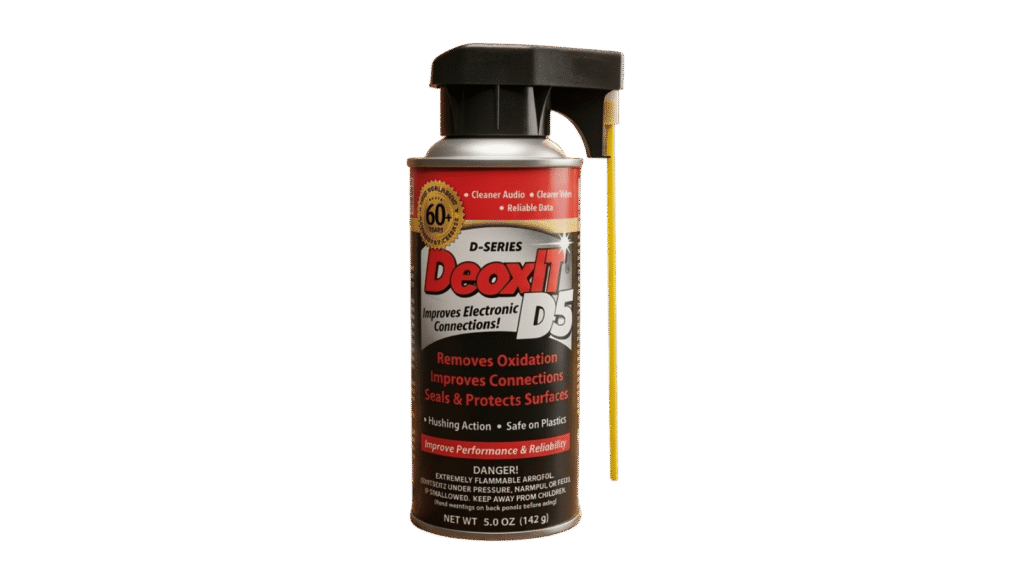
If you want to know how to clean guitar pedals properly, the toolkit is simple: a microfiber cloth, cotton swabs, a soft brush, and a can of DeoxIT D5 contact cleaner.
The one rule that matters most is never spray anything directly onto a pedal. Always apply to a cloth or swab first.
I try to clean my pedals roughly once a month (okay, okay… year), and that routine helps with everything from understanding how your pedals work to keeping your pedals sounding their best.
This guide covers exterior cleaning, fixing scratchy pots and oxidised jacks, which products actually work (and which ones will make things worse), and the prevention habits that save you time long term.
What You Need to Clean Guitar Pedals
You don’t need much. Here’s the full kit I use, and the whole lot costs under $50.
| Tool | What It’s For |
|---|---|
| Microfiber cloth | Wiping down enclosures without scratching paint or graphics |
| Cotton swabs | Getting into tight spots around knobs, footswitches, and jacks |
| Soft-bristled brush (clean paintbrush or toothbrush) | Sweeping dust out of crevices where a cloth can’t reach |
| DeoxIT D5 contact cleaner | Cleaning oxidised jacks, switch contacts, and general electronics |
| DeoxIT FaderLube F5 | Specifically for cleaning and lubricating potentiometers (knobs) |
| Simple Green (diluted) | Safe exterior cleaner for stubborn grime that water alone won’t shift |
A dedicated jack cleaning brush is a nice extra if you want one, but a cotton swab with DeoxIT does the same job.
The two DeoxIT products are the only ones I’d call essential. D5 handles contacts and jacks. FaderLube is formulated for the carbon tracks inside pots, so it cleans and lubricates in one step. You can get both for around $15 to $20 online.
How to Clean the Outside of Your Pedals
Start by unplugging everything. Disconnect the power, pull the patch cables, and take the pedal off the board if it’s mounted. A dry microfiber cloth handles about 80% of routine exterior cleaning on its own.
For stubborn grime (the kind that builds up from gigging, where beer and shoe dirt combine into a sticky film), dampen the cloth slightly with water or a small amount of diluted Simple Green. Never spray liquid directly onto the pedal. Always apply it to the cloth first, then wipe.
Not all pedal enclosures are created equal, and this is where most generic cleaning advice falls short. Painted finishes like you’ll find on most Boss pedals and many boutique units need a gentle touch. Screen-printed graphics (common on Electro-Harmonix pedals) are especially fragile and can rub off with too much pressure or the wrong cleaner.
Bare aluminium and powder-coated enclosures are more forgiving.
If you’re using anything beyond plain water, test it on the back of the pedal first. I’ve seen forum threads where players used rubbing alcohol on a vintage Boss flanger, and the purple finish started weeping. Armor All is another one to avoid completely. It’s been described as damaging to painted surfaces, and it leaves a residue that attracts more dust.
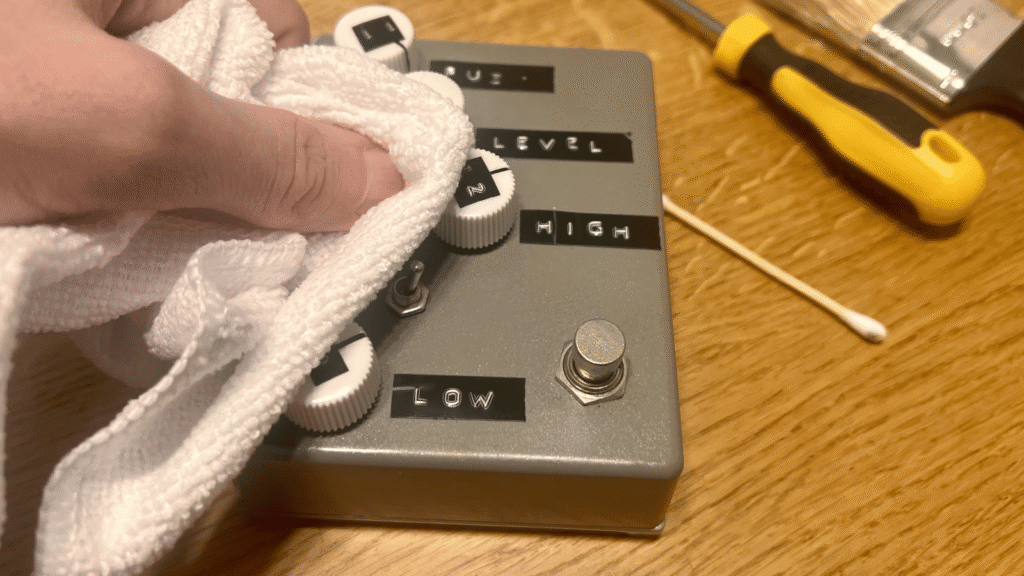
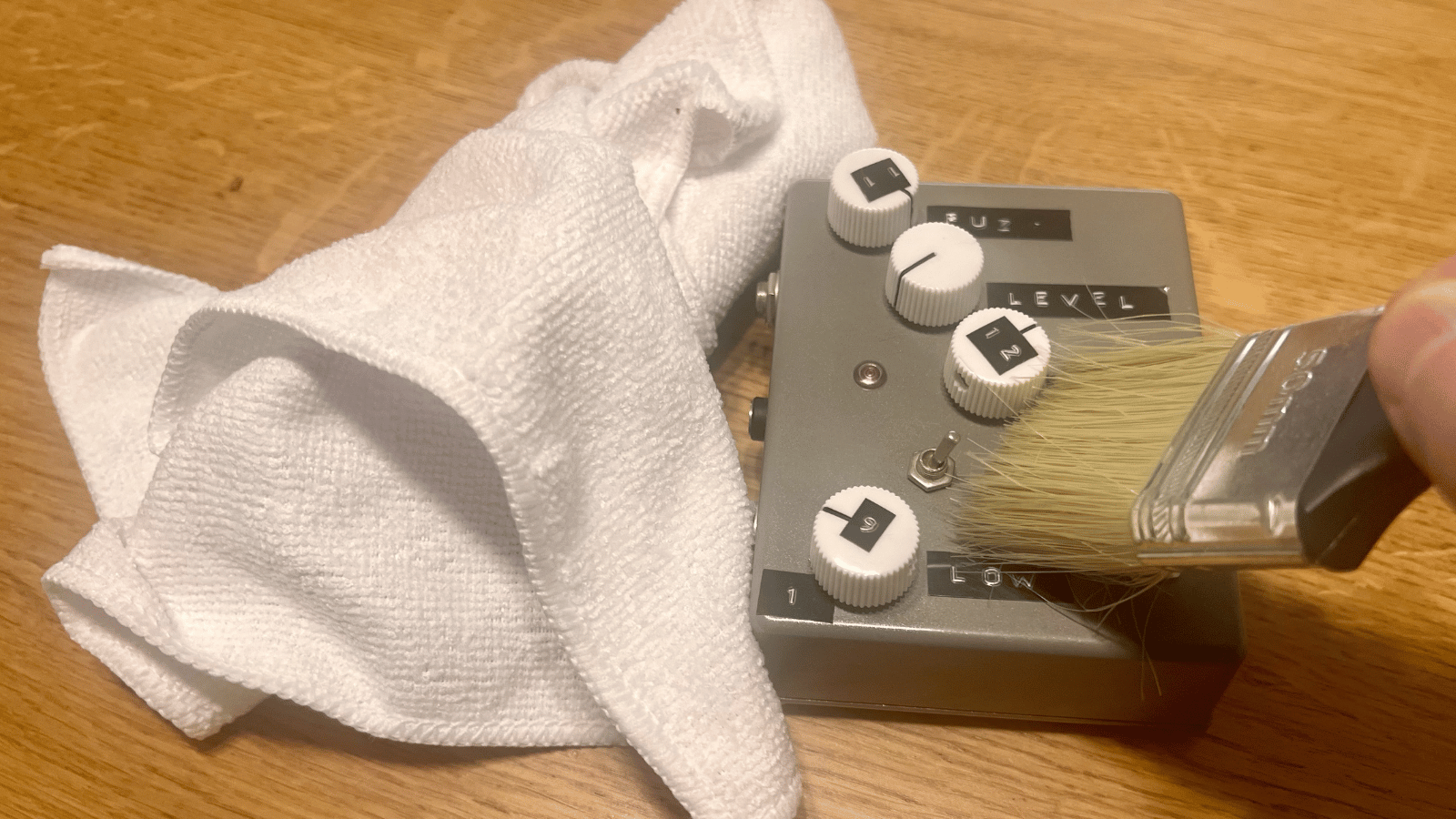
For dust in the gaps around knobs and footswitches, a clean paintbrush or soft toothbrush works better than a cloth. Cotton swabs are good for tight spots around input and output jacks.
A quick note on compressed air: short bursts from a reasonable distance are fine for surface dust. But prolonged blasts can push debris deeper into the electronics or damage components with cold propellant. I use it sparingly and only on the exterior.
How to Fix Scratchy Pots and Clean Dirty Jacks
If your pedal crackles when you turn a knob, the pot (potentiometer) has dirt or oxidation built up on its internal contacts. If your signal drops out or gets scratchy when you plug in or wiggle the cable, the jack is oxidised. These are the two most common problems that cleaning actually solves.
Cleaning Pots
Before you open anything, disconnect your power supply and unplug all cables. Then remove the back cover (usually four screws on most pedals).
Once inside, you’ll see the pots mounted to the enclosure with their solder terminals visible on the circuit board. Each pot has a small opening or gap where the shaft enters the housing. That’s where the contact cleaner goes.
Spray a short burst of DeoxIT D5 into that opening. Then rotate the knob back and forth quickly, full range, about 20 to 30 times. This works the cleaner across the carbon track and clears the oxidation.
One application usually fixes the problem completely. If the scratching comes back within a few weeks, the pot itself may be worn out and need replacing.
Cleaning Jacks
Oxidised jacks are even simpler. Apply a small amount of DeoxIT D5 to a cotton swab, insert it into the jack, and rotate it a few times.
Pull it out and you’ll probably see a dark residue on the swab. That’s the oxidation.
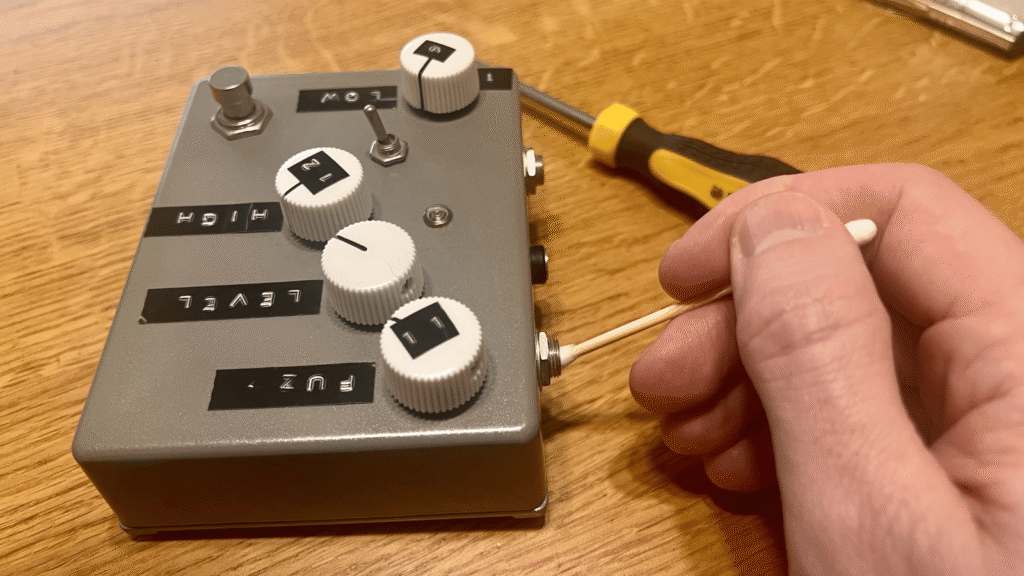
For badly corroded jacks, repeat the process two or three times with a fresh swab each time. You can also use this same approach on footswitches. Spray a small amount of DeoxIT into the switch mechanism and toggle it on and off several times to work the cleaner through.
(This applies to mechanical bypass foot switches, not soft-touch or relay-bypass pedals.)
If you’re not comfortable opening up a pedal, take it to a tech. But for most players, this is a 10-minute job with a screwdriver and a can of DeoxIT.
Which Cleaning Products Should You Use?
DeoxIT D5 for contacts and jacks. DeoxIT FaderLube F5 for pots. A microfiber cloth and diluted Simple Green for exteriors. That’s the kit, and it covers every cleaning scenario you’ll encounter.
The most common question I see in guitar forums is whether you can use WD-40 instead. The short answer: no. Regular WD-40 is not a contact cleaner.
It leaves a residue that becomes gummy as it dries, attracts dust, and makes the original problem worse within days. The forum consensus on this is clear and consistent.
There is a separate product called WD-40 Specialist Contact Cleaner, which is a different formula entirely. Some players use it as a cheaper alternative to DeoxIT and report decent results. My take: DeoxIT costs a few dollars more and is purpose-built for this job. Just get the right tool.
Here’s how the main options compare:
| Product | Best For | Pros | Cons | My Verdict |
|---|---|---|---|---|
| DeoxIT D5 | Jacks, contacts, switches | Industry standard, cleans and protects | Slightly more expensive | Buy this one |
| DeoxIT FaderLube F5 | Potentiometers | Cleans and lubricates carbon tracks | Only needed for pots | Worth having if you clean pots regularly |
| WD-40 Specialist Contact Cleaner | Budget alternative for contacts | Cheaper, widely available | Mixed long-term reviews | Acceptable in a pinch, not my first choice |
| Isopropyl alcohol | Bare metal jacks only | Cheap, effective on metal | Can damage painted and screen-printed finishes | Use with caution, never on enclosures |
| Simple Green (diluted) | Exterior grime | Safe on most finishes, gentle | Not for electronics | Good for stubborn exterior dirt |
A few products to avoid outright: regular WD-40 (not the Specialist version), acetone (it will strip paint), and Armor All (damages finishes and leaves residue). If you’re ever unsure about a product, don’t use it on the front of the pedal until you’ve tested it on the back.
While you’re cleaning, it’s also worth checking your battery compartment for signs of battery corrosion.A leaking 9V can do more damage than any amount of external grime.
How to Keep Your Pedals Clean Between Deep Cleans
The single best habit you can build is a quick wipe-down after every gig or practice session. Two minutes with a dry microfiber cloth removes the fresh dust and grime before it has a chance to work its way into the electronics. This alone prevents most of the problems covered in this article.
If you gig regularly, think about what your shoes are picking up. Venue floors are covered in beer, tape residue, dirt, and whatever else gets tracked in. All of that transfers straight to your pedals every time you step on a footswitch.
I keep a dedicated pair of shoes just for playing, and it makes a noticeable difference to how much grime builds up on the board. That said, they do still get dirty. Music venues are not known for their squeaky-clean floors.
For storage, a pedalboard case with a lid is the simplest protection you can get. If your pedals live at home, keeping them on the board is better than leaving them loose in a drawer where they collect dust and knock against each other. For more on this, see our guide on how to store guitar pedals.
Before a gig or tour, take five minutes to inspect each pedal and test all connections. This is the time to catch a scratchy pot or a dodgy jack before it becomes a problem on stage. If you’re setting up a pedalboard from scratch, clean every pedal before it goes on.
How often should you do a deep clean? Monthly if you’re gigging or practising regularly. Quarterly if your board mostly lives at home.
The schedule should match your use, not a fixed calendar. And if you’re wondering whether leaving pedals plugged in between sessions affects anything, it’s worth reading up on that separately.
My Monthly Pedal Cleaning Routine
Here’s how I actually clean my pedals, start to finish. The whole process takes about 30 minutes.
One-by-one, I take every pedal off the board. Leaving the cables and power in place. Once each pedal is off, I work through each one.
First pass is exterior only. Dry a microfiber cloth across every enclosure, then cotton swabs and a paintbrush around the knobs and footswitches. Some of my pedals have screen-printed graphics, so I have to be especially gentle with them.
Second pass is internals. I don’t open every pedal every month, but I’ll check any knob that felt gritty during the first pass. If a pot is scratchy, it gets the DeoxIT treatment. I also gently clean all the jacks with a swab and D5 as a matter of routine. I find my tap-tempo switches tend to need cleaning more than others. I guess because I tap them more than most (with shoes on when gigging).
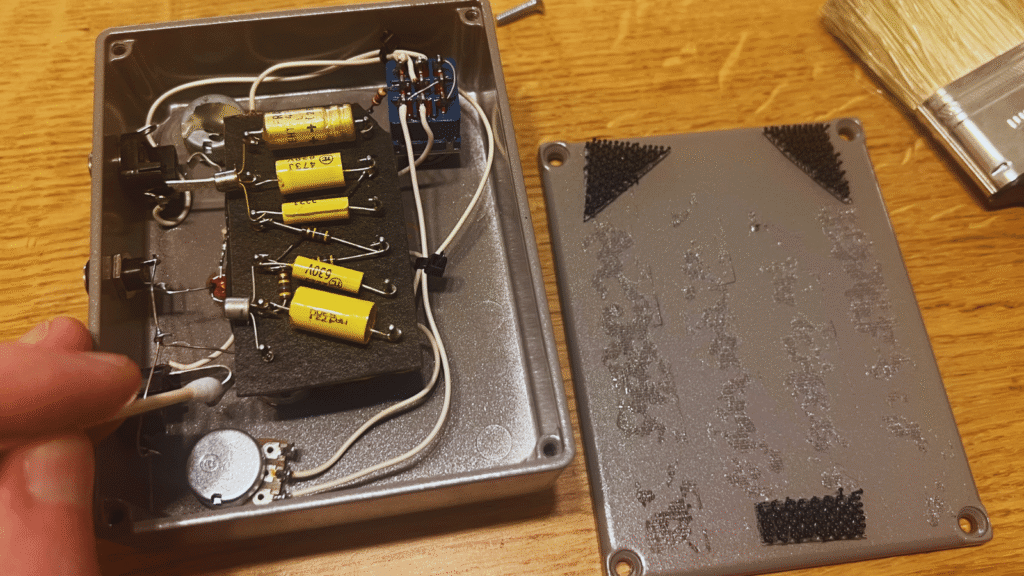
Then everything goes back on the board, cables reconnected, and I run through each pedal to make sure it’s working.
It’s not glamorous work. But the pedals sound better, the connections stay reliable, and I’m not dealing with surprises at a gig. Regular cleaning is the simplest thing you can do to extend how long your pedals will last.
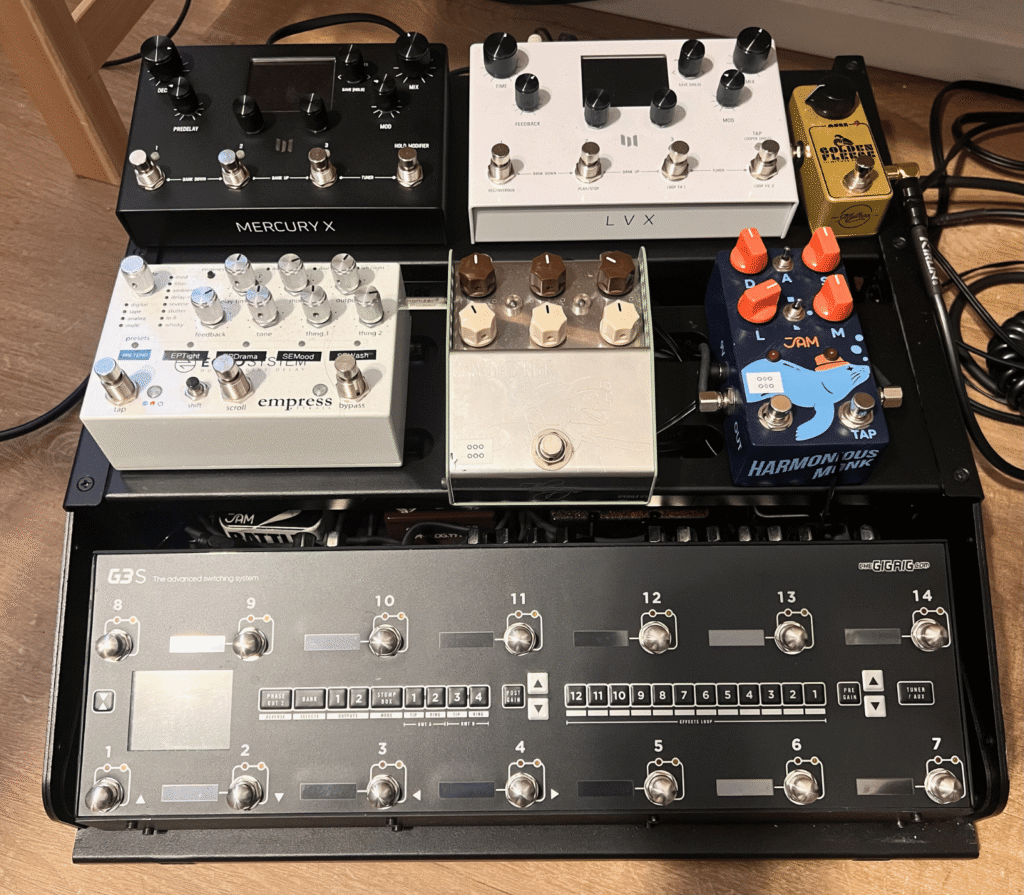
A microfiber cloth, a can of DeoxIT, and 20 minutes a month. That’s all it takes to keep your pedals clean and working properly.
If you haven’t cleaned yours in a while, start with the pots. That’s where you’ll hear the biggest difference. Your pedals don’t need to be spotless. They just need to work.
Related Reading
- How to Store Guitar Pedals . Cleaning is half the battle. Proper storage is the other half.
- How Long Do Guitar Pedals Last . Regular cleaning extends your pedals’ lifespan. Here’s what to expect.
- How to Set Up a Guitar Pedalboard . Building a new board? Clean every pedal before it goes on.
- Is It OK to Leave Guitar Pedals Plugged In . Another common care question answered.
Guitar Pedal Cleaning FAQ
Can you use rubbing alcohol on guitar pedals?
On bare metal jacks and contacts, yes. On painted or screen-printed enclosures, it’s risky. Isopropyl alcohol has been known to damage certain finishes, so always test on the back of the pedal first.
For exterior cleaning, a damp microfiber cloth or diluted Simple Green is the safer option.
Can I use WD-40 on guitar pedals?
Regular WD-40 is not a contact cleaner. It becomes gummy as it dries and attracts dust, making the problem worse. WD-40 Specialist Contact Cleaner is a different product that some players use, but DeoxIT D5 is the better choice for the small price difference.
How often should you clean guitar pedals?
A quick wipe-down after every gig or practice session is ideal. For a deeper clean (pots, jacks, and internals), monthly works well if you play regularly. Quarterly is fine if your board mostly stays at home.
How do you fix a scratchy pot on a guitar pedal?
Spray DeoxIT D5 into the small opening on the potentiometer, then rotate the knob back and forth quickly about 20 to 30 times. This clears the oxidation from the carbon track. One application usually fixes it completely.
