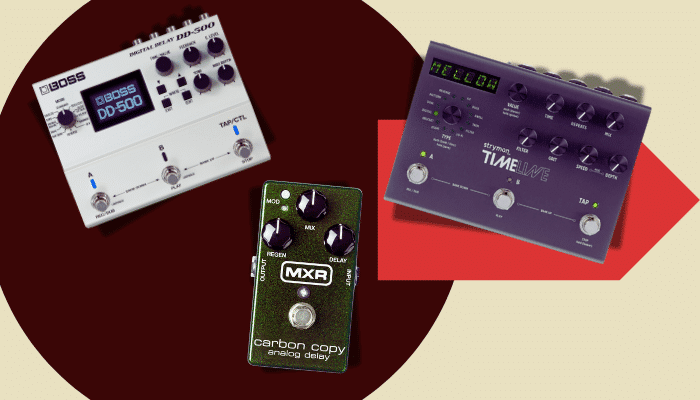
Delay Pedals

Everything you need to know about delay pedals. Types, recommended models, settings guides, and signal chain placement. Whether you’re buying your first delay or fine-tuning your ambient rig, start here.

All Delay Pedals Guides

About Delay Pedals

Everything on this page is about delay pedals and how to get more from them. Whether you’re trying to understand the difference between analog, tape, and digital delay, or you want specific settings for a sound you’ve heard on a record, these guides cover the full range. Delay is one of the most versatile effects you can own. A single pedal can thicken your rhythm parts, add dimension to solos, create rhythmic patterns, or build ambient soundscapes. The trick is knowing how to use it.

If you’re new to delay, start with our complete guitar delay pedals guide covering types, settings, and setup. It explains how each delay type works and what makes them sound different. If you already own a delay and want to push it further, 5 pro-level delay pedal techniques covers reverse swells, polyrhythmic patterns, and stereo approaches that most players never explore. And if your delay sounds great in isolation but wrong in your rig, our guide to delay pedal placement in your signal chain will help you find the right position.

Delay sits at the intersection of several other topics we cover. How you set it up depends on the rest of your signal chain, and it pairs closely with reverb to shape the spatial character of your sound.

Choosing the Right Delay for Your Playing Style

The three core types of delay pedals each have a distinct tonal character, and understanding those differences is the fastest way to narrow your options. Analog delays use bucket brigade device (BBD) circuits that naturally warm and darken each repeat as it fades. This makes them ideal for slapback, blues, and any context where you want the delay to sit behind your dry signal without competing. Digital delays reproduce your signal with precision, offering clean repeats, longer delay times, and features like tap tempo, presets, and MIDI control. Tape delay emulations recreate the character of vintage machines like the Roland Space Echo and Maestro Echoplex, with modulated repeats and organic degradation that many players find musically inspiring.

If you’re weighing up these options, our analog vs digital delay pedals comparison breaks down the real sonic and practical differences. Many players end up running both types for different musical situations.

How Delay Fits Into Your Rig

Delay doesn’t exist in isolation. Where you place it in your signal chain affects whether your repeats sound clean or compressed, pristine or gritty. Running delay through your amp’s effects loop keeps repeats clear when you’re using amp gain. Stacking delay with reverb, modulation, or overdrive creates textures that go far beyond what either effect does alone. If you want to see how professional guitarists use delay in real rigs, our artist pedalboard breakdowns document specific delay settings and chain positions from players like David Gilmour, The Edge, and Tom Morello.

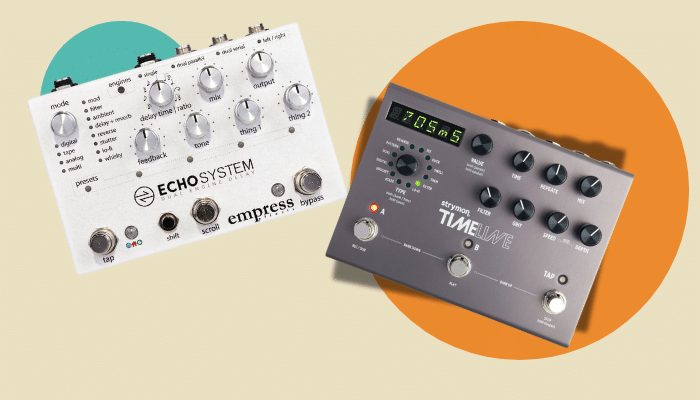
Frequently Asked Questions

The three core types are analog, tape, and digital. Analog delays produce warm, naturally darkening repeats. Tape delays recreate the modulated, organic character of vintage echo machines. Digital delays offer precise, clean repeats with more features and longer delay times. Our complete delay pedals guide covers each type in detail with settings recommendations.

Place your delay near the end of your chain, after gain and modulation pedals but before reverb. If your amp has an effects loop, running delay through it keeps your repeats clean when using amp distortion. Our guide to
delay pedal placement covers every position with pros and cons.

Slapback is a short, single-repeat echo that thickens your tone without obvious trailing repeats. Set your delay time between 60 and 120 milliseconds, feedback near zero, and mix around 30 to 40%. It’s the signature sound of rockabilly and early rock and roll. Our step-by-step slapback delay guide walks through settings for different genres.

Analog delays use bucket brigade circuits that produce warm, slightly degraded repeats with a vintage character. Digital delays use signal processing for precise, clean echoes and typically include more features like tap tempo, multiple delay modes, and presets. Our analog vs digital delay comparison covers the full breakdown.