



Kurt Cobain taped pedals to the floor, smashed guitars nightly, and told Guitar World that “junk is always best.” The popular story is that he didn’t care about gear at all.
Then you look at the evidence.
He hand-wrote PolyChorus settings for individual songs. He bought five Small Clones from the same shop and had the depth switch hardwired on at least two of them. His guitar tech Earnie Bailey built him custom fuzz circuits to replace a stolen Univox. And during the In Utero sessions, he spent a full day auditioning different pedal and amp combinations before settling on a Tech 21 SansAmp feeding a broken Fender Quad Reverb loaded with rare Utah speakers.
This was not a guitarist who didn’t care about tone. This was a guitarist who cared intensely but built an image around not caring.
That gap between myth and reality is what makes Kurt Cobain’s pedalboard worth studying properly.

After cross-referencing Earnie Bailey’s direct accounts, Butch Vig’s studio recollections, Steve Albini’s detailed Reddit responses, and auction records from Julien’s, we’ve pieced together every pedal Kurt used across three albums, his actual settings, and the signal chain logic behind each era of Nirvana’s sound.
Below you’ll find the full breakdown as part of our artist pedalboard profiles. Plus budget alternatives that prove Kurt’s tone remains one of the most replicable in rock.
This breakdown draws on the most authoritative primary sources we could find for Kurt Cobain’s gear.
Primary sources:
- Live Nirvana’s equipment guide, researched by Caio Leme with direct input from Nirvana guitar tech Earnie Bailey. This is the single most detailed and reliable source on Kurt’s pedals, with specific dates, show-by-show documentation, and direct Bailey quotes
- Guitar World’s August 1997 feature, “Nirvana: Super Fuzz Big Muff,” which includes firsthand accounts from producer Butch Vig, Sound City engineer, and Guitar Maniacs owner Rick King
- Steve Albini’s 2020 Reddit AMA and correspondence with In Utero assistant engineer Bob Weston, confirming pedal usage during the Pachyderm sessions
- Julien’s Auctions records for stage-used pedals (DS-1, DOD Grunge), which include provenance documentation from guitar techs
Secondary sources:
- Aaron Rash’s In Utero tone research, which identified the specific Fender Quad Reverb speaker configuration through A/B testing
- The Kurt Cobain Equipment FAQ (kurtsequipment.com) and Equipboard’s community-sourced documentation
What we couldn’t fully verify: Which specific Big Muff variant was used on Nevermind. Butch Vig confirms a Muff was used on Lithium, but Earnie Bailey says he never saw one on stage. The exact model remains one of the great Nirvana gear mysteries.
Kurt Cobain’s Signal Chain: Three Eras, Three Chains
Most artists have one signal chain. Kurt had three. And tracking how his pedal order changed across Bleach, Nevermind, and In Utero tells you more about Nirvana’s sonic evolution than any biography.
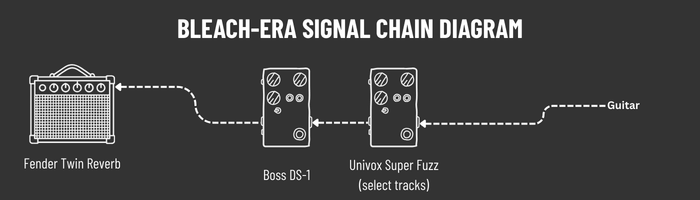
Bleach-Era Signal Chain
Nevermind-Era Signal Chain
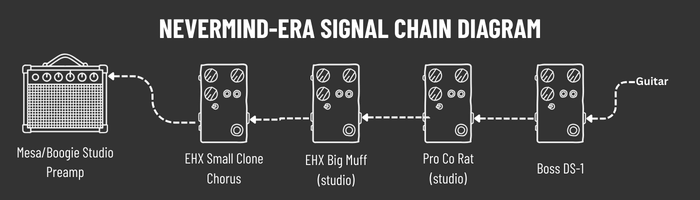
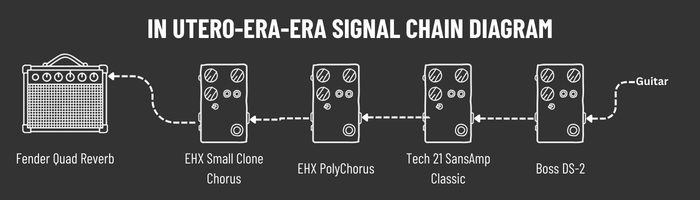
Why the Chain Changed (and What It Tells You)
The Bleach chain is almost laughably simple. Guitar into a DS-1 into an amp. That’s it. No chorus, no modulation, no effects loop. Kurt recorded the entire album with a single distortion pedal and a borrowed Fender Twin Reverb. If you want to understand Kurt’s starting philosophy, this is it. One sound, fully committed.
By Nevermind, the Small Clone had entered the chain after the DS-1. That placement matters. Running chorus after distortion means the chorus processes an already-distorted signal, which is what gives songs like Come As You Are and Smells Like Teen Spirit that thick, warbling quality rather than a clean shimmer. It’s the standard chorus-after-dirt approach covered in our guide to signal chain and pedal order, but Kurt leaned into it harder than most. He wasn’t using chorus for subtlety. He was using it as a texture that sat on top of full distortion.
The In Utero chain is where things get genuinely interesting. The DS-2 replaced the DS-1 in February 1992, but the real shift was the SansAmp Classic entering the chain as Kurt’s primary distortion source. The DS-2 and SansAmp could run independently or together. Bob Weston confirmed to researcher Aaron Rash that these were the two pedals Kurt settled on after a full day of auditioning gear at Pachyderm Studios. The PolyChorus sat after the drive stages, and the Small Clone stayed at the end. Kurt wasn’t stacking effects randomly. He was building a chain where each pedal had a defined role: the SansAmp for core grit, the DS-2 for additional aggression on heavier tracks, and the modulation effects placed after all the gain stages so they processed the full distorted signal.
For a guitarist who supposedly didn’t care, that’s a remarkably logical signal flow.
How Did Kurt Cobain Get His Distortion Sound?
Kurt’s distortion wasn’t built from stacking gain stages or pushing a tube amp into natural breakup. It came from running a single pedal at near-maximum settings into a relatively clean amplifier.
While most guitarists of the era layered drives for complexity, Kurt used one distortion at a time with almost no variation in his dial positions across years of touring.
His guitar tech Earnie Bailey summed it up:
“He knew all the sweet spots really well.”
The simplicity is deceptive. Getting that sound right meant treating the distortion pedal as the amp’s entire voice, not just an effect to kick on for choruses.
BOSS DS-1 Distortion
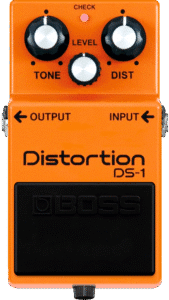
Kurt’s primary distortion from the Bleach sessions through the Nevermind tour. This was the foundation of Nirvana’s early sound. Not a boost, not a colour. The DS-1 was the entire distorted tone.
How Kurt used it:
Kurt ran an ’80s-era DS-1 with the level maxed out, tone between 11 and 1 o’clock, and distortion cranked to full. Those settings barely changed across three years and two albums.
What made Kurt’s DS-1 sound different from any other was the combination of that maxed signal hitting a clean Mesa/Boogie Studio Preamp. The preamp wasn’t adding its own dirt. It was amplifying the DS-1’s full character, letting the pedal dictate the tone.
Jack Endino recalled Kurt bringing “a little orange Boss DS-1 distortion pedal” to the Bleach sessions alongside his Univox guitars. It was the only effect he used on the entire album.
Interaction with other pedals:
During the Nevermind era, the DS-1 fed directly into the Small Clone chorus. When both were engaged, the chorus processed the fully distorted signal.
That’s the sound on the verses of Smells Like Teen Spirit.
A malfunctioning DS-1 was chucked onstage at De Doelen in Rotterdam on 1 September 1991. The unit used during the Nevermind sessions was likely among some equipment stolen from the band’s van as the sessions wrapped up.
Another stage-used DS-1, thrown into the crowd at Club Babyhead in Providence on 25 September 1991, sold at Julien’s Auctions for $9,000.
Estimated knob positions:
- Level: 5 o’clock (max).
- Tone: 11 o’clock to 1 o’clock.
- Distortion: 5 o’clock (max), occasionally dialled back to 1-2 o’clock in the studio.

BOSS DS-2 Turbo Distortion
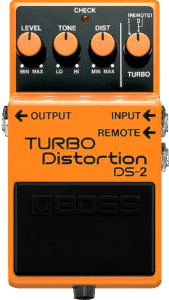
A direct replacement for the DS-1, entering Kurt’s rig in February 1992 and staying through the In Utero era.
Kurt treated it identically to his DS-1. The swap wasn’t about chasing a new sound. It was a like-for-like substitution with one key distinction: the DS-2 stayed in Mode 1 (the non-turbo setting), which closely replicates the DS-1’s voicing. Apparently, he never used Mode 2.
How Kurt used it:
Kurt’s DS-2 settings were virtually identical to his DS-1: level maxed, tone around 11 o’clock, distortion at full.
The pedal can be spotted on stage during the MTV Unplugged performance, sitting on the floor despite the acoustic set. It wasn’t used during the broadcast, but Kurt likely had it ready as a safety net.
During the In Utero tour, the DS-2 served as a secondary distortion alongside the SansAmp Classic.
At one time, it was engaged specifically during the pre-chorus of Smells Like Teen Spirit for a different texture than the SansAmp provided. Eventually, it was used primarily only on The Man Who Sold the World in the live set.
Interaction with other pedals:
In the In Utero chain, the DS-2 sat before the SansAmp. The two could run independently or stacked, giving Kurt two distinct distortion voices and a third combined option.
Aaron Rash’s research describes the DS-2 + SansAmp tone as having “a very bitey aggressive nature,” which he calls the “Presence Sound.”
Estimated knob positions:
- Level: 5 o’clock (max).
- Tone: 11 o’clock.
- Distortion: 5 o’clock (max).
- Turbo mode: Position 1 (non-turbo).
Tech 21 SansAmp Classic
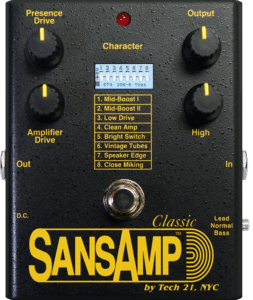
Kurt’s primary distortion source for the In Utero album and tour. This is the pedal that most people underestimate.
The SansAmp wasn’t a backup or supplement. Bob Weston confirmed to researcher Aaron Rash that it was the main drive.
How Kurt used it:
Kurt settled on the SansAmp after spending a full day at Pachyderm Studios auditioning different pedal combinations with Steve Albini.
He ran it into a Fender Quad Reverb. I read that that amp had a couple of broken tubes, giving its overdrive a raspy, unpredictable quality that Kurt liked.
Even more specifically, Aaron Rash’s A/B testing identified that the Quad was loaded with rare Utah speakers (orange sticker on the back, produced for only one year) rather than the more common Oxford units.
That speaker detail is what Rash calls “the missing ingredient” most tone chasers overlook.
The SansAmp was typically placed before the effects, with one output connected to them and then balanced out to the desk. On Unplugged, it was placed after the effects instead.
Interaction with other pedals:
Rash found two distinct core tones on In Utero:
- SansAmp only (bypassing the DS-2)
- Boss DS-2 into SansAmp (the “Presence Sound”)
Kurt treated the SansAmp as the foundation and the DS-2 as an optional layer on top.
Estimated knob positions:
- DIP switches: 3 up, 3 down, 2 up.
- Drive 1: 5 o’clock (max).
- Drive 2: 5 o’clock (max).
- High: 12 o’clock.
- Mode: Normal (centre position).

Pro Co Rat
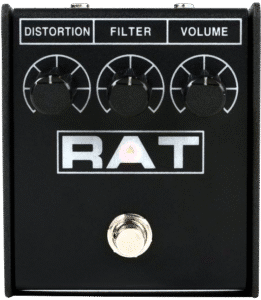
A brief guest, not a regular. The Rat’s appearances in Kurt’s hands are limited to a handful of post-Nevermind shows and the Nevermind sessions, specifically on Territorial Pissings.
This was Krist Novoselic’s primary distortion pedal. Kurt borrowed it.
How Kurt used it:
Live, Kurt only used a Rat once as far as I can tell. On 3 December 1989, at the Astoria Theatre in London during Lame Fest UK, he and Krist swapped pedals mid-set.
The Rat was Krist’s territory.
In the studio, the Rat’s role on Territorial Pissings was specific. The track needed a different kind of aggression than the DS-1 could provide. A rawer, more chaotic distortion for one of Nevermind’s most abrasive songs.
Butch Vig mentioned the Rat as part of the Nevermind session setup alongside the Big Muff and Small Clone.
Interaction with other pedals:
The Rat wasn’t part of Kurt’s regular chain. It was brought in for a specific studio purpose and otherwise lived in Krist’s rig.
Estimated knob positions:
No documented Kurt-specific Rat settings exist.
However, Krist’s settings at the Paramount show were documented:
- Distortion at 9:30
- Filter at 11 o’clock
- Volume maxed
This gives a rough starting point for the Nirvana Rat sound. For Territorial Pissings, expect everything pushed hard.
Kurt Cobain’s Modulation Pedals: More Deliberate Than You Think
For a guitarist associated with raw simplicity, Kurt’s modulation choices tell a different story. He didn’t use chorus or flange as background wash. He used them as defining textures on specific songs, with settings precise enough to hand-write on the pedals themselves.
Electro-Harmonix Small Clone
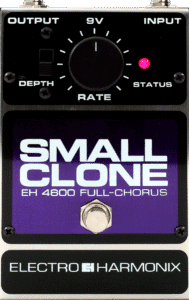
After distortion, this is Kurt’s most important effect.
The Small Clone was a constant from 1990 until the end. It defined the sound of Come As You Are, shaped the verses of Smells Like Teen Spirit, and appeared on more Nirvana recordings than any other modulation effect.
How Kurt used it:
Kurt bought his first Small Clone from Guitar Maniacs in Tacoma, Washington, sometime in 1990. But he didn’t buy just one. He bought five.
According to Guitar Maniacs owner Rick King, Kurt kept coming back for more.
Given the production window, some of these units likely had the SAD1024 delay chip while others used the MN3007, which produces a subtly different chorus voicing.
Kurt’s approach to the Small Clone was characteristically absolute. He set the rate around 12 o’clock, kept the depth switch permanently in the up position, and never varied from this.
His tech Earnie Bailey eventually hardwired the depth switch in place on at least two units because Kurt never used it in any other position. I find this super interesting. This is not “not caring” about the details. This is a guitar player who found exactly the sound he wanted and locked it in permanently.
When I was a teenager in the ’90s, the Small Clone was one of the first pedals I owned specifically because of Kurt. It remains one of the most accessible entry points into the Nirvana sound.
Interaction with other pedals:
The Small Clone sat at the end of Kurt’s chain in every era, always after distortion and after any other modulation. It was the last colour applied before the amp.
That positioning meant it processed everything upstream, which is why the chorus on Nirvana records sounds thick and immersive rather than clean and shimmery.
Butch Vig confirmed this was “making the watery guitar sound you hear on the pre-chorus build-up of Smells Like Teen Spirit and also Come As You Are.”
Estimated knob positions:
- Rate: 12 o’clock.
- Depth switch: Up (hardwired on at least two units).

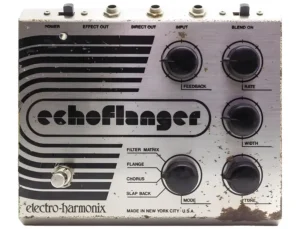
Electro-Harmonix EchoFlanger and PolyChorus
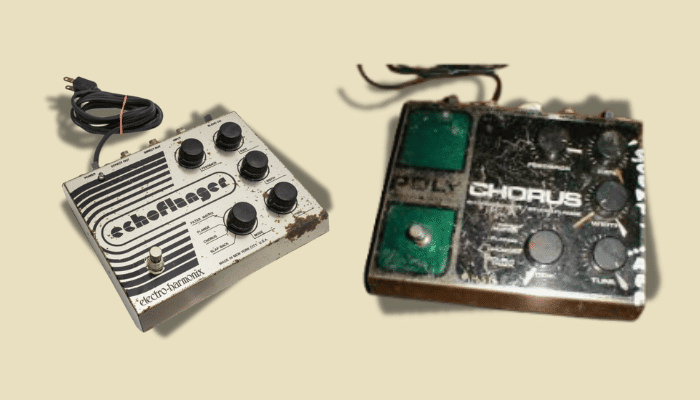
These are Kurt’s experimental modulation tools for the In Utero era.
The EchoFlanger came first, but reliability issues led Earnie Bailey to replace it with a PolyChorus during touring. Both share similar internal circuitry, so the swap maintained tonal consistency. Bailey kept whichever was working that day ready to go.
How Kurt used it:
The PolyChorus is where the “Kurt didn’t care about gear” myth falls apart completely.
Kurt hand-wrote settings on the pedal itself for individual songs. He had different dial positions for the Heart-Shaped Box solo, for Radio Friendly Unit Shifter, and for Scentless Apprentice.
These weren’t general-purpose settings. They were precision adjustments for individual recordings and performances.
EHX’s own documentation preserves photographs of Kurt’s handwritten notes on the PolyChorus, showing specific configurations for each track.
The swirling textures on Radio Friendly Unit Shifter, the haunting modulation on the Heart-Shaped Box solo, and the chaotic warble on Scentless Apprentice all came from this one pedal with different configurations each time.
Interaction with other pedals:
In the In Utero chain, the PolyChorus sat after the drive stages (DS-2 and SansAmp) but before the Small Clone.
That placement meant it was processing an already-distorted signal and adding its own modulation, which the Small Clone then further thickened.
Two modulation effects in series, each with a distinct purpose. For a setup that’s supposedly “simple,” that’s a signal chain that’s had a lot of thought go into it.
Estimated knob positions:
This varied per song. Kurt’s hand-written notes document specific settings for Heart-Shaped Box, Radio Friendly Unit Shifter, and Scentless Apprentice. For a starting point, try:
- Chorus mode
- Feedback and rate near 12 o’clock
- Width high
- Filter engaged for a smoother response.
MXR Phase 100
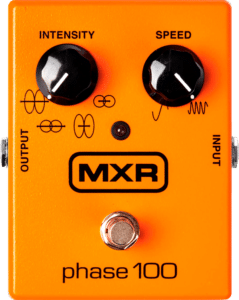
A rare appearance rather than a regular. The Phase 100 shows up on Curmudgeon, a Nevermind-era B-side. It wasn’t part of Kurt’s regular live setup.
How Kurt used it:
The Phase 100 is an interesting window into Kurt’s willingness to experiment when a song demanded it.
Curmudgeon has a distinctly different texture from anything else in the Nevermind sessions, and the Phase 100 is the reason.
Kurt reportedly purchased the pedal from Voltage Guitars around the same time he picked up his Fender XII and a blue Mosrite. It was a purpose-driven acquisition rather than something that lived permanently on the floor.
Like the Big Muff story, the Phase 100 shows us that Kurt’s rig extended beyond the core setup when recordings called for specific textures.
Interaction with other pedals:
The Phase 100 appears to have been used independently for Curmudgeon rather than stacked with Kurt’s regular chain.
Estimated knob positions:
No documented settings available. The Phase 100 has a speed control and a four-position intensity switch.
For the slow, swooshing quality audible on Curmudgeon, a moderate speed with the intensity in position 2 or 3 would be a good starting point.
Fuzz and the DIY Grunge Spirit
Kurt’s relationship with fuzz predates Nirvana’s first album. These weren’t pedals he added for variety. They were part of the foundation, and losing one of them triggered a chain of events that resulted in custom-built replacements and one of the great unsolved gear mysteries of ’90s rock. The fuzz lineage connects Kurt to the same octave-up tradition that shaped Jimi Hendrix’s sound, though Kurt’s approach was rawer and less controlled.
Univox Super-Fuzz
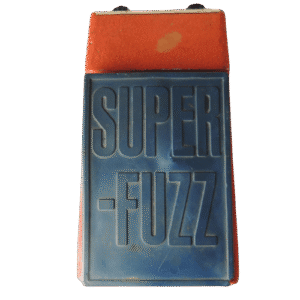
Kurt’s pre-Bleach fuzz. The Super-Fuzz was in his hands before the band had a record deal, and its octave-up character shaped what would become the early grunge template.
How Kurt used it:
The Super-Fuzz gave Kurt access to textures the DS-1 couldn’t produce.
Heavier, more chaotic, with an octave-up harmonic content and a mid-scoop that delivered a scooped, aggressive tone completely different from the DS-1’s more focused distortion.
The Super-Fuzz was part of Kurt’s setup during the pre-Bleach period, though it’s unclear whether it appeared on the album itself. It was, however, used on Love Buzz and Sifting (instrumental), both early tracks that predate the Bleach sessions.
What is clear is that it was stolen from Nirvana’s practice space. That theft set off a chain of events that defined Kurt’s relationship with fuzz for the rest of his career.
Interaction with other pedals:
The Super-Fuzz occupied a different sonic space than the DS-1.
Where the DS-1 was Kurt’s controlled distortion voice, the Super-Fuzz was wilder and less predictable. Its loss led directly to the creation of the Yung-Mann Fuzz.
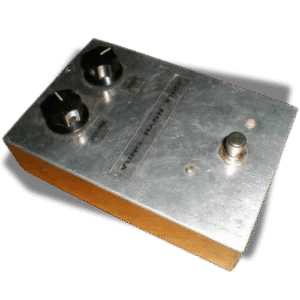
The Yung-Mann Fuzz (Earnie Bailey’s Shin-ei FY-8tr Copy)
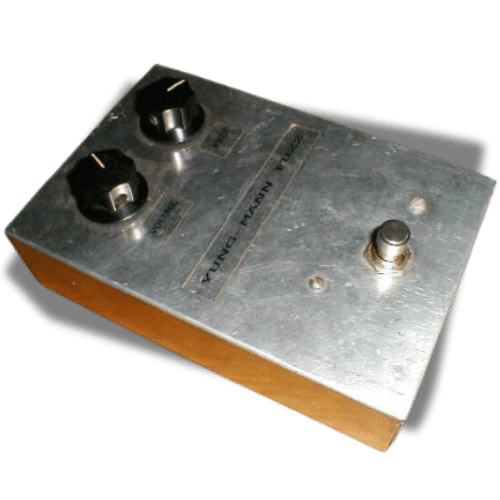
A custom replacement for the stolen Super-Fuzz, built by Earnie Bailey.
Rather than buying another off-the-shelf fuzz, Bailey hand-built Kurt a recreation based on the Shin-ei FY-8tr circuit with the tone switch hardwired to the scooped mids setting.
How Kurt used it:
The Yung-Mann Fuzz was housed in a silver metal box and represented the DIY ethos of the grunge scene in physical form.
Bailey didn’t just clone the Super-Fuzz. He based the circuit on the fuzz section of the Shin-ei FY-8tr, which is the engine inside the original Univox Super-Fuzz.
The tone switch was hardwired to the scooped mids position. That tells you exactly what Kurt wanted from his fuzz sound: that deep, hollowed-out character with the mids pulled back. For anyone trying to replicate this, the Shin-ei FY-8tr circuit (or its modern clones) with a mid-scoop is the target.
Bailey actually built two custom fuzzes for Kurt. The second was loosely based on a Mosrite Fuzz circuit with a third transistor added to boost it over unity gain. The Yung-Mann is the better documented of the two.
Interaction with other pedals:
Like the Super-Fuzz before it, the Yung-Mann occupied a separate sonic role from Kurt’s distortion pedals. It wasn’t a replacement for the DS-1 or DS-2. It was another voice for when Kurt wanted something more extreme and unpredictable.
Electro-Harmonix Big Muff: The Nevermind Mystery
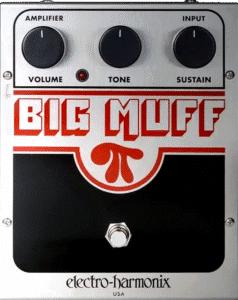
The Big Muff’s role in Kurt’s story is confirmed for the studio but genuinely disputed for the stage. Butch Vig explicitly states a Big Muff was used on Lithium. Earnie Bailey says he never saw one on Kurt’s live rig. The specific variant remains unknown.
How Kurt used it:
On Lithium, a Big Muff was paired with a Fender Bassman amp. Vig described the combination as giving the track “that thumpier, darker sound” compared to the DS-1’s brighter attack.
But the mystery runs deeper than most articles acknowledge. Nobody is certain which Big Muff variant was used.
Vig himself recalled: “I think I had a Russian Big Muff, which is, you know, very close.” That phrasing suggests the Muff may have been Vig’s rather than Kurt’s.
Earnie Bailey, said: “Which Muff Kurt used on Nevermind is one of the great mysteries and probably the question I see most.”
He also confirmed that a green Russian unit was among equipment Krist once brought to his house, though it’s unclear whether Kurt ever used it.
A Big Muff was also present during the In Utero sessions. Albini confirmed its presence in both a 2007 forum post and his 2020 Reddit AMA. Whether it was actually used on the album is another open question.
Interaction with other pedals:
On Lithium, the Big Muff replaced the DS-1 rather than stacking with it.
The two served different purposes.
The DS-1 was Kurt’s default distortion. The Big Muff was brought in for a specific, heavier texture on a specific song. That kind of session-specific pedal swapping is another sign Kurt paid more attention to tone than the legend suggests.
The Pedal X Mystery

Pedal X is one of the most debated pieces of gear in Nirvana history. And most of what’s been written about it is wrong.
What it actually is:
Steve Albini brought the pedal to the In Utero sessions at Pachyderm Studios. In his 2020 Reddit AMA, he described it as “kind of a ring modulator/overdrive” made by a friend of his.
Many articles (including the original version of this article) described Pedal X as a tremolo or modulation pedal. That’s incorrect. Albini’s own words are clear.
What happened with it:
The pedal was auditioned during the Heart-Shaped Box sessions. Kurt tried it on the guitar solo.
Krist Novoselic hated the sound, and apparently, the pedal was not used in the final mix.
This is a critical correction from our earlier version of this article. The Heart-Shaped Box solo you hear on the album apparently does not feature Pedal X. The modulation on that solo comes from the PolyChorus.
Why it matters:
I believe Kurt cared about gear more than he ever let on. A guitarist who “doesn’t care about gear” doesn’t spend time auditioning a mysterious ring modulator borrowed from the producer during a recording session.
The Pedal X story, even though the pedal was ultimately rejected, demonstrates that Kurt actively experimented with unfamiliar effects when he thought they might serve a song.
He tried it, judged it on its merits, and moved on when it didn’t work. That’s deliberate tone-chasing, not indifference.
Time-Based Effects
Kurt wasn’t a delay player by any stretch. The one delay pedal he owned reveals something about his earlier, more experimental phase and underscores how rarely he reached for time-based effects.
BOSS DM-2 Delay
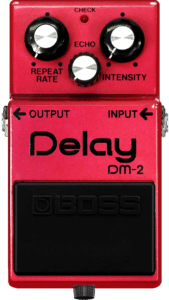
An occasional texture rather than a core sound. The DM-2 appeared in both studio and live settings, but it was never a permanent fixture in Kurt’s chain the way the DS-1 or Small Clone were.
How Kurt used it:
The DM-2 is most clearly heard on If You Must, an early track where the repeats add depth behind Kurt’s raw guitar recordings. It also appeared on some of Kurt’s home demos, adding subtle echoes to his solo writing sessions.
The fact that Kurt largely abandoned delay after the early period is telling.
He wasn’t interested in ambient textures or rhythmic repeats. His approach was fundamentally about direct, immediate sound. He wanted the guitar signal distorted and present, not trailing off into space. The DM-2 was a tool for specific moments, not a permanent voice.
Interaction with other pedals:
The DM-2 didn’t have a fixed position in a regular chain because it wasn’t a regular part of Kurt’s setup. When used, it would logically sit after distortion, adding repeats to the already-shaped tone.
Estimated knob positions:
Due to Kurt’s preference for simplicity and the DM-2’s three-knob layout (repeat rate, intensity, echo), a moderate delay time with low intensity and the echo level just audible behind the dry signal would match the subtle way he used it on early recordings.
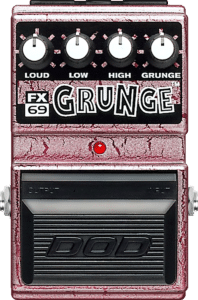
The DOD Grunge Pedal: A $16,000 Joke
The DOD FX69 Grunge deserves a mention not because it was important to Kurt’s sound, but because the story is too good to leave out.
Kurt kept a DOD Grunge pedal on his board during the In Utero tour. It’s visible next to his SansAmp during the MTV Live and Loud performance at Pier 48 in Seattle, December 1993.
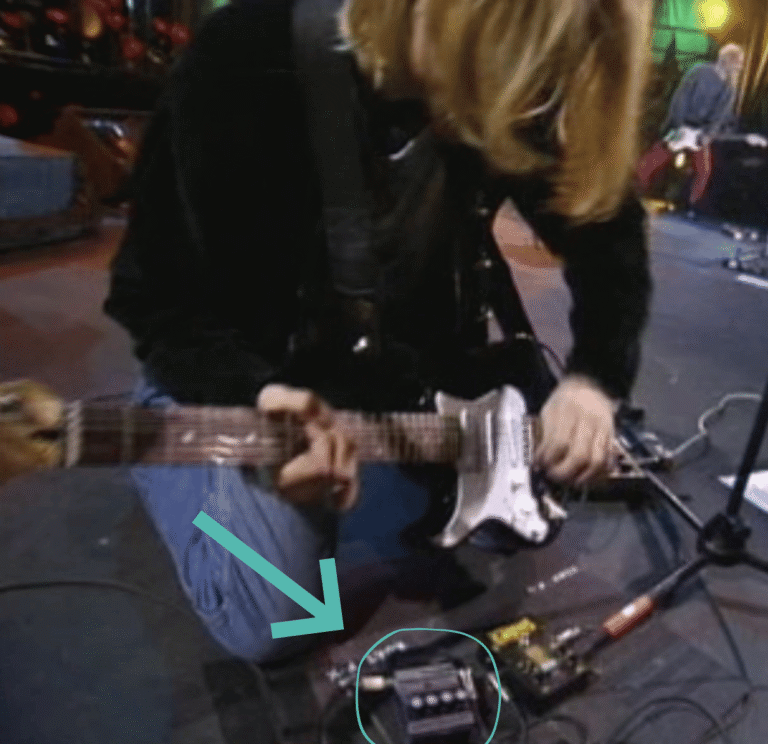
According to both the Kurt Cobain Equipment FAQ and his guitar techs, it was largely a joke. Kurt was openly disdainful of the word “grunge” and the cultural phenomenon surrounding it. Having a pedal literally called “Grunge” sitting on his board was exactly his sense of humour.
Whether Kurt actually engaged it is debated. Some sources, including Ground Guitar commenter documentation, suggest the Grunge pedal was used on The Man Who Sold the World and parts of Endless Nameless at the Live and Loud show, replacing the DS-2 on those tracks.
Others maintain it just sat on the board unplugged. At the Live and Loud show, it had a bad contact. At the San Diego Sports Arena show on 29 December 1993, Kurt threw the pedal offstage between Sliver and In Bloom and quipped, “Excuse me, that was my grunge pedal.”
The pedal ended up with Diana Costa, an audience member who requested it from a security team member. It appeared on the History Channel’s Pawn Stars in 2015, where the owner was offered $500. He declined. In 2021, the pedal sold at Julien’s Auctions for $16,000. That’s nearly double what the DS-1 that actually defined Nirvana’s early sound fetched at the same auction house.
Which Pedals Did Kurt Cobain Use on Each Song?
Most Nirvana tone guides give you “DS-1 and Small Clone” and leave it at that. But when you dig in, the reality is more specific. Kurt picked different pedals for different songs, and sometimes the same song used different pedals depending on the era.
The table below combines confirmed studio sources, documented live performances, and tonal analysis. Where a pedal is documented by a named source, we’ve labelled it “Confirmed.” Everything else is “Likely” based on the known chain for that era and what we can hear in the recordings.
Smells Like Teen Spirit – Nevermind (studio)
High Confidence
Pedals
BOSS DS-1, EHX Small Clone
Source
Butch Vig, Guitar World Aug 1997: Small Clone creates the pre-chorus build-up. DS-1 as primary Nevermind distortion.
Come As You Are – Nevermind (studio)
High Confidence
Pedals
EHX Small Clone
Source
Butch Vig, Guitar World Aug 1997. The defining Small Clone recording. Clean guitar with chorus throughout.
Lithium (heavy sections) – Nevermind (studio)
High Confidence
Pedals
EHX Big Muff + Fender Bassman
Source
Butch Vig: Big Muff through Bassman “to get that thumpier, darker sound.” Vig likely provided the Muff.
Territorial Pissings – Nevermind (studio)
High Confidence
Pedals
Pro Co Rat
Source
Multiple sources. The track needed rawer, more chaotic distortion than the DS-1 could deliver.
Drain You (bridge) – Nevermind (studio)
Moderate Confidence
Pedals
EHX Small Clone
Source
Editorial analysis: the warbling, pitch-shifted quality of the bridge breakdown has the unmistakable character of the Small Clone at full depth. One of the best examples of Kurt using chorus as texture rather than just a clean-tone effect.
Heart-Shaped Box (solo) – In Utero (studio)
High Confidence
Pedals
EHX PolyChorus, SansAmp
Source
Hand-written settings on the PolyChorus itself. Pedal X was auditioned but Krist vetoed it. Not in the final mix.
Scentless Apprentice – In Utero (studio)
High Confidence
Pedals
EHX PolyChorus, SansAmp
Source
Hand-written PolyChorus settings. Audible throughout the entire track, not just isolated sections.
Tourette’s – In Utero (studio)
Moderate Confidence
Pedals
BOSS DS-2 + SansAmp (stacked)
Source
Aaron Rash identifies this combination as the “Presence Sound.” Tourette’s is Rash’s prime example of the DS-2 + SansAmp stack at full aggression.
Curmudgeon – Nevermind B-side
High Confidence
Pedals
MXR Phase 100
Source
Kurt Cobain Equipment FAQ via Earnie Bailey. Pedal purchased from Voltage Guitars alongside Fender XII and Mosrite.
Love Buzz / Sifting – Pre-Bleach
High Confidence
Pedals
Univox Super-Fuzz
Source
Live Nirvana. Stolen from practice space, eventually replaced by Bailey’s custom Yung-Mann Fuzz.
The Man Who Sold the World – In Utero tour (live)
High Confidence
Pedals
BOSS DS-2, SansAmp
Source
Live Nirvana: DS-2 eventually only used for this song live. Both pedals active at Live and Loud.
“Dazed and Confused” (cover)
High Confidence
Pedals
Wah (JB95) + Fuzz Face, routed to Fender Twins
Source
Recorded on a cheap Stella acoustic with no effects. The vulnerability of a bare guitar was itself a deliberate choice.
The mapping reveals something that a simple gear list never could. Kurt wasn’t cycling through pedals for variety. He was solving specific tonal problems song by song.
- The Big Muff appears on Lithium because the DS-1 didn’t have the low-end weight Vig wanted.
- The PolyChorus appears on Heart-Shaped Box, Scentless Apprentice, and Radio Friendly Unit Shifter because those three songs needed modulated chaos the Small Clone couldn’t provide.
- The Rat appears on Territorial Pissings because that track demanded a rawer, uglier distortion than Kurt’s usual palette.
Even the absence of pedals is deliberate. Polly needed nothing because the bare acoustic vulnerability was the point. I’ve said this a lot, but for a guitarist who supposedly didn’t care about tone, every pedal decision on this list seems purposeful.
How to Get Kurt Cobain’s Guitar Tone on a Budget
Here’s the thing about building a Kurt Cobain pedalboard on a budget. Most of it is already budget gear. The DS-1 costs less than a decent dinner. The Small Clone has been under £90 for decades. The gap between “authentic” and “budget alternative” is smaller here than for almost any other artist on this site.
The only real cost barriers are the discontinued items. The SansAmp Classic and PolyChorus are where you’ll pay collector prices or need a modern substitute. Everything else, you can buy the exact pedal Kurt used. For context on how distortion, overdrive, and fuzz differ, see our gain pedal guide.
Budget Alternatives
Budget pick
Use the DS-1 instead. Kurt used the DS-2 with identical settings in Mode 1 (non-turbo), which produces a tone very close to the DS-1. If you already own a DS-1, you already have 90% of what the DS-2 gave Kurt.
What you lose
The DS-2 has marginally more midrange presence, which is why Aaron Rash identifies it as part of the In Utero “Presence Sound.” For most players, the DS-1 covers it.
Budget pick
Tech 21 SansAmp GT2 is the closest current production unit to the original Classic. It offers similar amp-simulation voicings with selectable amp character and mic placement switches. It won’t nail the exact DIP switch configuration Kurt used, but it gets into the same neighbourhood.
Even cheaper
Behringer GDI21 V-Tone Guitar Driver (~$39 new). A clone of the SansAmp GT2 circuit in a plastic enclosure. Tonal accuracy is surprisingly close. Build quality is the main compromise.
What you lose
The original SansAmp Classic’s specific DIP switch voicing was a key part of the In Utero tone. No current pedal replicates that exact configuration. The GT2 and GDI21 get you amp-simulation dirt, but the character is different. If the In Utero tone is your priority, budget for a used Classic.
Budget pick
EHX Neo Clone (~£55 new). Same manufacturer, smaller enclosure, similar circuit. The Neo Clone gets close to the Small Clone’s warm analogue character. It’s the obvious choice if you want that specific EHX chorus flavour without the larger footprint.
Even cheaper
Behringer UC200 Ultra Chorus (~£20 new). Almost disposable at this price, but the UC200 delivers a serviceable chorus effect for bedroom practice and recording.
What you lose
The Small Clone’s appeal is its simplicity. One knob, one switch, one sound. Kurt’s was set once and never moved. The more knobs you add, the more ways you have to get it wrong.
Budget pick
EHX Eddy vibrato/chorus (~£80 new). The Eddy gives you analogue vibrato and chorus with enough range to approximate the PolyChorus’s more extreme settings. It won’t replicate the flanger and filter matrix modes that made the PolyChorus special on Heart-Shaped Box, but it handles the basic modulated textures.
What you lose
The PolyChorus wasn’t just a chorus pedal. It was a multi-mode modulation engine that Kurt used for specific per-song settings. The hand-written notes on the original pedal tell you everything about how deliberate those choices were. No single budget pedal replaces that versatility. For the Heart-Shaped Box solo tone specifically, you’d need a dedicated flanger alongside a chorus.
Complete Budget Board Summary
| Kurt’s Pedal | Original / Used Price | Budget Alternative | Budget Price |
|---|---|---|---|
| BOSS DS-1 | ~$80 new | BOSS DS-1 (just buy it) | ~£35 used |
| BOSS DS-2 | ~$109 new | Skip (DS-1 covers it) | ~$80 |
| Tech 21 SansAmp Classic | ~$300 used | Behringer GDI21 | ~$39 |
| EHX Small Clone | ~$107 new | EHX Neo Clone | ~$87 |
| EHX PolyChorus | ~$300 used | EHX Eddy | ~$118 |
| Pro Co Rat | ~$90 new | Optional (studio only for Kurt) – Budget already. But the Rat. | $90 |
How Kurt Cobain’s Pedalboard Evolved
Kurt’s setup didn’t stay static across Nirvana’s three albums. Each era brought deliberate changes that tracked Nirvana’s sonic ambitions. Here’s the timeline.
- 1987-1989 (Bleach era): Kurt’s board was barely a board. A BOSS DS-1, a borrowed Univox Super-Fuzz, and occasionally a wah pedal. That was it. The DS-1 ran into Jack Endino’s Fender Twin Reverb at the Bleach sessions.Everything else was just guitar into amp. The Super-Fuzz was stolen from a practice space during this period, which would later prompt Earnie Bailey to build the custom Yung-Mann Fuzz as a replacement.
- 1990-1991 (Nevermind era): The biggest single addition to Kurt’s sound arrived in 1990 when he bought an Electro-Harmonix Small Clone from Guitar Maniacs in Tacoma. He eventually bought five of them. The Small Clone went after the DS-1 in the chain, creating the chorus-into-distortion combination that defined Come As You Are and Smells Like Teen Spirit. During the Nevermind sessions, Butch Vig also had a Big Muff and Pro Co Rat available. Both appeared on specific tracks but neither became permanent fixtures.
- 1992-1994 (In Utero era): February 1992 marked the DS-1 to DS-2 swap. More significantly, the In Utero sessions at Pachyderm introduced the Tech 21 SansAmp Classic as Kurt’s primary distortion after a full day of gear auditions. The EHX EchoFlanger and PolyChorus arrived for specific songs, with hand-written per-song settings. The chain grew from two pedals to five. The DOD Grunge appeared on the board as a joke during the In Utero tour. The irony of the “I don’t care about gear” guitarist ending his career with his most carefully assembled pedal collection was apparently lost on the myth-makers.
Build Your Own Nirvana-Inspired Pedalboard
Kurt’s approach to pedals was the opposite of most modern pedalboard culture. No stacking. No elaborate switching systems. No redundant backup drives. One distortion pedal, maxed out. One chorus pedal, set once and never touched. That was the philosophy. Do less, but commit fully.
If you’re starting from nothing, here are the two pedals that matter most.
First: a BOSS DS-1 or DS-2.
This is not negotiable. Kurt’s distortion tone came from a single pedal doing all the work. Not from amp gain, not from stacking, not from expensive boutique drives. A £70 DS-1 with the level maxed, tone at 11 o’clock, and distortion cranked is the sound of Bleach and Nevermind. If you can stretch to the DS-2 (~£90), you also cover the In Utero tour tone. Either way, the settings are the same. Commit to them. Kurt did.
Second: an EHX Small Clone.
The chorus is what separates Nirvana from every other loud-quiet-loud band of the early ’90s. Set the rate to noon, flip the depth switch up, and leave it. That’s Come As You Are, the Smells Like Teen Spirit pre-chorus, and dozens of other moments where the guitar suddenly sounds wider and more alive. See the budget alternatives section above if you want to save on this one.
Those two pedals into a clean Fender-style amp is the foundation of Nirvana’s sound. Everything else Kurt added over the years was refinement on top of that core.
If you want to go further, the SansAmp Classic (or the GT2/GDI21 alternatives) unlocks the In Utero tone. The PolyChorus opens up Heart-Shaped Box and Scentless Apprentice. But don’t mistake accumulation for progress. The guitarist who told Guitar World “junk is always best” proved it. A DS-1 and a Small Clone is all you need to start. How hard you play them is what matters.
Frequently Asked Questions
What pedals did Kurt Cobain use?
Kurt’s core pedals were the BOSS DS-1 (Bleach through Nevermind), BOSS DS-2 (1992 onward), Electro-Harmonix Small Clone chorus, Tech 21 SansAmp Classic (In Utero era), and Electro-Harmonix PolyChorus/EchoFlanger. He also used a Pro Co Rat, MXR Phase 100, BOSS DM-2 delay, and custom fuzz pedals built by tech Earnie Bailey on specific recordings.
See the full signal chain breakdown for how these changed across eras.
Did Kurt Cobain use a Big Muff?
Yes, but the details are contested. Producer Butch Vig confirms a Big Muff was used on Lithium during the Nevermind sessions, paired with a Fender Bassman for a “thumpier, darker sound.” However, Vig likely provided the pedal himself. Guitar tech Earnie Bailey says he never saw a Big Muff on stage. The specific variant remains unknown. Bailey has called it “one of the great mysteries” of Kurt’s gear.
What pedal did Kurt Cobain use on In Utero?
The Tech 21 SansAmp Classic was Kurt’s primary distortion for both the In Utero album and tour, confirmed by assistant engineer Bob Weston. The BOSS DS-2 served as secondary distortion and could stack with the SansAmp for what researcher Aaron Rash calls the “Presence Sound.” The EHX PolyChorus provided modulation on Heart-Shaped Box, Scentless Apprentice, and Radio Friendly Unit Shifter.
Did Kurt Cobain use a wah pedal?
Briefly, during the Bleach era only. The specific model is unknown. Unlike his other effects, the wah never became a regular part of Kurt’s setup and was dropped early in Nirvana’s career.
What amp did Kurt Cobain use?
Kurt’s amplifier history is as varied as his pedals. Key setups include a Fender Twin Reverb (Bleach sessions), a Mesa/Boogie Studio preamp with Crown power amp (Nevermind era), and a Fender Quad Reverb with rare Utah speakers (In Utero). The Quad Reverb paired with the SansAmp defined the In Utero tone.
Did Kurt Cobain use a pedalboard?
Not in the traditional sense. Kurt preferred taping or placing individual pedals directly on the stage floor. No pedalboard enclosures, no organised cable routing, no switching systems. The Bleach and Nevermind eras typically meant two pedals on the floor. The In Utero tour expanded this to around five, maintained by tech Earnie Bailey, but the layout stayed deliberately minimal.
