


Joe Bonamassa’s amp rig is worth more than most people’s houses. Vintage Dumble Overdrive Specials, two Marshall Silver Jubilee heads, signature Fender Twins. The man tours with what might be the most expensive collection of amplifiers ever assembled on a single stage.
His guitars? A rotation of original-year Les Paul Bursts and other vintage classics that would make a museum curator weep.
And then there’s his pedalboard: a collection of unmodded, stock pedals that he buys, apparently, from Sweetwater.
That contradiction is the most interesting thing about the Joe Bonamassa pedalboard, and it tells you everything about where his tone actually lives.
While guitarists obsess over boutique overdrives and vintage circuits, Joe runs a Tube Screamer reissue he considers every bit as good as the original, a Fuzz Face he picked up for $170, and a Way Huge Conspiracy Theory. That last one is a Klon clone he co-designed specifically to prove you don’t need a $6,000 original.
After cross-referencing multiple sources, such as Premier Guitar rig rundowns, the June 2025 Guitarist magazine interview where Joe walks through every pedal by name, and detailed tour photos from his 2024 board, I’ve done my best to map out the complete signal chain, pedal interactions, and amp routing that turn these off-the-shelf effects into that unmistakable Bonamassa sound.
Below you’ll find our breakdown of every pedal Joe Bonamassa uses. Plus settings tips, song connections, and how to get close on a budget.
This breakdown draws on multiple primary sources spanning several years of Joe’s touring rig.
Primary sources:
- Premier Guitar rig rundowns (2018 and 2022), where Joe’s guitar tech Mike Hickey walks through the pedalboard and demonstrates the signal routing, including the amp switching system that’s central to how the board functions
- The June 2025 Guitarist magazine interview, where Joe himself names every pedal on his current board (“standard issue. I buy them out of Sweetwater”) and confirms none are modded
- Detailed photos of Joe’s 2024 tour pedalboard, which I analysed pedal-by-pedal against known product images to identify models
Secondary sources:
- The now-retired JBonamassa.com forum discussions, where fans document pedal settings and song-specific usage observed at live shows
- Guitar World and guitar.com coverage of the June 2025 Guitarist interview, providing additional context and pricing
- Way Huge / Jim Dunlop product pages for his signature and co-designed pedals
What I couldn’t verify:
The exact year of Joe’s Tube Screamer (he says it’s “either an ’80 or an ’81”) and whether the Klon-style pedal currently on the board is the Conspiracy Theory or the limited-edition Deep State. Both are Way Huge designs he collaborated on. I’ve covered this distinction in the FAQ section below.
It’s also important to note that this is mostly my own and others’ opinions and best guesses. This is a complicated rig, and a lot is going on beneath the surface.
Signal Chain Overview
The full picture of Joe’s rig involves multiple amp combinations, wet/dry Jubilee routing, and a Fuzz Face on its own separate signal path to the Fender Twins.
We’ve covered all of that in the signal chain breakdown below. But if you strip away the amp switching and focus on the pedal order alone, this is the core chain as best we can reconstruct it from rig rundowns, interviews, and board photos.
Here’s a recent picture I found of Joe Bonamassa’s pedalboard.

Joe Bonamassa’s Pedalboard Signal Chain
My best guess at the signal chain here is:
Dunlop JB95 Wah → Dunlop Fuzz Face → Klon Centaur (off-board) → Ibanez TS808 → Way Huge Conspiracy Theory → MXR Micro Flanger → Fulltone Supa-Trem* → Lehle 1@3 Switcher
Effects loop (Marshall Jubilee): Boss DD-3 → Hughes & Kettner Rotosphere Parallel/position unconfirmed: Electro-Harmonix Micro POG
* I’ve heard from some readers that the Supa Trem could be in position two before the gain stages.
Joe Bonamassa’s Signal Chain: Why Pedal Order Is Only Half the Story
Most pedalboard breakdowns show you a left-to-right chain and call it done. That’s usually enough.
But unsurprisingly, Joe’s rig doesn’t work that way.
Understanding his pedalboard means understanding the amp switching architecture behind it, because different pedals feed different amplifiers, and two of his most important effects don’t sit in the main chain at all. To be honest, it’s almost impossible for the average player to replicate.
Here’s the core routing.
Joe’s signal runs from his guitar through the wah, then through the gain stages in a deliberate order. The Fuzz Face likely comes first because germanium fuzz circuits are notoriously sensitive to impedance. They need to see the guitar’s pickups as directly as possible.
After the fuzz, the Klon Centaur, Tube Screamer, and Conspiracy Theory (or Deep State) function as stackable overdrive stages that can be combined in various ways. The Fulltone Supa-Trem and MXR Micro Flanger sit after the drives, and everything feeds into the Lehle 1@3 switcher.
This is where it gets interesting.
The Lehle doesn’t just select pedals. It selects entire amp combinations. Two 1987 Marshall Silver Jubilees are mostly always on, running simultaneously into a Van Weelden 4×12 cab loaded with EV12L speakers. That cab is split internally into two 2×12 sections, one per Jubilee.
The Lehle then adds other amps to the mix.
One setting pairs the Jubilees with two high-powered Fender Twin heads (apparently Joe had Fender build them in black cases so the rig looked uniform).
A second setting adds a 50-watt Dumble combo for tighter, more articulate overdrive.
And a third setting brings in two Dumble combos and a Mesa Boogie Revolver, a rotating-speaker cab that Joe uses for his most saturated, Eric Johnson-influenced lead tones.
Each amp combination has a fundamentally different character, which means the same overdrive pedals produce different results depending on which amps are active.
The effects loop then adds another layer to this.
As far as I can tell, the Boss DD-3 delay and Hughes & Kettner Rotosphere both run in one Jubilee’s effects loop. The other Jubilee runs completely dry. The audience always hears a blend of effected and uneffected signal. That is why Joe’s delay and rotary effects sound so integrated rather than sitting on top of the tone.
The dry Jubilee anchors the fundamental sound while the wet one adds slapback and rotary colour. Joe confirmed this wet/dry routing in the 2022 Premier Guitar rig rundown at the Ryman Auditorium1.
The Fuzz Face adds another routing surprise. Based on the rig rundowns and confirmed by Joe in the Guitarist magazine interview, it routes specifically to the Fender Twin amps. That’s a completely separate signal path from the Marshall-based chain.
For a deeper look at how signal chain order shapes your tone, including why fuzz placement matters so much, see our complete guide.
Signal Routing Overview
| Signal Path | Pedals | Destination |
|---|---|---|
| Main chain | Wah → Fuzz Face → Klon → TS808 → Conspiracy Theory (Deep State) → Supa-Trem → Micro Flanger | Lehle switcher → amp pairs |
| Effects loop | DD-3 Delay, Rotosphere MKII | Marshall effects loop |
| Parallel path | Micro POG | Parallel routing |
| Fuzz path | Fuzz Face | Fender Twin amps |
KEY TAKEAWAY
Joe’s tone isn’t shaped by his pedals alone. In fact, Joe uses amps like the rest of us use pedals. The Lehle amp switcher means the same overdrive pedals produce different results depending on which amp combination is active. The routing architecture is as important as the pedals themselves.
What Overdrive Does Joe Bonamassa Use?
Joe runs four gain pedals, but they’re not four separate sounds. They’re a system. Three stackable overdrives and a fuzz on its own dedicated signal path.
The key to understanding them is that they feed into different amp combinations via the Lehle switcher, so the same pedal produces different results depending on which amps are active.
See our full gain guide for a deeper look at how overdrive, distortion, and fuzz interact differently.
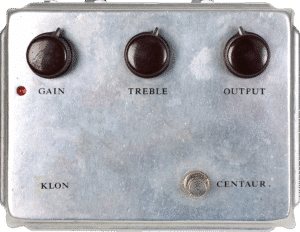
Klon Centaur (Off-Board)
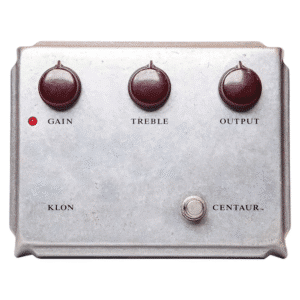
The Klon sits off the main pedalboard on a separate surface you can see this clearly in the pedalboard picture above. Its job is to add transparent-ish gain without changing the fundamental character of whichever amp combination Joe is using at the time.
How Joe uses it:
The off-board placement is practical, not precious. Joe’s tech Mike Hickey, has the Klon positioned where it’s accessible for adjustment between songs without reaching across the main board. Based on how Joe describes his approach to overdrive stacking, the Klon likely runs with low gain and higher output. It functions more as a boost that thickens the signal than as a standalone overdrive.
In the June 2025 Guitarist interview, Joe doesn’t single out the Klon by name. He lists the Tube Screamer and Conspiracy Theory, but lets the Klon’s presence speak for itself. That’s telling. It suggests the Klon is foundational rather than featured.
Interaction with other pedals:
The Klon stacks with both the TS808 and the Conspiracy Theory (Deep State). Engaging two or all three creates the layered saturation Joe uses for solos, with each pedal adding gain and midrange emphasis at different frequencies. The order matters. The Klon’s relatively flat EQ character means it fattens the signal before the more mid-focused Tube Screamer shapes it.
Estimated knob positions:
From the photo of Joe’s pedalboard it looks like his Klon is set with everything at 11 o’clock.
But given Joe’s preference for amp-driven tone with pedals adding push rather than heavy clipping, I would estimate a more reasonable starting point to be Gain: 9 o'clock, Treble: noon, and Output: 1 to 2 o'clock.
Ibanez Tube Screamer (TS808)
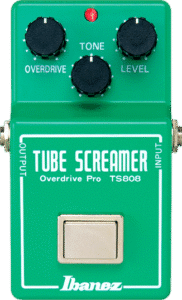
This is the pedal Joe keeps coming back to. In a Guitar World interview, he named the Tube Screamer as his most-used pedal across both TS9 and TS808 configurations. On this board, it’s the primary mid-push overdrive that makes his Les Paul cut through the Marshall Jubilee stack.
How Joe uses it:
Joe’s Tube Screamer is either a 1980 or 1981 original. He told Guitarist he’s not entirely sure which year. But here’s the thing that matters more: he’s said publicly that the current TS808 reissue is just as good. His exact words to Guitar World were that for $80 you can’t beat a reissue TS808 with both Fender and Gibson guitars.
That’s the world’s most prolific vintage gear collector telling you the reissue is fine. We’ll take that.
Joe’s broader tone philosophy applies directly here. He’s described his ideal sound as an “articulated midrange” achieved by turning treble down and gain up. The Tube Screamer is the pedal most aligned with that description, adding midrange push while the guitar’s tone knob and the amp’s EQ handle the rest.
Interaction with other pedals:
Stacks with the Klon (which fattens the signal before the TS shapes it) and the Conspiracy Theory (which adds its own Klon-style color after). Joe can engage one, two, or all three for escalating levels of saturation and sustain. This is how he builds from rhythm crunch to lead tone without touching the amp.
Estimated knob positions:
It’s not clearly visible in tour photos. For Joe’s “gain up, treble down” philosophy through a Marshall Jubilee, a logical starting point would be Drive around 1 o’clock, Tone at 10–11 o’clock (rolled back to avoid brightness), and Level around 1 o’clock to push the amp’s input.
Way Huge Conspiracy Theory / Deep State
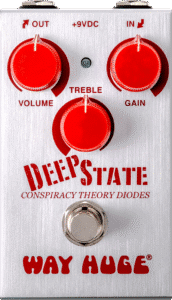
This is the Klon-style overdrive that Joe co-designed with Way Huge’s Jeorge Tripps. Its job is to provide Klon-flavour transparent(ish) overdrive at a fraction of the price. Joe’s motivation was explicit: he said the secondhand Klon market “has gotten out of hand,” and he wanted to prove that an affordable alternative could sound virtually identical.
How Joe uses it:
Joe demonstrated the Deep State (the limited-edition variant) in a side-by-side comparison against a 1995 Klon Centaur, pairing the Deep State with an Epiphone Les Paul and a Fender Sidekick amp against the Klon through a ’59 Les Paul and Dumble. His verdict was “virtually identical.”
Our 2024 tour photo above shows the Way Huge Deep State (the limited run of 550 units in 2024). But in the June 2025 Guitarist interview, Joe names the “Way Huge Conspiracy Theory.”
Both pedals share the same core circuit. The Deep State uses a different diode that Tripps discovered, producing what Way Huge describes as smoother, more touch-sensitive clipping. Joe may use them interchangeably on tour, or the Guitarist interviewer may have used the more familiar name. We’ve covered this in the FAQ section.
Interaction with other pedals:
Sits last in the three-overdrive stack (after the Klon and TS808). This means it’s receiving an already-boosted signal. Running it at lower gain in this position would add a final layer of harmonic richness and sustain rather than raw drive.
Estimated knob positions:
Given its position as the third gain stage receiving pre-boosted signal, try Gain: 9 to 10 o'clock, Treble: noon, and Output: noon to 1 o'clock.
Dunlop Fuzz Face
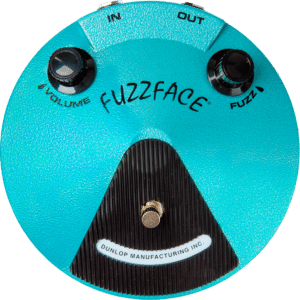
The Fuzz Face has a unique job in Joe’s rig. It doesn’t feed the Marshall Jubilees like every other gain pedal on the board seems to. Based on the Premier Guitar rig rundowns, the Fuzz Face routes via the Lehle switcher to the Fender Twin amps on a completely separate signal path.
This is a deliberate routing choice, not an accident.
How Joe uses it:
Apparently, Joe paid $170 for this pedal. That’s interesting because he owns gear worth six figures each, but he’s running a stock Fuzz Face he could replace tomorrow from pretty much any music store.
Joe routes the Fuzz Face to the Twin Reverbs because, as he explained in the 2022 rig rundown, running it through the Marshalls would “collapse the whole rig.” A dimed germanium fuzz into Jubilees that are already breaking up creates an uncontrollable wall of compressed mush. Through the clean Twins, the fuzz retains its full dynamic range. Joe described the routing as symbiotic. The rig “knows” the fuzz is doing something, but the Marshalls stay intact.
Germanium fuzz circuits are notoriously sensitive to what comes before them in the signal chain. They generally respond best to a high-impedance source like guitar pickups. Joe’s JB95 wah was specifically designed with an output buffer to prevent impedance issues with vintage fuzz pedals, but the exact routing between the wah and Fuzz Face has varied across documented versions of Joe’s rig. In some configurations, a splitter sits between them.
Interaction with other pedals:
Largely independent of the other gain pedals because it routes to different amps. The wah before it is the main interaction. Wah into fuzz is a classic combination that Jimi Hendrix used extensively, and Joe leans into that lineage for his heavier, more psychedelic moments.
Estimated knob positions:
We can’t see these in the photos. But, for the open, dynamic fuzz tone Joe gets through the Twins, try Fuzz: 1 to 2 o'clock and Volume: to taste (matching the output level of his overdrive sound for seamless switching between amp paths).
Modulation Pedals
Joe’s approach to modulation mirrors his approach to everything else on this board: minimal, functional, and almost entirely dependent on amp interaction for its final character.
MXR Micro Flanger
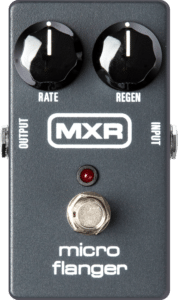
The MXR Micro Flanger adds subtle movement and width to Joe’s tone. It sits in the main signal chain after the overdrive stages and before the Lehle amp switcher, meaning it colours the signal before it hits whichever amp combination is active.
How Joe uses it:
When asked by Guitarist magazine whether any of his pedals had been modified (using the MXR Micro Flanger as the specific example), Joe’s response was definitive: “Nope, standard issue. I buy them out of Sweetwater.” That quote applies to the entire board, but it’s notable that the interviewer singled out the Micro Flanger.
It’s a discontinued pedal in some configurations, which might have suggested modification. Joe confirmed it’s stock.
The Micro Flanger is a single-knob pedal. There’s one speed control and that’s it. Joe appears to use it sparingly for specific songs rather than as an always-on effect. Live footage suggests it comes on for sections where he wants a slight thickening of the tone without the more dramatic sweep of a full-sized flanger.
Interaction with other pedals:
Sits after the gain stages, so it processes an already-overdriven signal. This gives the flanging effect more harmonic content to work with compared to flanging a clean signal.
Estimated knob positions:
The single speed knob appears set around Speed: noon in available photos, suggesting a moderate rate. This is consistent with subtle, musical flanging rather than the jet-engine sweep you’d get with the knob maxed.
Hughes & Kettner Rotosphere MKII
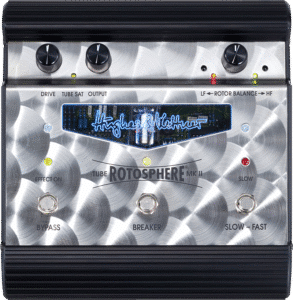
Joe calls this pedal “a fake Leslie.” Its job is to simulate a rotating speaker cabinet. It runs in the Marshall Silver Jubilee’s effects loop alongside the Boss DD-3 delay. This is one of the two most important effects-loop pedals on the rig.
How Joe uses it:
The Rotosphere is now discontinued, and secondhand units fetch $400 to $600. This is one of the few pedals on Joe’s board that isn’t easily replaceable. It sits in the amp’s effects loop rather than in front of the amp.
That’s critical. Running a rotary effect in the loop means it processes the amp’s already-driven tone, producing a richer, more three-dimensional swirl than you’d get placing it before the preamp.
The Rotosphere specifically partners with the Marshall Jubilees, not the Fender Twins. When Joe engages the rotary effect, it’s processing Marshall crunch. That combination produces the thick, organ-like modulation you hear on songs where Joe channels a classic rock aesthetic. The MKII version uses a real tube in the circuit, which adds warmth and harmonic complexity to the effect.
Interaction with other pedals:
As far as I can tell, it shares the Marshall effects loop with the Boss DD-3. When both are active, you get a rotary-modulated signal with delay, creating a spacious, vintage-sounding wash behind Joe’s lead lines.
Estimated knob positions:
Not clearly visible in the picture. For a Leslie-style effect that sits behind a driven Marshall, I’d start with Speed: 10 o'clock (slow) or Speed: 1 o'clock (fast switching) and Depth: noon.
Fulltone Supa-Trem
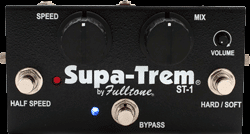
The Supa-Trem handles tremolo duties. Joe mentioned it by name in the June 2025 Guitarist interview, confirming it’s still on the current board.
How Joe uses it:
The Supa-Trem’s name is misleading. In the PG Rig Rundown, Joe called it “the secret weapon” and said he doesn’t really use it for tremolo at all. Instead, it provides a subtle always-on gain boost and midrange nudge that thickens his tone.
That said, tremolo is clearly audible on “Bird on a Wire” performances (listen to the Beacon Theatre live recording), suggesting Joe does engage the tremolo effect for specific songs even if the pedal’s primary job is as a tone enhancer.
The Supa-Trem has an unusual signal chain position that dates back to the Rig-Talk era. In the older documented signal path, it sat second in the chain (after the wah but before the drive pedals). That’s unconventional for tremolo, which most guitarists place after their drives. Whether it still sits in that position on the current board is unconfirmed.
The Supa-Trem is priced at $279 new, making it one of the more expensive pedals on a board where most effects cost under $200. Fulltone’s analogue circuit produces a smoother, more organic tremolo than digital alternatives.
Interaction with other pedals:
Its chain position relative to the drives is significant. If it still sits before the overdrives (as in the older documented chain), then the tremolo effect is being processed by the gain stages, which would soften the tremolo’s volume dips and produce a subtler, more integrated pulsing effect than post-drive tremolo.
Estimated knob positions:
For the kind of subtle, musical tremolo Joe uses on ballad sections, start with Speed: noon and Depth: 10 to 11 o'clock (enough to hear movement without dramatic volume drops). Mix: full if using it as a dedicated effect.
Time-Based Effects
Joe runs a single delay pedal on his board, and it sits in the amp’s effects loop rather than in the main signal chain.
Boss DD-3 Digital Delay
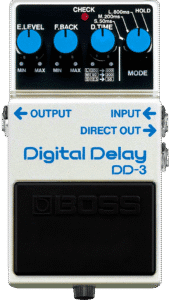
The DD-3 provides slapback delay. That’s it. Joe doesn’t use it for long ambient trails or rhythmic dotted-eighth patterns. It adds depth and space to his lead tone by running short repeats behind the note, thickening the overall sound without drawing attention to the effect itself.
How Joe uses it:
The DD-3 runs in the Marshall Silver Jubilee’s effects loop, not in front of the amp. This is the same routing as the Rotosphere, and for the same reason.
Delay in the effects loop processes the amp’s driven tone cleanly. Delay in front of a driven amp would send the repeats through the amp’s distortion, creating a muddy, indistinct wash.
Interaction with other pedals:
Shares the Marshall loop with the Rotosphere. When both are engaged, the delay is applied to the rotary-modulated signal. This layering creates the vintage wash that characterises some of Joe’s slower, more atmospheric passages.
Estimated knob positions:
Forum reports suggest all knobs at noon, but the audible result sounds more like a focused slapback. Start with Delay Time at 10–11 o’clock (short slapback), Feedback at 9–10 o’clock (one or two repeats), and Effect Level at noon.
Pitch & Octave
Joe uses a single octave pedal, and like the DD-3 delay, it’s a specific tool for specific moments rather than a core part of his sound.
Electro-Harmonix Micro POG
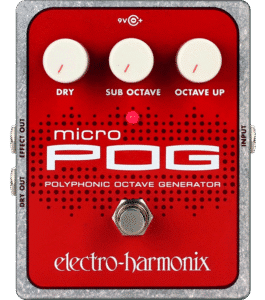
The Micro POG adds octave effects. Joe mentioned it in the Guitarist magazine interview, and you can see it in the pedalboard picture above, confirming it’s still on the current board. Its exact position in the signal chain is unconfirmed.
How Joe uses it:
The Micro POG appears to be one of the most situational pedals on Joe’s board. It’s not a core tone-shaping tool like the overdrives or the DD-3 slapback. Instead, it comes out for specific songs or sections where Joe wants the thick, organ-like quality that octave blending produces. The pedal has three simple controls: Dry, Sub Octave, and Octave Up.
Joe most likely blends a touch of sub octave beneath his dry signal for added low-end weight during certain passages, rather than running the full octave-up organ effect.
Interaction with other pedals:
Its interaction depends on chain position, which we couldn’t confirm exactly. If it sits before the drives, the octave signal gets processed by the overdrive stack, creating a fatter, harmonically richer drive tone. If it’s in a parallel path or after the drives, it would add a cleaner octave layer beneath the distorted signal.
Estimated knob positions:
Not visible in the picture. For the subtle octave-beneath-dry-signal approach, try Dry at maximum, Sub Octave at 9–10 o’clock (just enough to feel the low-end weight), and Octave Up off or at minimum.
Dynamics and Filtering
A wah pedal is a filter, not an effect. It doesn’t add anything to the signal. It selects which frequencies pass through and lets you sweep that selection in real time with your foot. Joe’s JB95 likely sits first in the chain for exactly this reason. It shapes the raw guitar signal before anything else touches it.
Dunlop Joe Bonamassa Signature Wah (JB95)
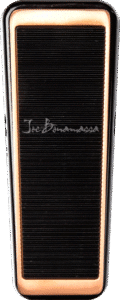
The JB95 is Joe’s signature wah pedal, positioned first in the signal chain at floor level off the main board for easy foot access. Wah before everything else is the conventional choice, and Joe sticks with convention here.
How Joe uses it:
The JB95 is a modified Cry Baby with a specific voicing tailored to Joe’s preferences.
An interesting detail I read on the old JBonamassa.com forum, is that Joe apparently runs the wah in its buffered (non-true-bypass) mode rather than true bypass.
I read forum members describe this as the “tone suck” setting. The slight high-frequency roll-off from the buffer actually suits Joe’s “treble down” philosophy, darkening the signal slightly even when the wah is disengaged.
Joe uses the wah selectively, not as a constant presence. It’s most prominent in his heavier moments, particularly the Fuzz Face and wah combination. Joe has spoken extensively about using his guitar’s volume and tone controls “100 times in an evening.” The wah adds another layer of real-time tonal control during performance.
Interaction with other pedals:
Feeds directly into the Fuzz Face when both are engaged. Wah into fuzz is a classic pairing. The wah’s frequency sweep before the fuzz creates dramatic, vocal-like textures that post-fuzz wah can’t replicate.
Utility Pedals
These pedals don’t colour the tone, but they are arguably the most important items on the board. Without clean power and the Lehle switcher, the entire amp-routing architecture that makes Joe’s rig distinctive wouldn’t function.
Lehle 1@3 A/B/C Switcher
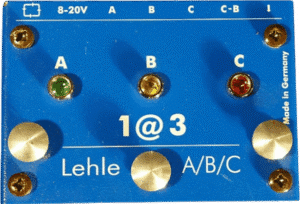
The Lehle is the brain of Joe’s entire rig. It sits at the end of the main pedalboard signal chain and routes the processed signal to different amp combinations. Without it, the multi-amp architecture that defines Joe’s live sound wouldn’t exist.
How Joe uses it:
The Lehle 1@3 takes one input (Joe’s pedalboard output) and switches between three outputs, each going to a different amp setup. The two Marshall Jubilees are always on as the anchor. As Joe described in the Seymour Duncan interview:
“The Jubilee is always on. There’s a Jubilee, it’s always on and it’s the base of the sound.”
The Lehle adds different amps alongside them. In the 2022 Premier Guitar rig rundown, Joe walked through the combinations:
The Jubilees paired with two high-powered Fender Twins for clean rhythm and touch-sensitive blues work, the Jubilees paired with a 50-watt Dumble combo for tighter, more articulate drive, and the Dumble combos paired with a Mesa Boogie Revolver rotating-speaker cab for his most saturated lead tones.
Joe describes this as “basically three separate sounds” and “the world’s most expensive three-channel amp.” Each amp combination responds differently to the same overdrive pedals, so switching amps effectively gives Joe six or more distinct drive voicings without changing any pedal settings.
Interaction with other pedals:
Every front-of-amp pedal on the board feeds through the Lehle. It’s the intersection point where pedal choices and amp choices multiply together. The Fuzz Face is the notable exception, routing separately to the Fender Twins.
Loop Box, I/O Box & Voodoo Lab Pedal Power 2 Plus
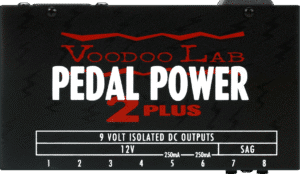
These three items handle the practical plumbing of the pedalboard. The I/O box manages the guitar input and amp outputs (not pictured). The loop box (also not pictured) routes pedals in and out of the signal chain (so Joe’s tech can switch configurations without re-patching cables). The Voodoo Lab Pedal Power 2 Plus (pictured) provides isolated power to every pedal on the board.
How Joe uses it:
Joe described these in the Guitarist interview with characteristic bluntness:
“The rest of it’s just junction boxes. Inputs for the amps, and a junction box to get to the switcher and out, and then there are the two boxes that power everything.”
They’re invisible to the audience but essential to the board’s function. The isolated power supply matters because it prevents ground loops and noise that can plague multi-amp rigs, especially when running both Marshall and Fender amplifiers on the same stage.
Which Songs Use Which Pedals?
Joe doesn’t switch pedals constantly. For most songs, the Marshall Jubilees and his overdrive stack do the heavy lifting, with the Lehle switcher changing amp combinations rather than individual effects. But certain songs have signature moments where specific pedals are clearly active.
I wrote this section using information and discussions I noted down from the now-retired JBonamassa.com forum. I also got some information from rig rundown demonstrations, Joe’s own comments on the “Sloe Gin” recording setup, and a little bit of my own tonal analysis of live performances.
Song-by-Song Pedal Mapping
“Dazed and Confused” (cover)
High Confidence
Pedals
Wah (JB95) + Fuzz Face, routed to Fender Twins
Source
JBonamassa.com forum; Fuzz Face routing confirmed in Premier Guitar rig rundown
“Bird on a Wire”
High Confidence
Pedals
Fulltone Supa-Trem (tremolo prominent throughout)
Source
JBonamassa.com forum fan documentation of live shows
“Sloe Gin” (intro/verse)
Moderate Confidence
Pedals
DD-3 slapback + Rotosphere (rotary/chorus texture), likely Jubilee + Dumble amp pair
Source
Forum identifies chorus/modulation on intro. Joe confirmed DD-3 and “TC chorus box” on the original recording. Current board uses Rotosphere in the same role.
“Sloe Gin” (solo build)
Moderate Confidence
Pedals
TS808 + Klon stacked, DD-3 slapback, Lehle switching to Jubilee + Dumble pair
Source
Tonal analysis. The solo’s saturated-but-clear character is consistent with stacked drives into the Dumble combination. Joe described the original recording tone as sounding “distorted but really clean and clear.”
“Lonesome Road Blues”
Moderate Confidence
Pedals
Rotosphere (rotary modulation), DD-3 slapback
Source
JBonamassa.com forum identifies chorus/rotary effect. Current board’s Rotosphere serves this role from the Marshall effects loop.
Standard blues-rock rhythm
Moderate Confidence
Pedals
TS808 alone or Klon alone into Jubilee + Jubilee pair
Source
Tonal analysis. Joe’s default rhythm crunch has a focused midrange push consistent with a single overdrive into the Marshall anchor. The dual-Jubilee pairing gives the thickest Marshall-on-Marshall character.
Lead solo climax
Low Confidence
Pedals
Klon + TS808 + Conspiracy Theory stacked, Lehle switching to Jubilee + Dumble pair, DD-3 slapback
Source
Tonal analysis. Joe’s most saturated lead tone has the layered harmonic complexity of multiple drives stacked, with the open dynamics and headroom characteristic of Dumble amplification. The DD-3 slapback adds depth without muddiness.
What this mapping reveals is that Joe’s pedalboard is more about amp selection than pedal switching.
The Lehle and the overdrive stack give him a huge amount of available tones. The dedicated effects (Rotosphere, Supa-Trem, Fuzz Face) come out for specific songs or sections. For most of the set, Joe is working the same three overdrives in different combinations and switching amp pairs.
That’s why the board looks so simple. The complexity of Joe’s pedalboard is in the routing, not the pedal count.
Get This Tone on a Budget
Joe’s board is surprisingly affordable by pro standards. He has said as much himself.
The Klon Centaur is the obvious outlier, but the rest of his pedals are production models you can buy new from any major retailer. The real cost of his rig is in the amps. Dumbles, vintage Marshalls, and signature Fender Twins are where the five-figure numbers live. The pedalboard is the accessible part.
That said, there are still savings to be found. Expand the sections below to read how to approximate each pedal’s role on Joe’s board without buying the exact model.
For a deeper look at how each effect type works, see our guides to gain pedals and modulation effects.
Budget Alternatives
Electro-Harmonix Soul Food: Priced around $75, EHX designed the Soul Food explicitly as an affordable Klon circuit. It nails the transparent boost character and responds well to volume knob cleanup. Joe himself co-designed the Way Huge Conspiracy Theory as a Klon alternative, calling the two “virtually identical.” If you can find a used Conspiracy Theory for $200–250, that is the closest match to what Joe actually reaches for.
What you lose
The Soul Food uses silicon clipping diodes where the original Klon uses germanium. In practice, the difference is subtle. You lose a touch of compression and harmonic warmth at the very edge of breakup. At gig volume into a cranked amp, most players would not hear the difference.
This is already a mid-priced pedal. Joe uses a vintage ’80 or ’81 unit (worth ~$400 used), but he has said the reissue is the same circuit and the same chip. If $170 is still a stretch, the Ibanez TS Mini ($80) uses the same TS808 circuit in a smaller enclosure.
What you lose
Nothing meaningful with the reissue. The TS Mini sacrifices battery operation and full-size knobs, but the circuit is identical.
Dunlop FFM4 Joe Bonamassa Fuzz Face Mini | At around $100 new, this is the miniaturised version of Joe’s own signature. Same Russian-spec germanium transistors. Same voicing for humbuckers. Smaller enclosure.
Mid-range pick
Dunlop JHF1 Jimi Hendrix Fuzz Face | ~$150 new. Silicon transistors give a brighter, more aggressive fuzz. Different flavour to Joe’s germanium tone, but still a real Fuzz Face circuit. See how Hendrix used his in our Jimi Hendrix tone guide.
What you lose
The full-size Fuzz Face enclosure is part of the experience for some players. The mini version has the same guts but less satisfying foot feel. With the Hendrix model, you get a different transistor type entirely. Silicon is tighter and more cutting. Germanium is warmer and more dynamic. For Joe’s blues tone, germanium is the right call.
This Way Huge Conspiracy Theory is itself a budget Klon alternative that Joe co-designed. If you already have the Soul Food or another Klon-style pedal covering the transparent overdrive slot, you do not need both. One Klon-style drive is enough for a budget board. The Conspiracy Theory’s specific value on Joe’s board is as his medium-gain voice. The Soul Food fills this role well enough at a third of the price.
TC Electronic Vibraclone is a great budget Rotosphere, at around $99 new. Joe’s own Guitar World interview suggested this as a direct swap. It is a straightforward rotary sim with speed and drive controls. It lacks the Rotosphere’s tube circuit and dual-band rotor simulation, but it gets the basic swirl right.
Mid-range pick
Another slightly more mid-range option is the Strymon Lex. At around $299 new, this is closer to the Rotosphere’s dual-rotor approach, with separate horn and drum speed controls. It’s digital, but very convincing.
What you lose
The Rotosphere’s tube saturation and its specific interaction with Joe’s Marshall effects loop. The TC gets you rotary modulation. The Strymon gets you convincing Leslie simulation. Neither has that warm, slightly gritty analogue character that makes the Rotosphere special. For most playing situations, the TC is close enough.
Boss TR-2 Tremolo: At around $99 new, the TR-2 is the industry-standard tremolo pedal. It covers sine wave and square wave patterns with a simple three-knob layout. It does the job.
What you lose
The Supa-Trem’s photocell circuit gives it a softer, more organic pulsing quality. The Boss TR-2 can sound more mechanical at extreme settings. For Joe’s always-on subtle tremolo use, the TR-2 at a low depth setting is perfectly serviceable.
This is already a budget pedal. Joe uses it for simple slapback delay. If you want to save further, the Donner Yellow Fall (~$35) or the Boss DD-3T (~$154, same price but with tap tempo) are options. Honestly, any basic digital delay set to a short repeat time will cover this role. See our delay guide for more options.
What you lose
At the slapback settings Joe uses, almost nothing. A short digital repeat is a short digital repeat. This is the easiest pedal on the board to replicate cheaply.
Donner Octave Guitar Pedal is a great budget alternative to the Electro-Harmonix Micro POG. At around $40 new, the polyphonic octave tracking has improved dramatically in budget pedals. The Donner tracks reasonably well for single-note lines.
What you lose
Tracking quality on chords. The Micro POG’s polyphonic tracking is still best in class. Budget octave pedals often glitch on complex voicings. Given that Joe uses the Micro POG sparingly on specific songs, a budget option is fine if you only need occasional octave moments. If octave is central to your playing, save for the real thing.
This is already affordable. The MXR Micro Flanger is a one-knob wonder. If you need to save, the Donner Jet Convulsion Flanger (~$35) covers similar territory. But $100 for the real thing is not a stretch for most budgets.
Dunlop GCB95 Original Cry Baby | ~$90 new. The standard Cry Baby is one of the most popular guitar pedals ever made. It lacks the JB95’s Halo inductor and the output buffer that Joe had added for impedance matching with his Fuzz Face. But it is a real wah with a real sweep.
What you lose
The JB95’s wider sweep range and its built-in buffer. If you run a wah into a fuzz, impedance matching matters. Without the buffer, the fuzz may sound thin or choked. A simple buffer pedal ($30–50) between the wah and fuzz solves this.
Complete Budget Board Summary
Joe’s board at approximate retail (excluding the Klon Centaur): ~$1,900
Joe’s board including the Klon at collector pricing: ~$6,000+
Budget equivalent board: ~$837.
| Role | Budget Pick | Price |
|---|---|---|
| Transparent OD (Klon role) | EHX Soul Food | $75 |
| Mid-hump OD (TS role) | Ibanez TS Mini | $80 |
| Fuzz | Dunlop FFM4 Fuzz Face Mini | $100 |
| Rotary | TC Electronic Vibraclone | $99 |
| Tremolo | Boss TR-2 | $99 |
| Delay | Boss DD-3 | $154 |
| Octave | Donner Octave | $40 |
| Flanger | MXR Micro Flanger | $100 |
| Wah | Dunlop GCB95 Cry Baby | $90 |
| Total | ~$837 |
Complete Budget Board
You can get 90% of this tone for around a seventh of the cost. And honestly, the biggest tonal difference between your board and Joe’s will not be the pedals. It will be the vintage amplifiers running behind them.
How Joe Bonamassa’s Pedalboard Has Evolved
Joe’s pedalboard tells a story of refinement, not revolution. The core architecture has remained remarkably stable since Dave Friedman built the main board around 2012. What changes is the detail. A drive pedal gets swapped. A delay model rotates. The philosophy stays the same.
- ~2007 (Sloe Gin era): A small setup. Joe described the recording rig as “a DD-3 delay, a wah, and maybe a TC chorus box.” A Phase 45 appeared live for specific songs. The Tube Screamer was already present.
- 2012: Dave Friedman builds the main US touring board, which Joe calls “the Boomer board. The Lehle 1@3 amp switching system appears, establishing the multi-amp architecture that still defines Joe’s rig. The Way Huge Pork Loin fills the mid-gain slot. A “mystery pedal” is blurred out in photos. Forum consensus identifies it as the Klon Centaur.
- 2018: Board largely unchanged. The Micro POG appears. Joe’s signature JB95 wah replaces earlier Cry Baby models.
- 2022: The Way Huge Overrated Special replaces the Pork Loin in the mid-gain slot. Joe describes it as “basically for more like a Gilmour thing”. The Klon Centaur moves off-board for ergonomic access.
- 2024–2025: The Way Huge Deep State appears to replace the Overrated Special in 2024 tour photos. By June 2025, Joe’s using the Conspiracy Theory instead. Both are Klon-style drives he co-designed. Everything else stays put.
The pattern here is clear.
The TS808, Fuzz Face, Rotosphere, Supa-Trem, Micro Flanger, and DD-3 have survived every iteration. The only slot that rotates is the mid-gain overdrive. That one position has been a Pork Loin, an Overrated Special, a Deep State, and a Conspiracy Theory. Four pedals, one role, across more than a decade.
Build Your Own Blues-Rock Foundation
Joe’s board philosophy comes down to one idea: The amp is the instrument, and the pedals push it harder.
He is not using effects to create sounds his amps cannot produce. He is using them to control how hard the amps work. That is the key insight for building your own version of this rig.
If I were trying to build a pedalboard similar to Joe Bonamassa, here’s how I’d do it.
Start with a Tube Screamer
It has been on every version of Joe’s board since at least 2007. It is his most-used pedal by his own admission.
Whether you buy the TS808 reissue ($170) or the TS Mini ($80), this is the foundation.
Set the drive low, the level high, and push your amp into natural breakup. If your amp does not break up at reasonable volumes, a Tube Screamer alone will not get you there.
Second, add a Klon style overdrive
The EHX Soul Food ($75) fills this role. Use it as an always-on tone thickener at low gain, or stack it with the Tube Screamer for lead boost. Joe runs up to three drives at once for his most saturated tones. Two gets you most of the way there.
Third, consider a wah
The Dunlop GCB95 ($90) covers the same expressive territory for blues soloing. Put it first in the chain, before your drives. See our signal chain guide for the full reasoning.
That is three pedals for under $250. They cover the core of what Joe does on stage for most songs.
But, here is the honest truth, and it connects back to the contradiction at the heart of Joe’s rig.
You can buy every pedal on his board for under $2,000. You cannot buy a single one of his amplifiers for that. Joe Bonamassa’s tone lives in his amps and in his hands.
That said, a Tube Screamer and a Klon Clone into a good tube amp will get you in the ballpark of Joe’s sound.
Frequently Asked Questions
How much is Joe Bonamassa’s pedalboard worth?
Excluding the Klon Centaur (which trades for $4,000–$20,000 on the collector market), Joe’s pedalboard totals roughly $1,500–1,900 at retail.
The discontinued Hughes & Kettner Rotosphere ($400–600 used) is the only other pedal not readily available new. A version of everything else can be bought from many music stores today. The real cost is in his amplifiers, not his pedals.
Does Joe Bonamassa use a Klon Centaur?
Yes. A Klon Centaur sits off-board (not mounted on the main pedalboard) and has been part of his rig since at least 2012.
However, he also co-designed the Way Huge Conspiracy Theory as a Klon alternative, calling the two “virtually identical.”
The Conspiracy Theory occupies a separate slot on the main board. For the budget-conscious, see our budget alternatives section above.
Can you sound like Joe Bonamassa on a budget?
You can approximate his pedalboard for around $837 using budget equivalents.
The most important pieces are a Tube Screamer-style overdrive and a Klon-style transparent drive. Together they cover 80% of what Joe’s pedals do.
But his tone comes primarily from his amplifiers and his playing technique. Pedals shape the tone. Amps and hands create it.
What is Joe Bonamassa’s most-used pedal?
The Ibanez TS808 Tube Screamer. Joe has confirmed this in multiple interviews. He uses a vintage ’80 or ’81 unit but has said the current reissue uses the same chip and circuit.
The TS808 has appeared on every documented version of his pedalboard over the past 15+ years.
Does Joe Bonamassa use modded pedals?
No. When asked directly by Guitarist magazine in June 2025 whether any pedals on his board had been modified, Joe responded: “Nope, standard issue. I buy them out of Sweetwater.” This is one of the most distinctive aspects of his approach. While many touring professionals use heavily modified circuits, Joe’s board is entirely stock.
What is the Way Huge Deep State?
The Deep State is a limited-edition overdrive Joe co-designed with Way Huge (Jeorge Tripps). It is a variant of the Conspiracy Theory (itself a Klon-style circuit) featuring a different clipping diode that produces a slightly smoother, more compressed drive character.
Joe’s 2024 tour photos show the Deep State on his board. His 2025 Guitarist interview names the Conspiracy Theory instead. He has likely used both, rotating them in the same mid-gain slot.
