I once grabbed a 12V adapter by mistake and plugged it into a 9V delay pedal. It powered on fine. Three hours later, the signal started cutting out, and within a week the pedal was dead.
At one point or other, it’s happened to most players I know.
So can you use a 12V power supply on a 9V guitar pedal? In most cases, no. Using a higher voltage than your pedal is rated for can damage internal components, cause overheating, or kill the pedal outright.
But the full answer has more nuance than “just don’t do it.” Some pedals are specifically designed to accept a range of voltages, and running them at 12V or 18V can actually improve your tone. The difference comes down to what’s inside the circuit and what the manufacturer built it to handle.
After using hundreds of pedals on my own board over the years (and accidentally frying one in the process), I’ve learned that understanding voltage tolerance is more useful than blanket fear.
If you want a broader look at pedal power basics, start with our guide on how to power guitar pedals.
TL;DR
- No. Don’t use a 12V supply on a pedal rated for 9V only.
- Some pedals accept 9 to 18V. Check the label before assuming yours can’t handle it.
- Higher voltage on compatible pedals increases headroom and can improve tone.
- Digital pedals are especially vulnerable to overvoltage. Never exceed their rating.
What Happens If You Use 12V on a 9V Pedal?
The internal components get pushed beyond their rated limits, and the results range from subtle degradation to immediate failure.
Capacitors, diodes, and integrated circuits inside your pedal are all designed to operate within specific voltage ceilings. Push past those ceilings and you’re either looking at a slow death (heat buildup, gradual performance loss) or a fast one (blown component, dead pedal). There’s no safe middle ground.
What makes this tricky is that a pedal often seems fine at first. This is a pattern I’ve seen over and over in forum threads and experienced firsthand.
You plug in the wrong adapter, the pedal powers on, the sound seems normal. Then hours or days later, things start to go wrong. The signal cuts in and out, you get unexpected buzzing or hissing, or the pedal just stops working entirely.
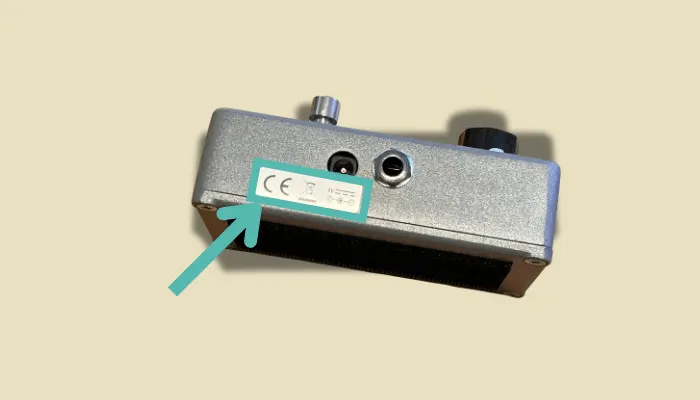
Always check the label near the power jack before plugging in.
That delayed failure is actually worse than an instant one, because it gives you a false sense of security. You might assume 12V is fine for your pedal when the damage is already happening inside.
The warranty angle is straightforward too. Most manufacturers won’t cover damage from using the wrong power supply, so you’re on your own for repairs or replacement.
If your pedal is producing unwanted noise after a voltage mismatch, that’s a red flag worth investigating immediately.

Why Some Pedals Survive Higher Voltage (And Others Don’t)
It comes down to the components inside and their individual voltage ratings. You can’t tell from the outside, which is why blanket advice in either direction (“never do it” or “it’s fine”) misses the point.
Electrolytic capacitors are the usual weak link. These are rated for specific voltages. A pedal built with 16V-rated caps can technically survive 12V input, but there’s almost no safety margin. A pedal with 25V caps has room to spare. The problem is you rarely know which caps are inside without opening the enclosure.
The analog vs digital split matters too. Simple analog circuits (overdrives, fuzzes, boosts built on op-amps and transistors) tend to tolerate higher voltage because their components are often rated well above 9V. Digital pedals are a different story. They run internally on 3.3V or 5V through a voltage regulator. More input voltage just forces that regulator to work harder and generate more heat.
Certain chips are especially fragile. Maxim 1044 voltage doublers, found in Klon clones and vibe circuits, commonly fail above 12V. CMOS-based chips tend to max out around 15V. If you want to understand how guitar pedals work internally, these are the details that matter most.
Which Pedals Can Actually Handle Higher Voltage?
Any pedal that lists a voltage range on its label (e.g., “9-18V DC”) is designed to run at higher voltages. And there are more of these than you might think.
The Fulltone OCD is one of the most well-known examples. It accepts 9 to 18V, and many players run it at 18V as their default. The Catalinbread SFT is another. Community consensus on forums like The Gear Page is that it sounds like a completely different pedal at 18V compared to 9V. The EQD Depths is specifically designed for the range too, with the manufacturer noting that 9V gives a warmer sound while 18V adds sparkle and headroom.
| Voltage Range | What It Means | Example Pedals |
|---|---|---|
| 9V DC only | Do not exceed. Risk of damage | Most Boss pedals, TC Electronic digital pedals |
| 9-12V DC | Can handle a slight increase. Check label | Some boutique analog overdrives |
| 9-18V DC | Designed for it. Higher voltage = more headroom | Fulltone OCD, Catalinbread SFT, EQD Depths |
The common thread is headroom. Running a compatible pedal at higher voltage increases the clean headroom, which means the pedal breaks up later and responds more dynamically to your picking. For overdrives used as an always-on tone shaper, this can be a genuine improvement rather than just a spec difference.
If a pedal accepts 9 to 18V, running it at 12V gives you a middle ground. More headroom than 9V without going all the way to 18V. Some players prefer this sweet spot, especially for Bluesbreaker-type circuits used as a light boost.
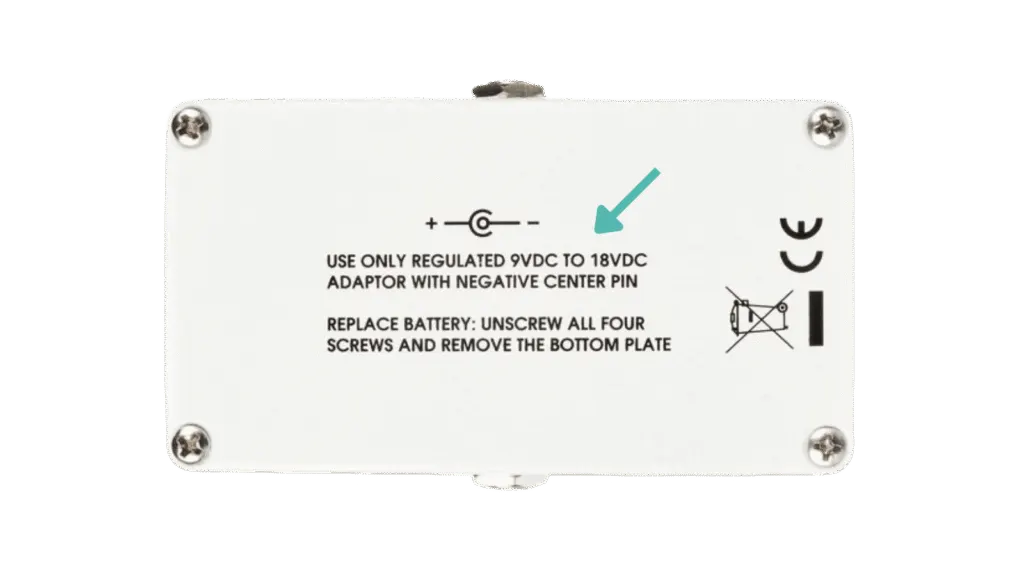
Pedals that list a voltage range are designed for experimentation.
How Do You Check Your Pedal’s Voltage Requirements?
Check the label near the power input jack. Most pedals print the voltage, polarity, and current draw directly on the enclosure or on a sticker on the base plate.
You’re looking for three things: voltage (9V, 12V, or a range like 9-18V), polarity (centre-negative is the standard for most guitar pedals), and current draw in milliamps (mA). Your power supply’s mA rating needs to meet or exceed the pedal’s requirement.
If there’s no label visible, check the manual or the manufacturer’s website. Some manufacturers also list power supply tolerances, which tells you how much variation the pedal can safely handle.
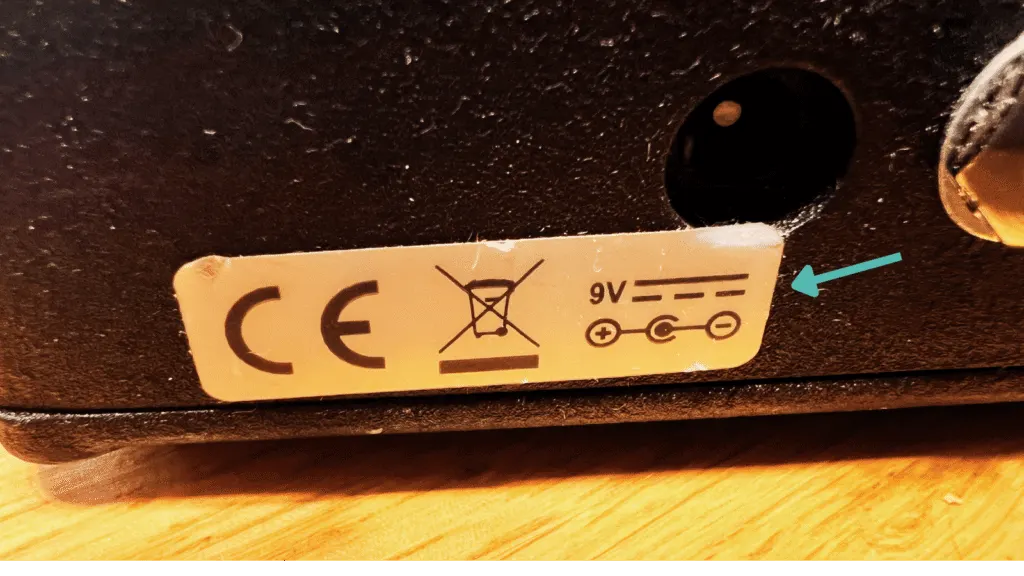
These specs tell you everything you need to match your power supply.
The simple rule: if it says “9V DC” with no range listed, treat it as 9V only. If you need help choosing the right supply, our guide to the best 9V batteries for guitar pedals covers battery options too.
The Bottom Line on Voltage and Your Pedals
For pedals rated 9V only, never exceed it. The risk isn’t worth the experiment. For pedals with a listed voltage range, experimenting with 12V or 18V is both safe and potentially worth it for the headroom and dynamic response you gain.
The practical next step is simple. Before plugging in any power supply, flip your pedal over and read the label. Five seconds of checking saves you from a dead pedal or a warranty claim that goes nowhere.
Most guitarists will never need to think about voltage beyond “use the right one.” But if you’re the type who wants to squeeze every bit of tone from your rig, knowing which pedals can handle higher voltage is worth those five seconds.
Related Reading
- How to Power Guitar Pedals: Everything You Need to Know
- How to Daisy Chain Multiple Guitar Pedals
- How Long Do 9V Batteries Last in Guitar Pedals?
- Is It OK to Leave Guitar Pedals Plugged In?